

















▪️An impressive seven African boxers punched their way to the finals raising the hopes of a gold rush for the continent
▪️Botswana’s first ever female boxer to win a medal in the Commonwealth Games Lethabo Modukanele explains why African boxers stumbled
▪️One of the seven finalists, Ghana’s Joseph Commey did not enter the ring because he was unwell. “I felt like I have disappointed my country and ashamed of myself,” says Commey
July 17, 2026
African boxers may have failed to win gold at the 2022 Commonwealth Games but statistically, their overall performance was the best ever in 24 years at the Club Games since the 2002 edition in Manchester, England.
The historic yet bittersweet chapter for African boxing, displaying immense raw talent that ultimately stopped just short of the highest podium.
Expectations were high when Africa entered the finals with unprecedented momentum. Seven elite fighters—five men and two women—had dismantled their opponents to secure a spot in the gold-medal bouts. The atmosphere was charged with anticipation. Fans and pundits confidently predicted a gold rush, expecting these finalists to break regional records and assert global dominance.
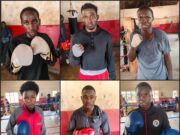
In the finals were Nigeria’s featherweight Elizabeth Oshoba, Mozambique two-time Africa champion Rady Gramane, Ghana’s bantamweight Abraham Mensah, Ghana’s featherweight Joseph Commey, Mauritius’ light-welterweight Richarno Colin, Zambia’s welterweight Stephen Zimba and Mozambique light-middleweight Tiago Muxanga.
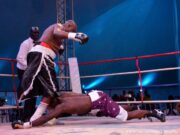
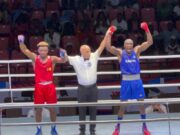
Contrary to those high expectations, the gold-medal matches delivered a harsh reality check. None of the seven African finalists managed to secure a victory, all settling for silver medals.
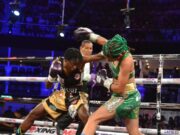
In women’s bouts, Oshoba was beaten fair and square by Michaela Walsh of Northern Ireland and middleweight Gramane lost to Canada’s Tammara Thibeault.
The five men fared no better with Mensah losing to Dylan Eagleson of Northern Ireland, Commey giving away a walkover against Northern Ireland’s Jude Gallanger, Richarno losing to Scotland’s Reese Lynch, Zimba going down to Plan Croft of Wales and Muxanga beaten by Northern Ireland’s Tokyo Olympics bronze medallist Aidan Walsh, brother to Michaela Walsh who defeated Nigeria’s Oshoba. Michaela had previously won silver in the 2014 and 2018 Commonwealth Games with his brother Aidan winning silver at the 2018 Commonwealth Games.
A crestfallen Ghana’s Commey describes the Birmingham Games as the most disappointing moment in his boxing career. He saw off India’s Mohammad Hassanmud in the semi-finals and was all set for Northern Ireland’s Jude Gallagher in the finals but he failed the medical check-up.
“I wanted to fight but I was stopped by my coach, that made me feel so ashamed of myself,” Commey told boxersworld.co.ke in an interview.
“I felt so much pain and disappointment for not fighting Gallagher although I was ill but I wanted to try my possible best to fight him on that day, I felt like I have let down my country, that was the most disappointing moment in my boxing career.”
Several factors contributed to the Birmingham collective heartbreak.
Boxing analysts point out that African fighters faced top-tier, heavily funded boxers, particularly from host nation England and powerhouse teams like Scotland, Northern Ireland and India.
Many bouts were decided by razor-thin split decisions where tactical discipline and defensive positioning edged out aggressive punching. In high-pressure finals, opponents with greater exposure to major international tournaments managed the clock and judges’ perceptions more effectively.
Despite the absence of gold, framing the tournament as a failure for Africa misses the broader, highly commendable achievement of the continent. African boxing demonstrated incredible depth and resilience across the entire event.
Boxers from nine different African nations climbed the podium, proving that boxing talent is distributed widely across the continent rather than concentrated in just one or two traditional powerhouses.
The continent amassed a total of 19 medals. This collective success highlighted a rising standard of athleticism and technique across both the men’s and women’s divisions. That two women qualified for the finals marked a massive leap forward for gender inclusivity and growth in African combat sports.
The Birmingham Games proved that African boxers possess the power, skill, and heart to compete with the world’s best. However, missing out on the prestigious gold medals highlights a critical gap. To turn silvers into golds, continental boxing federations and their respective governments must invest more heavily in international training camps, constant exposure in major tournaments in Europe, Asia and Americas, advanced tactical coaching, and mental conditioning for high-stakes finals possibly from sports psychologists.
The 19 medals haul in Birmingham was the best ever since the 2002 Commonwealth Games in Manchester, England, where Africa won a total of 17 medals, two of them golds by Zambia’s flyweight Kennedy Kanyanta who beat Botswana’s former national team coach Lechedzani Luza and Nigeria’s light-heavyweight Jegbefumere Albert, the conqueror of Uganda’s Joseph Lubega.
At the Birmingham Games, Botswana’s Lethabo Modukanele won her country’s first ever boxing medal by a female boxer, a bronze in the minimumweight division.
Boxing is basically a game of addition and subtraction. I hit you to score points and avoid you hitting me back to ensure I’m on top, and if you hit me, I quickly counter to subtruct your points.
Boxing analysts wonder do the African boxers lose their concentration in the ring opting to rely on raw power and pressure fighting to handle their opponents?
That seven of them pounded their way to the finals negates the aforementioned because they didn’t make it on walkovers. They won their bouts decisively.
I interviewed Modukanele on phone in 2022 in Birmingham keen to get her views on why the six African boxers stumbled.
“The african boxing style is unique to africa, and so is every other region’s style,” said Modukanele.
She went on: “In africa, mostly East, West and below, our fighting style is based mainly on hitting hard, we are trained to have long lasting engines/stamina, so we tend to engage in fast-paced wars, and we look for constant engagement
“That fighting style is detrimental to our success when we face European and mostly Asian and Arab fighters. Those fighters have finesse, they have superb punch selection and their footwork is very good.
“Most of the African fighters rely on pressure fighting, which works to a certain extent.
“I also believe with the knowledge that those other fighters have, those skills coupled with the biased judging and refereeing, we go in already having doubts about our chances of winning.”
Modukanele lost on points 5-0 her semi-final minimumweight bout to England’s Demi-Jade Resztan.
She explains why she lost to the England boxer.
“My fight with the English girl was a case of the above mentioned.
“I started off well, having what I believed was the upperhand but then I got dragged into a fire-fight after receiving a count in the first round for slipping of all the things, and that worsened my game plan. I felt the count was unnecessary because she didn’t hit me with any punch.
“I went into the second round trying to recover, to balance the loss out with an intention of winning the last two rounds, and so the strategy for that was to apply more pressure, to attack incessantly but that only helped the English girl outscore me in the process.
“I got sloppy trying to apply the pressure and that allowed her to capitalize on my mistakes. I felt so disappointed, I had no choice but to accept the loss.”
Modukanele is at it again. She’s one of the Botswana boxers taking part in the Glasgow Games. Hopefully, this time around the smooth operator will get her act right plus the rest of the African boxers in Glasgow.