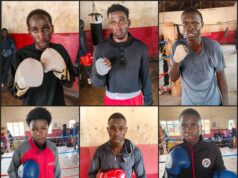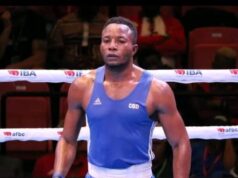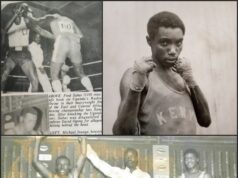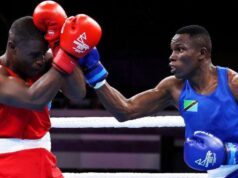



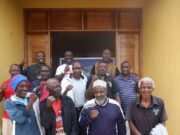

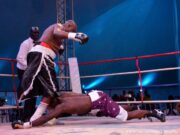



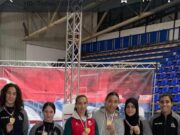
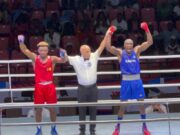




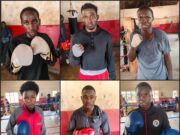


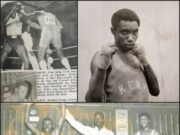


▪️Kinyua and siblings grew up with his grand mother in the harsh life of Korogocho slums following the death of his mother but through boxing he is now living comfortably in Birmingham
August 6, 2026
The stench of burning plastic and raw sewage in Nairobi’s Korogocho slum can suffocate ambition before it even has room to breathe. For a young, destitute ghetto kid named Moses Kinyua, survival meant developing a thick skin and lightning punches.
Amid the dust, drugs, crime, and crushing poverty of one of Kenya’s toughest informal settlements, Kinyua found his salvation in the boxing ring, choosing to punch his way out of a bleak destiny rather than succumb to it.
Kinyua, now living in Birmingham, takes us back to his roots.
“I was born 47 years ago in Maringo Estate, Makadara Constituency but I grew up in Korogocho slums from the age of two to 22 years old and then moved to Baba Dogo, Kasarani.
“We were brought up by our late grandmother Monica Waduma, a family of five brothers and one sister,” Kinyua told boxersworld.co.ke in a telephone interview from Birmingham, explaining why they moved to Korogocho.
“Our mother passed away when we were young, so we shifted to our grand mother’s house in Korogocho. I went to Kariobangi North Primary School.
“For my high school, I was at Athi River Academy in Machakos County and completed my secondary education at Ruaraka School from 1991-1994.”
Life in any informal settlement is always a difficult pathway to navigate through.
“Our survival was rough and tough,” recalls Kinyua, “we couldn’t rely on our grand mum on everything, so we used to go to a dumping site in Mukuru waiting for what we called ‘chombo’, that’s a lorry full of waste food from JKIA airport (food from the airplane) that we can grab some to sell and get money.”
The boxing bug caught up with Kinyua in 1992, joining Kariobangi Boxing Club under the famous South African coach Eddie “Papa” Musi. Among the boxers who inspired him at his new club was Olympian Steve “Dempsey” Mwema, a gold medallist at the 1987 African Games.
“Musi was such a patient and understanding coach, slowly he taught me all the fundamentals of boxing, I also trained under John Okusi at St John’s Boxing Club in Korogocho.”
Kinyua’s grand mum also supported him during his early days in boxing.
“I remember my grand mom knocking on my small mud room door every morning reminding me it’s time for jogging
“She used to work for Nairobi City Council until she retired 1990, and started brewing and selling a popular drink in the slums known as chag’aa until 1997.
“In 1995 I represented Dallas Muthurwa under late coach Patrick “Mad” Okoth, the same year I participated in the Kecoso Games and national trials. I then moved to Kenya Police in 1996, the following year I joined Kimbo, our coach was Kenneth “Valdez” Ochieng who polished me a lot with his international experience. He also coached in Denmark. I still lived in Korogocho slums but training with Kimbo at Jericho.”
His raw power and unyielding determination quickly caught the eye of national selectors, transforming him from a local street scrapper into a beacon of hope for the “Hit Squad,” Kenya’s national boxing team. He was capped in 1996.
“My first time to represent Kenya was 1996 against Uganda in the Urafiki Cup. I fought Sande Kizito at Nakuru Madson Square Garden. I was down in the first round but I managed to continue and lost on points
“My toughest opponent in amateur internationally was Jackson Asiku from Uganda..He was very strong and his movements was extremely good
“At home the toughest boxer I met was Suleiman Bilali.
He was very slippery and hard to hit because of his movement style. We were always meeting in the finals during the Kenya national league and trials.
He won most of the fights fairly but he once admitted that I was his toughest opponent as well.”
The defining moment of Kinyua’s amateur career arrived on the global stage at the 1998 Commonwealth Games in Kuala Lumpur, Malaysia. Stepping into the ring with the weight of Korogocho on his shoulders, Kinywa put on an impressive show of grit and technical skill, fighting his way through a grueling tournament to capture a silver medal for Kenya.
“In the trials for Kuala Lumpur, I defeated Tom Waruinge the son of the late boxing legend Philip “Nakayama” Waruinge, then I told myself that I will have to come back with a gold medal from Malaysia. Unfortunately I returned home with a silver medal. I fought against homeboy Sapok Biki and to be honest it was totally daylight robbery, I won the fight.
“The Malaysians could not afford to be humiliated in front of the former PM Muhadir Mohammed. That was my greatest achievement in amateur boxing.”
At Korogocho, Kinyua was warmly welcomed by excited slum dwellers. He was now their hero, each and everyone wanting to associate with the Commonwealth Games silver medallist.
A special function was organised to receive back Kinyua at St John’s Catholic Church where his silver medal was a major attraction.
“Everyone wanted to touch my silver medal, to most of them in the slums this was their first time to see a medal. It was one of those joyful moments I’ll never forget in my life especially how I inspired the youth of Korogocho. They were there at the function in their hundreds.
“I encouraged a lot of young people in Korogocho to join boxing such as the late John Gacheru we used to call him Jonte, he joined me in boxing and many youth took up the sport.
“Gacheru did well especially in pro boxing. There was the late Samuel Kamau he became a good pro, Kamau was very close to me in boxing and my big brother Martin who was boxing for Moi Air Base.
The Commonwealth Games glory opened international doors that a slum boy could previously only dream of. Hungry for greater challenges and financial stability, Kinyua turned professional, packing his gloves and moving to South Africa. His silver in Kuala Lumpur was the last time he represented the national team. The deal to relocate to South Africa was initiated by one of Kenya’s best promoters Reuben Ndolo, now the chairman of the Kenya Professional Boxing Commission.
Kinyua appreciates Ndolo’s involvement in the South Africa pro deal.
“We were really grateful to Ndolo for connecting us to his friend Rhoan Gardner of Ringwise Boxing Academy. Among other boxers we moved together to South Africa were David Kiilu, George Adipo, Michael Lonzi, Athanus Nzau, Geofrey Munika, Joshua “Poison” Onyango, Patoma Cito and Lolenga Mock now in Denmark.”
For two years, he established himself as a fierce contender in the professional circuit, earning a reputation for his relentless work ethic and devastating ring presence.
Kinyua launched his professional career on April 28, 1999, by outpointing Vusi Khumalo in Pretoria, South Africa. Following his debut, the 1998 Commonwealth Games silver medallist regularly defeated local regional talent, including Jan Molekoa and Godfrey Leteane, alongside fellow East Africans Hilary Olwena, Bernard Njoroge both of Kenya and Tanzania’s Bernard Balya.
He fought his way unbeaten through nine fights but his unblemished record was finally checked on May 28, 2000 by South Africa’s Vincent Mogotsi who defeated him on points during their six-round bout at the Lesotho Sun Convention Centre in Maseru, Lesotho.
Kinyua recounts some of his fights while based in South Africa.
“I outboxed my first opponent Vusi Khumalo clearly at Benoni Social Hall. My first loss in Lesotho against Vincent Mogosti was because he was a bit heavier than me, he weighed 56kg and I was 52 kg but I took the fight to keep me active.”
Kinyua’s journey didn’t stop in the southern hemisphere. Looking to secure a brighter future and scale new career heights, he turned to the United Kingdom where he fought in several fights including five unsuccessful attempts at the Commonwealth title before eventually settling there in 2008.
“In 2002 with the help of Reuben Ndolo,” he recalls, “I travelled to Nottingham in the UK to challenge for the Commonwealth bantamweight championship against the late Nick Booth. I took the fight with only three weeks notice and unfortunately I lost in the seventh round on stoppage, my gas was totally gone.
“I returned to England in 2004, and fought Dale Robinson one of the best lower weight fighters at the time, I lost on points six rounds. In that same year 2004 I travelled for an international fight in Paris against Bernard Inom. I was connected by my friend Ashira Oure former international fighter and three times world title challenger. Inom was an excellent boxer he won on points six rounds.
“In 2005 I fought against Lee Haskins for the Commonwealth flyweight championship elimination but lost on points 10 rounds. I fought with a broken jaw, lost the fight closely. This was my most difficult fight. I broke my jaw in the third round and I had to fight the remaining seven rounds with a broken jaw.
I remember after the fight one of the sports journalists asked me why fight with a broken jaw for seven rounds?
“My answer was simple, I told him I did not fly all the way from Nairobi to United Kingdom to quit in the third round, that was my motivation.
“I had a rematch with Dale Robinson we drew six rounds. Again I fought Dale Robinson for the third time in my last fight in 2006. This time he won the six-round fight on points.
“Then I decided to retire after that fight. Always good to go out in the sport clean. Though I was still young at the age of 30 years I don’t regret at all. It’s good to retire when all your faculties in the mind are intact.”
The Kenyan star boxer, who was also an East and Central African flyweight chanpion, is delighted he overcame adversity in Korogocho slums, nicknamed Koch, to be where he is now.
“Life in Koch was a struggle, you had to be strong mentally to survive but we managed as a family. My Big brother Martin is still working with KDF Laikipia Airbase, and younger sibling David is in China as businessman.
“I got married in 2008 to a beautiful woman from Laikipia County by the name Judy Wangari Kinyua. Unfortunately my grand mum Monica died just a week before our wedding. It was a very painful moment for me losing such an important person in my life before our wedding in Kenya. My wife joined me in London in 2009. We are blessed with one child Samuel Mugo Kinyua who will be 16 years old in December. Sam is not into boxing but in academy at the moment, maybe he will join boxing later. Judy is working with Health Department ”
Life overseas, as Kinyua explains, is not all rosy as some Kenyans imagine.
“I’ve had my darkest moments here, for over eight years I was not able to travel due to documentation, that was very traumatic because I couldn’t travel back home in case of emergency, bereavement or a family gathering.
“We face a lot of challenges, it can be financially, emotionally, and even loneliness. Unlike home you can easily borrow money from a friend it’s not possible in the UK, they’ll think you’re crazy and ask you to take a loan from your bank. Even greeting a white neighbour is like asking for trouble. One of my friends was asked by a neighbour why is he greeting them they don’t need that, just mind your business unless you know each other well.
“Also as a foreigner it’s necessary to follow the laws of the country .
Breaking the law has very serious consequences that can lead to deportation no matter your status. There’s no bribing here.”
I ask Kinyua what about social life, food and friends?
“Living in the UK for almost 20 years now, life is quite different here. We don’t have more social life like in Kenya. UK is a working nation especially for foreigners it’s work 24-7 to meet your bills. For food we purchase some of the food we eat at home at a market here. You can’t also just pop in to someone’s house without an appointment like we do in Kenya. My friend was once invited for lunch by a Kenyan married to a white girl and was surprised the lunch was served at almost 6pm in the evening, they call it lunch/dinner. He was further shocked it was not as heavy as he thought, we eat well back home. These days when they invite him he makes sure he eats his lunch in advance.
“Socially we do have fellowship sessions with Kenyans in Birmingham where we meet to pray as well as catching up on home politics. With the ‘wazungus’ we only socialize at work and maybe parties once in a while. Life is also expensive here with several bills to handle that you hardly remain with anything to send back home. Winter seasons are so lonely.”
Like a crafty boxer that he was in the ring, Kinyua has learned the hard way to survive in the UK and soak up some of the life’s punches. He’s now a happy man with his guard up always.
Today, the echoes of the Korogocho slums are a lifetime away. Kinyua, who trains young boxers to earn a living, has built a peaceful, successful life in Birmingham, England. No longer fighting just to survive, the former champion is now happily settled with his wife Judy and son Samuel, a living testament to the fact that while you may start in the gutter, dedication can take you anywhere in the world.