Home Blog Page 57

MBOTE RETAINS TOP POSITION, MORE WOMEN ON BOARD

0
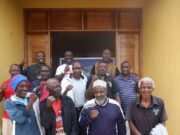
Nakuru County Boxing Association Chairman Isaac Mbote (right) receives his certificate from Nakuru Electoral Board member Millicent Kibiko on Saturday March 29, 2025
More women brought on board in Nakuru County Boxing Association

FreeArea, a tranquil suburb outside of Nakuru’s Central Business District, played host to the much-anticipated Nakuru County Boxing Association repeat AGM and election.

True to its name, it provided a free, peaceful and sober environment to conduct the AGM which was a complete contrast to the initial AGM that was invaded by strangers, overshadowed by violence, and venue filled with chocking smell of alcohol that led to its cancellation.

With the elections over, Mbote and Boxing Federation of Kenya President Anthony “Jamal” Ombok, put their heads together on key development issues. Plans are in the pipeline for Nakuru vs Nairobi boxing match

As part of the agenda in the AGM, over 50 delegates from various boxing clubs in Nakuru City expressed their authority in determining who will carry the vision of boxing development in Kenya’s third largest city by electing a 13-member committee as required by the constitution.


This election also saw more women than ever before claim their rightful place at the top of the NCBA’s leadership, giving us hope that more women boxers will join boxing and their voices will be heard on matters boxing.

Elected members are as listed below;

1. Chairman: Isaac Mbote
2. 1st V. Chairman: Samuel Nderitu
3. 2nd V. Chairman: George Kamau
4. Secretary: Moses Noor
5. Asst. Secretary: Mary Wangari
6. Treasurer: Peter Odhiambo
7. Asst. Treasurer: Lydia Wangeci
8. Competition Secretary: Lemid Thiong’o
9. Asst. Competition Secretary: Isaac Kuria
10. Committee members
• Philip Ateka
• Janet Mungoma
• Leah Wangari

Light-heavyweight gold medallist in the 1995 African Games in Zimbabwe, Peter “Dynamite” Odhiambo (right), was elected as the treasurer

The elections were supervised by Sports Registrar Madam Rose Wasike, Abel Manyara (Department of Sports) and James Akama (Kenya National Sports Council) while Election observers included BFK President Anthony “Jamal” Ombok, BFK Secretary General Dave Munuhe, Treasurer Benjamin Moses, Communications Director Duncan Kuria, BFK Competition Secretary John Waweru and his assistant Joselyn Maare Secretary and Executive member Dominic Opiyo from Kisumu.

OSHOBA BACK TO ACTION AS SHADIR VIES FOR ABU TITLE

0

Nigeria’s bright female prospect Elizabeth Oshoba aka The Yoruba Hurricane returns to the ring tonight in Gloucester in the UK to face Czech Republic’s Lenka Volejnikova (3-2-1) in a six-round featherweight fight.

Oshoba (8-0-0, 5 KOs) is expected to get the better of Volejnikova to extend her unbeaten streak to nine fights.

“I don’t have much to say for now but my opponent should be ready to be swept aside by the hurricane because I’m now punching harder,” Oshoba told boxersworld.co.ke from Gloucester in an interview.

_Oshoba and Volejnikova after the weigh-in_

“Otherwise I’m getting on well I’ve adapted to living in a foreign country though at times I miss home.”

Oshoba, the reigning WBC Silver champion, last fought in June 29, 2024, knocking out Argentina’s Augustina Marisa in the third round.

“My big aim this year is to get a shot at the world title, I feel I’m ready to take on the best in my weight division,” Oshoba told me in a phone chat.

Meanwhile in South Africa tonight, Uganda’s Shadiri Bwogi (8-0-0, 5 KOs) will vie for the Africa Boxing Union (ABU) super-middleweight title against home boy Jason Medi aka Born Ready (10-0-1, 5 KOs) in a 12-round fight.

“I’m appealing to all my fans in South Africa especially the Ugandans living here to turn up in large numbers to watch me demolish my opponent,” said Bwogi.

Open letter to new IOC President Kirsty Coventry IOC SHOULD STOP COLONISING INDEPENDENT NATIONAL BOXING FEDERATIONS

0
New IOC President Kirsty Coventry should relax their unnecessary hard stance on IBA and instead foster unity.

Open letter to new IOC President Kirsty Coventry

IOC SHOULD STOP COLONISING INDEPENDENT NATIONAL BOXING FEDERATIONS

The sports fraternity hopes Coventry will not be a stooge of the outgoing IOC President Thomas Bach.

Hi Kirsty

Congratulations on your resounding victory in the IOC elections. I hope my open letter finds you  in good health as you plan on relocating to Lausanne, Switzerland.

I will dwell on the confusion the IOC has caused by demanding that National Federations affiliated to the International Boxing Association (IBA) must move to World Boxing (WB) to enable them to participate in the Olympic Games.

I advice you to change this directive immediately because it doesn’t make sense at all. As much as we know the IOC has an axe to grind with IBA concerning governance issues and questionable officiating among others.

IOC prides itself on a very fundamental issue of Fairplay in your governance but you have now dug your heads in the sand to deny NFs their freedom of association. Is that Fairplay?

IOC should let NFs decide which international body they want to be associated with instead of dangling the Olympic Games carrot to force them join WB.

Take note IBA has been in existence since 1946. It’s the mother and father of world boxing but just because some selfish IOC members were against its Russian leadership in the wake of the Ukraine war, you chose to suffocate its existence until you kicked IBA out of the IOC family.

Yet as you know the IOC itself has its own skeletons in the cupboard but you chose to remove the speck in the eye of IBA forgetting of your own inadequacies.

Kirsty, I believe you have come to IOC leadership independently but not as a stooge of the outgoing President Thomas Bach. Therefore the boxing fraternity expects you to operate professionally putting aside the tiff between IOC and IBA.

Don’t punish innocent boxers because of your personal differences with IBA. Let all boxers take part in the Olympic qualifiers irrespective of their affiliation.

In any case IOC is now allowing professional boxers to participate in the Olympics, and they will do so without being affiliated to World Boxing. So, why force others to join WB?

We know the wicked motive of IOC is to finish IBA which to me is retrogressive and selfish given that WB alone cannot satisfy the needs of thousands of boxers worldwide.

Right now, some NFs are in a tight corner on what path they should take regarding your undemocratic position of forcing them to join WB in order to participate in the Olympic boxing tournament.

For your information, Olympics has lost its lustre of yesteryears and is no longer competitive as it used to be because the IOC has watered down the competition by reducing weight divisions, thus denying some boxers their right to take part in the Games.

Against this background, and for the interest of the African boxers, I’m humbly requesting you and WB to ensure all the weight classes are reinstated and let boxers participate in the Olympics freely without forcing their NFs move to WB.

I hope to get your response soon because I know this letter will reach you. The world is now a small village.

Stand firm as the new sheriff in town, and if need be take the bull by horns. Most important is for the IOC to stop COLONISING independent NFs to shift to WB just because of the Olympics. IOC should foster unity and friendship in sports. Put aside your hatred on IBA and join forces to develop boxing worldwide. Right now there is no sports body which is 💯 perfect. You all have your skeletons.

NENEZ BOXING ARCHIVE: The birth of professional boxing in Kenya

0
Napunyi Oduori (hand raised) gave Kenya pro boxing a flying start together with legendary Steve Muchoki. In this picture Napunyi shakes hands with Tanzania's Onesmo Ngowi whom he TO'd in the third round in 1983 to become East Africa super-bantamweight champion. Far left is the first chairman of KPBC Joe Akech and on the far right is Mal Whitfield, US Sports Affairs Officer in Kenya.

NENEZ BOXING ARCHIVE: The birth of professional boxing in Kenya

Napunyi (right) outpoints Japan’s Fusao Imai in his pro debut in Tokyo, 1981.
Modesty Napunyi Oduori made history on July 2, 1983, becoming the first ever Kenyan professional boxer to win a title at home when the bare chested game was introduced in the East African country. Back then he became of the world’s superpowers in the ring.
History:
Napunyi started his pro boxing in Tokyo where he made a successful debut on September 1, 1981 by outpointing Japan’s Fusao Imai in a six-round fight.
The stylish Napunyi and Nakuru product Isaiah Ikhoni had turned professional in Japan in August, 1981.
After showing his mettle, winning the Japanese featherweight title beating stubborn Spider Nemoto, Napunyi, a childhood buddy whom we used to box together at Prisons as juniors in early 70s, returned home in 1982 and told me he’s not going back to Japan. His abrupt decision took me by surprise.
Curious, I asked him why he wants to fight from home yet he had more opportunities in Japan but he stuck to his guns. He was not happy with the treatment in Japan. I had no choice but to partner with a close friend to make it happen. As a family man, he also had to put food on the table since he had already resigned from Kenya Prisons and life was becoming tough for him.
Pro-Boxing Genesis:
It was a challenging task for me but I took it head-on. By then there was no pro boxing in Kenya. So we decided to introduce pro boxing and get an opponent for Napunyi from outside. I then sent a telegram to Tanzania’s Emmanuel Mlundwa from Uniafrique House where Mogg Yoon, a Korean taekwondo instructor, had given me an office to operate from.
I was also hustling having lost my job at Weekly Review/Nairobi Times and started Sports Review magazine with my colleague at Weekly Review Benson Oduke. The Uniafrique office was our meeting base with Napunyi.
In my telegram to Mlundwa in 1982, I told him Napunyi has decided to fight from Kenya, and therefore he should find an opponent for him.
Mlundwa, one of Tanzania’s best boxers, had already introduced pro boxing at home in 1982 under Boxing Union of Tanzania (BUT). He responded positively to my telegram, and from there we swung into action.
By then Steve Muchoki, Kenya’s first and the only world champion in amateur boxing at that time, was also back home and had similar plans of introducing pro boxing in Kenya. Talk of great minds thinking alike.
We all teamed up and we were joined by among others Joe Akech, former international boxers David Attan, Billy Kiremi and US-based Boniface Kahoro with one common goal: to introduce professional boxing in Kenya.
KPBC:
And in January 1983, the Kenya Professional Boxing Commission (KPBC) was launched at the defunct Ainsworth Hotel in Westlands. The owner of the hotel, the late Francis Mburu, was Muchoki’s good friend. They also grew up together in Muthurwa Estate AKA Dallas. Mburu was picked as KPBC patron and Joe Akech the chairman, secretary-general Boniface Kahoro and treasurer Steve Muchoki. Some of the prominent boxers who attended the colourful ceremony included Uganda’s former world champion Ayub Kalule who was based in Nairobi.
Muchoki played a crucial role in the introduction of pro boxing in Kenya with his wide knowledge in the business. Moreover, he had turned pro in 1979 in Denmark under influential promoter Mogens Palle. He brought on board among others Mburu and Akech. The launch of KPBC was the culmination of a series of brain-storming meetings held in Mburu’s office during which Muchoki made it clear the introduction of pro boxing must be preceded by the creation of a regulatory body.
With the regulating body, KPBC launched and registered, the stage was all set for Kenya’s first pro boxing card.
Contract signing ceremony for the first professional boxing contest in Kenya on July 2, 1983, at the KICC. Far left in the picture is the chairman of Boxing Union of Tanzania (BUT) Emmanuel Mlundwa who signed the contract on behalf of Onesmo Ngowi who fought Kenya’s Modesty Napunyi Oduori {seated} second right for the East African super-bantamweight title.
Kenya Professional Boxing Commission chairman Joe Akech is second left and far right is legend Steve Muchoki who met Tanzania’s Clement Chacha. Looking on standing from left is former star international boxer and one of KPBC founder-members David Attan, KPBC Public Relations Officer Joe Okeyo, KPBC member and 1972 Munich Olympics welterweight bronze medalist Dick “Tiger” Murunga, KPBC Secretary-General and former international Boniface Kahoro and the first pro boxing promoter in Kenya D.S. Njoroge.
Dawn of a new era in Kenya boxing:
July 2, 1983 will forever be etched in the memories of Kenya’s boxing enthusiasts.
That’s when Kenya staged the first post-independence professional boxing card at the Plenary Hall of Kenyatta International Conference Centre (KICC).
In the main fight, Modesty Napunyi Oduori TKO’d Tanzania’s Onesmo Ngowi in the third round to clinch the East African super-bantamweight title. Ngowi made four trips to the canvas before his seconders threw in the towel to save him from a possible disaster.
“I’m so excited to fulfill my dream of fighting from home,” a jovial Napunyi told me after the fight.
Muchoki, the only Kenyan amateur boxer to have won a world title in 1978, outpointed Tanzania’s Clement Chacha over eight rounds in a flyweight battle. Former star boxer George “Mosquito” Findo and Ziwani-based Juma Kutondo made their pro debuts against Tanzanian boxers.
George “Mosquito” Findo made pro debut in 1983.
American Sports Affairs Officer for Africa Mal Whitfield was the chief guest flanked by Joe Akech, chairman of the newly formed Kenya Professional Boxing Commission (KPBC).
Former boxers Owiso Oure Katibi, Jimmy Zablon, Steve Thega, Stephen “Kimbo” Matiani and Alex Omwomo received commemorative certificates for their sterling performance for the national team.
Southpaw Juma Kutondo
Legendary footballer Joe Kadenge accompanied by his son Rogers Kadenge and chairman of the Amateur Boxing Association of Kenya (ABA) Major Marsden Madoka also attended the historic boxing event in the packed KICC’s Plenary Hall..
Napunyi thus became Kenya’s first pro boxer to win a title on Kenyan soil. What a memorable day it was in Kenya’s boxing history. We felt on top of the world after finally accomplishing our mission. I covered the historic day for Kanu-owned Kenya Times newspaper and my friend Stephen Ongaro for Daily Nation.
With no promoters then, KPBC financed the first pro boxing show.
Encouraged by the July 2 card, music promoter DS Njoroge decided to venture into pro boxing promotion, staging his first show in October, 1983 at the KICC with Steve Muchoki outpointing Zambia’s Flywell Botha to capture the Africa flyweight title.
DS staged another African title in 1984 at KICC in which Napunyi decisioned tough Nigerian southpaw Obele “Rastaman” Anazor to clinch the Africa super-bantamweight title watched by his father Mzee Joseph Oduori, mum Paulina and some of his siblings Sylvester Odhiambo, Philip, Anyash, Chauh and Knight.
DS Njoroge, the first promoter to be affiliated to KPBC, promoted the show spiced by his throbbing beats.
DS Njoroge was the first promoter to be affiliated to the Kenya Professional Boxing Commission.
Njoroge opened the way for other promoters to join the foray among them Chris Kamuyu who used pro boxing as a springboard to politics, Davlin Promotions owned by David Attan and his wife Linda, Level Two Promotions, Korean Kapsoo Kim and the current KPBC chairman Reuben Ndolo who made a huge impact. Ndolo was instrumental in ferrying to South Africa some top Kenyan boxers among them George “Kidi” Adipo, Moses Kinyua and David Kiilu.
Among the big fights Ndolo promoted included Napunyi’s Commonwealth featherweight title contest against Ghana’s Oblittey Commey at City Hall. The stylish Napunyi, a sharp counter-puncher, soundly beat Commey on points to become the second Kenyan pro boxer to win a Commonwealth title after Muchoki.

JAMAL KO’s BIG-TALKING MARTIN IN ROUND ONE

0
A smiling Boxing Federation of Kenya (BFK) President Anthony Otieno Ombok aka Jamal was on top of his game knocking out his timid challenger in the first round.

JAMAL KO’s BIG-TALKING MARTIN IN ROUND ONE

Winner Jamal flanked by vice-president Isaac Mbote (far left) and secretary-general David Munuhe (right).

Boxing Federation of Kenya (BFK) President, Anthony Otieno Ombok aka Jamal, is a man of a few words.

He prefers action to do the talking for him while his opponent, Martin Luther, is known for his colourful language on social media.

On March 1, 2025, Jamal and his entire executive won the BFK elections unopposed. His opponents were so scared of Jamal’s lethal team that they opted not to challenge them.

Instead, Martin & Co went to the Sports Disputes Tribunal court challenging the elections they claimed was fraudulent with several anomalies.

The battle was now set between Jamal and Martin.

Interviewed by boxersworld.co.ke ahead of the big day, Jamal, as usual, was composed and confident of victory.

“This one will be a clean KO, I want to silence this mosquitoweight opponent, he has to know people,” said Jamal.

The fight started at a breakneck pace with Martin throwing a lot of punches that hardly reached the target. He was doing shadow boxing.

Registrar of Sports Rose Wasike gave the nod to Jamal and team, saying the elections were constitutionally okay.

Then Jamal unleashed a left uppercut which pushed Martin back to the ropes with Jamal in hot pursuit.

He uncorked a one-two punch that hurled Martin out of the ring. Luckily enough, a kind judge saved him from landing down on his head.

The punch-drunk challenger was then helped back to the ring by his seconders. By now the writing was already on the wall: he would not last the full course.

Jamal went for the kill with a flurry of combinations as his opponent buried his face under both gloves for safety.

The BFK prezo caught him with a left hook to the jaw followed by a screaming right to the solar plexus that saw Martin visit the canvas for the full count.

In one minute, 40 seconds it was all over. Jamal’s opponent was helped back to his corner and rushed to hospital for treatment.

I’m told he has now recovered – though still with a black eye – and ready for another duel with BFK’s vice-president Isaac Mbote for the leadership of Nakuru County on Saturday, March 29th.

The 1995 African Games light-heavyweight gold medallist Peter “Dynamite” Odhiambo says NaxVegas will be 🔥 fire for 🔥 fire on Saturday, March 29th.

Mbote has been in residential training promising to silence his big-talking adversary once and for all.

All roads now lead to NaxVegas for this eagerly awaited showdown to take place under tight security.

MANDELA CUP CHANGED MY LIFE, SAYS LESOTHO BOXER

0
Lesotho's Mandela Cup minimumweight gold medallist Retselisitsoe Kolobe (in red) on his way to victory against Botswana's Kobamelo Molatlhegi in the finals of the 2024 Mandela African Boxing Cup tournament in Durban, South Africa.

MANDELA CUP CHANGED MY LIFE, SAYS LESOTHO BOXER

Kolobe is now a proud owner of his personal car he converted into a taxi cab to make more money.

Lesotho’s Retselisitsoe Kolobe now owns a taxi cab and will soon be living in his own house.

The gold medal he won in the 2024 inaugural Mandela African Boxing Cup tournament in Durban, South Africa, has transformed his life beyond his normal expectations.

He outpointed Botswana’s Kobamelo Molathegi in the final minimumweight bout to pocket $5000 prize money from the International Boxing Association (IBA). The organisation staged the tournament in conjunction with the Africa Boxing Confederation and the South Africa National Boxing Organisation.

“The prize money helped me a lot, I now have a taxi cab and building my own two-bedroomed house in a place called Ha Pita,” says the 24-year-old Kolobe who made his international debut in 2022.

While Kolobe is delighted he owns a taxi, he says at times it interferes with his training schedule.

“It’s a challenge to me now because when the training time comes I’m supposed to be transporting my clients so I cancel the gym work.”

Construction work on his personal house is still in progress.

Ongoing construction of Kolobe’s house courtesy of $5000 prize money he earned in the Mandela Cup.

“I’m very happy I’ll be sleeping in my own house, I thank the IBA so much for the prize money in Durban. I can’t believe that I’m now doing taxi cab business.”

Kolobe is a member of LP Boxing Club, and he started boxing in 2016.

Kolobe on the left in a training session.

“One of my village friends encouraged me to venture into boxing,” recalls the entrepreneur whose burning ambition is to become a world champion.

Kolobe’s gold in Durban enabled Lesotho to finish fifth overall and the second-best placed Southern African nation behind Mozambique. The country floored other top Zone 4 boxing nations such as South Africa, Botswana and Namibia.

LESOTHO TO REMAIN IN IBA REFUSING TO BE COLONISED AS GHANA MOVES TO WORLD BOXING

0

LESOTHO TO REMAIN IN IBA REFUSING TO BE COLONISED AS GHANA MOVES TO WORLD BOXING

IBA is the sole worldwide governing body for the sport of boxing in all its forms, with 191 Member Federations and 5 Confederations.
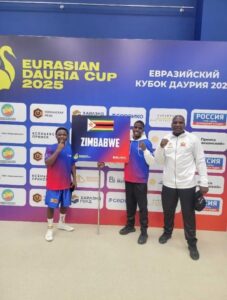
Lesotho Boxing Association (LeBA) has opted to remain in International Boxing Association instead of being “colonised” by joining World Boxing.

And Ghana Boxing Federation is the eighth African country to abandon IBA for World Boxing (WB).

LeBA Secretary General Lebohang Handy said they have decided to remain with IBA.

“LeBA considers pressure from IOC to join WB as a form of sporting colonisation, violating athletes choice in sports and human rights in sport,” Lebohang told boxersworld.co.ke in a statement.

He cited IBA’s financial rewards to boxers and supporting national federations to take part in their tournaments as one of the reasons for remaining in IBA.

“Olympic involvement has historically offered no long term value to Lesotho boxers,” said Lebohang.

“The prize money Lesotho boxers received from Mandela Cup has transformed their lives, this opportunity is lacking in the Olympics which offers no direct financial empowerment to boxers only medals that have little value in boxers’ financial empowerment, and even if we’re in WB we still have the Olympic qualifiers we’re not assured of going to LA.”

Explaining why Ghana has migrated to World Boxing, the Vice President Daudi Fuseni said apart from elite and youth world championships, IBA has not empowered NFs and is now more into pro boxing. Here’s why Fuseni said they have shifted to WB:

“We need to be sincere with each other, IBA is currently moving gradually away from amateur to professional boxing.

“Currently when you look at IBA’s calendar of events, apart from the Youth and Elite world championships, the rest of their programs are their Champions Nights’ which do not benefit the federations. Mostly it’s pro boxers taking part with few or none from member federations apart from the one in Addis Ababa last year. The Champions’ Nights are of no benefit to federations.

“We need an international body that has a clear road map for the development of amateur boxing globally;

an international body that has a full calendar of activities solely for the development of amateur boxing globally.

“It was good for IBA to introduce Mandela Cup but it looks like an abruptly organised tournament to appease Africa because this year it’s not in their calendar of events.”

Ghana becomes the eighth African country to join World Boxing. Others are Algeria, Egypt, Gambia, Madagascar, Nigeria, Malawi and Sudan.

On the role of Africa Boxing Confederation (AFBC), Fuseni said the body has become a puppet of IBA owing to its financial disability.

Fuseni again: “AFBC do not have absolute control over their activities, they rely on IBA and therefore if IBA goes down, they fall with them.

“I believe AFBC should have a solid source of funding or sponsorship aside the support they get from the international body to run their programs.
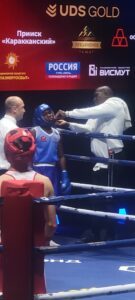
“The Mandela Cup, is supposed to appear in the AFBC calendar but because they’re relying on IBA to fund it, it’s not in their calendar of events. This is very unfortunate and that’s why we’re now the laughing stock of the West.

These are some of the challenges we face as Africans and the earlier we sort them out the better especially financial independence sector.”
 

NENEZ BOXING ARCHIVE: One of Kenya’s most decorated boxer , Steve Muchoki

0
Steve Muchoki back home on winning world light-flyweight title in 1978 in Belgrade, Serbia. East African Breweries chairman Kenneth Matiba admires Muchoki's best boxer trophy. Others in the picture from left are coach Peter Mwarangu, Stephen Moi aka Black Bomber and far right is ABA of Kenya chairman Major Marsden Madoka.

NENEZ BOXING ARCHIVE: One of Kenya’s most decorated boxer , Steve Muchoki, recounts his participation in the inaugural World Championships in 1974 in Havana, Cuba.

Muchoki remains the best ever light-flyweight Kenya has produced.

At 17 years of age and barely one-year-old in Kenya’s national boxing team, Steve Muchoki was among the five boxers picked to represent the East African country in the inaugural World Boxing Championships in Havana, Cuba, from August 17-30 in 1974.

Others selected were African Games bantamweight silver medallist Isaac Maina, African Games gold medallist, light-welterweight George Oduori, top regional light-middleweight David Attan and African Games middleweight champion Peter Dula.

Muchoki was surprised when the Amateur Boxing Association of Kenya (ABA) decided he was the one to don the national vest in the light-flyweight division.

“l was very surprised to be selected for such a big tournament because by then we had more experienced boxers in my weight such as Lawrence Kariuki of Prisons and Peter Kangethe of Police,” recalls Muchoki, adding: “At the same time I was happy, it showed the selectors believed in me.”

The ABA had every reason to believe in Muchoki following his shocking but deserved points victory over Uganda’s highly regarded and more experienced defending champion James Odwori in the finals of the Commonwealth Games in Christchurch, New Zealand, in 1974.

Muchoki’s astounding achievement in Christchurch was more captivating taking into account he had no international exposure but he silenced Odwori, a Kenyan boxing for Uganda. His father was working for the defunct East African Railways, but he was transferred to Uganda in the 1960s while Odwori was still a toddler growing up in Makongeni Railways Quarters in Nairobi. The boxer won gold at the 1970 Commonwealth Games in Edinburgh, Scotland.

Prior to gaining selection in Kenya’s team for the Christchurch Commonwealth Games, Muchoki defeated big names in the trials among them Prisons’ Lawrence Kariuki, a silver medalist at the 1968 Africa Championships in Lusaka, Zambia.

Muchoki had made his international debut for the national team in November, 1973, outpointing Uganda’s Baker Muwanga during the second leg of the Urafiki Cup between Kenya and Uganda at Nairobi’s City Hall.

After his triumph in Christchurch, Muchoki won another gold medal in the FESCAABA Championships in Dar es Salaam, Tanzania. This was a popular tournament then featuring East, Southern and Central African countries.

Muchoki receives Order of the Burning Spear (OBS) from President Jomo Kenyatta in 1978.

With two gold medals under his belt, the ABA of Kenya was convinced the talented secondary school student was up to the task in Havana.

Muchoki elaborates his training programme ahead of the Havana trip, and explains why he was happy. Earlier the selected coach Hasaan Amiri had been replaced by trainer Charles Anjimbi. Amiri pulled out owing to pressure of work at the Kenya Army.

“To me the late Hassan Amiri was a good coach but too harsh, forcing boxers to do what he thought was good to him but boxers didn’t like his coaching approach,” says Muchoki

“l was elated because l was now free to train the way l want with no pressure. Anjimbi was my first coach at Railways Starehe Boxing Club. He knew me well and how I train. The team manager-cum-doctor Major Momanyi made arrangements for us to be training at Prisons Staff Training College and sleeping at Langata Barracks.

“l can recall my training mates were lsaac Maina, George Findo, Philip Mathenge and Peter Dula. All of them were my seniors in the national team.” George Oduori and David Attan, were both selected for the Havana tournament. They were then based in Germany and decided to prepare there and link up with their compatriots in Havana but owing to travel complications they didn’t make it to Cuba.

Muchoki, probably relying on his sixth sense, was not comfortable doing sparring at Prisons Gym.

“I had to plan my training cautiously the moment l learned that we would be based in Langata Barracks and training at Prisons. l knew some boxers were not happy for my selection, and they might use dirty tricks during the sparring sessions to make sure I don’t go to Havana. Therefore, I decided to go for sparring at my club in Muthurwa Estate which we nicknamed Dallas. At Prisons anything could have happened to put me out of the Kenya team.

“My training was in the morning I would run from Langata Barracks to Nyayo Stadium roundabout and then to Prisons for the first training session. I then ran back to Langata Barracks after the training and in the evening I would do more road work and sparring with boxers I was familiar with in Dallas and back to the Barracks.”

Stamps printed in honour of Muchoki in 1976 ahead of Montreal Olympics. The talented Kenyan pugilist was poised to become the first black African boxer to win Olympic gold but Kenya joined other African countries which pulled out of the Games in protest at New Zealand rugby team’s tour of apartheid South Africa.

Finally the Kenya team left for Havana to participate in the inaugural World Boxing Championships.

“On arrival in Havana things were okay from accommodation to the food and the friendly atmosphere, I met with my buddy with Tanzania’s boxing team Emmanuel Mlundwa, I enjoyed myself a lot there.”

Muchoki was wary of meeting a Cuban boxer in his first fight.

“Deep in my heart l was just thinking if l meet a Cuban in my first fight what would I do? Because they were the best boxers in the world by then but to me it was a big challenge. I also wanted to beat the big powers in boxing who were by then Cuba, USA and the Soviet Union.”

Muchoki first beat Jose Ibiri of Argentina, saw off Romania’s Cosma Remus in the quarter-finals and outpointed Eugeniy Yudin of the Soviet Union in the semi-finals.

Pitted against Cuba’s Jorge Hernandez in the finals, Muchoki lost on points but when he returned home coach Charles Anjimbi claimed he was robbed of victory against the Cuban. Muchoki, was also not satisfied with the result.

Says Muchoki on the officiating in Havana: “Infact it was not only my fight that I felt robbed. There was biased officiating in some fights resulting in some judges being beaten in the lift for their biased officiating, we just don’t know where the assailants came from. This forced the organisers to assign security to the judges.”

Muchoki singles out the Argentine boxer, Jose Ibiri, as the toughest of all the opponents he fought in Havana.

“I can recall the boxer from Argentina was very aggressive but not tactical like the Cuban. This boxer was just coming forward so l had to sidestep every now and then to avoid his heavy punches. Mostly I was taking advice from my fellow boxers Isaac Maina and Peter Dula because they were near my corner.

“The Cuban was taller than me and he had long range jabs. I opted for in-fighting by keeping him close so that he couldn’t take advantage of his long reach, l was smart at in-fighting and combinations.”

So what did he gain by winning Kenya’s first ever medal in the World Championships?

“I got nothing from our government just the usual congratulations,” says Muchoki but he’s not bitter at not being rewarded like some countries do for their sportsmen and women.

“It was not a must for the government to reward me, that’s their choice if they felt it was a big achievement. I have learnt to live with our African leaders who don’t bother much about our achievements, they’re more interested in enriching themselves.”

Muchoki is very impressed by IBA’s President Umar Kremlev’s recognition of the boxers’ performance in the ring by introducing prize money.

“Kremlev has shown he cares for the welfare of the boxers, God bless him,” says Muchoki appealing to Kremlev to honour the medalists in Havana.

Muchoki, who went on to win a gold medal and Best Boxer Award in the 1978 World Championships, is grateful to the chairman of the Kenyan federation at the time, Major Marsden Madoka, for employing him at Kenya Breweries which was one of the leading Kenyan clubs with cream boxers. Madoka was then a highly placed senior employee at Breweries and brought on board several international boxers.

“I just don’t know where I would be without Madoka’s support. The Army and Police wanted me but I was not keen to join the forces.”

We hope Kenya’s President William Ruto will invite Muchoki to State House to honour him for his great achievements including legendary Philip Waruinge.

Muchoki says with the current economic situation in Kenya, life is not a bed of roses but he’s surviving aided by the boxing philosophy he learnt as a boxer.

“Life is not easy now, I’m struggling for a living by coaching a club to put food on the table,” says the humble Muchoki, a devoted Catholic who was an altar boy during his youth.

Photos courtesy

CREATION OF NEW AFRICAN BOXING BODY TO SCUTTLE DISJOINTED AFBC

0
African boxers will be the biggest beneficiaries with the formation of a new boxing confederation in the pipeline to be affiliated to World Boxing.

CREATION OF NEW AFRICAN BOXING BODY TO SCUTTLE DISJOINTED AFBC

International Olympic Committees’ official recognition of World Boxing has further scuttled the feuding factions in the Africa Boxing Confederation (AFBC).

Now, the existence of AFBC – formed in 1960 – is threatened by the formation of a new African boxing body to be affiliated to World Boxing.

Plans are already in the pipeline for the formation of WB- affiliated boxing organisation in Africa to rival the existing one which is currently going through a leadership crisis in the wake of a big rift with two presidents claiming legitimacy. One faction is led by the IBA- recognised President Eyassu Berhanu and the other one is under the leadership of the combative Congolese Boxing Federation President Ferdinand Ilunga Luyoyo whose group met in Kinshasa last year and passed a vote of no confidence in Berhanu’s leadership during the AFBC African Men’s and Women’s Boxing Championships.

With WB now officially recognised by the IOC, it’s obvious more NFs in Africa will abandon IBA and join WB irrespective of whether their boxers will qualify for the 2028 LA Games. The bottom line now for the NFs is to know which side of their bread is buttered especially in view of the respect the IOC commands among their respective African governments.

Therefore as it is now, each national federation will have to make their own individual decision to join WB ignoring the ongoing circus in the deeply divided AFBC which currently has no clout to give them direction. Perhaps a new body will be a breath of fresh air for Africa boxing to move away from decades of bad leadership that has been synonymous with AFBC.

It is understood the Luyoyo faction is leaning towards WB in protest at what they feel is failure by IBA to take firm action on Berhanu’s leadership which they accuse of incompetence, shady deals and arrogance. In reality both factions have rotten eggs since they’re all birds of the same feather. Their acrimony came to a head during the AFBC African Men’s and Women’s Boxing Championships in Kinshasa last year when Berhanu was denied the opportunity to address the crowd during the opening ceremony of the tournament.

Luyoyo was then the man of the moment taking centre stage with the country’s minister in charge of sports ignoring the presence of Berhanu whom the Luyoyo group alleged had attempted to sabotage the tournament by writing to participants not to attend the Kinshasa boxing event largely ignored by IBA. Strangely, there was no prize money like the previous ones in Yaounde and Maputo.

The Luyoyo faction, which claims to have more NFs supporting them, has now given the IBA tough conditions to remove Berhanu at the helm failure to which they will join WB.

Removing Berhanu now is inconsequential and has been overtaken by events following the latest development. Each NFs is now carrying their own cross. They will have to make their own personal decision to join WB.

The AFBC circus has of course not gone down well with some of the member federations who view the African body as a rudderless vessel heading nowhere other than being used for personal aggrandisement.

“We’re preparing to join World Boxing, we can’t be in a body which does not attend to our problems, we don’t even know whom to deal with,” one of the presidents of the African NFs told me this morning.

He also laments on AFBC’s lean calendar of events and would prefer a new body which is likely to inject more activity in African boxing.

So far, seven African countries have officially moved to WB. They are Algeria, Egypt, Gambia, Madagascar, Nigeria, Malawi and Sudan. Ghana and Mauritius are among AFBC member countries planning to shift to WB.

A number of NFs officials who spoke to boxersworld.co.ke said they’ll prefer a new body to bring the much desired change in African boxing and professionalism in the management of the game after decades of stagnation and petty leadership tussles.

Right now they feel in addition to the thin calendar of events, AFBC has nothing much to offer to their national federations while some feel the IBA is spending more on boxers’ prize money at the expense of financially empowering the African federations which nurture the boxers’ talents.

Others however argue the immense financial contribution of IBA’s President Umar Kremlev has been a game changer in world boxing compared to his predecessors. A number of boxers have hailed IBA’s prize money tournaments that have changed their lives.

There’s apprehension however on the future of IBA once Kremlev departs given that for now he appears to be the sole financier. Unlike World Athletics and FIFA whose sponsors are known, in IBA it’s only Kremlev known as the official sponsor. Whether the funding is personal or from friends has not been made public.

However, it appears Kremlev is not going out in the foreseeable future with the IBA now morphing into a professional body. The entry of WB is likely to speed up the process to become a fully-fledged pro boxing organisation and probably change their constitution and structure of management, giving Kremlev more leeway to remain at the top.

As for the the entry of a new African body, it’s being viewed with great expectations in that it will be affiliated to an equally new international body expected to bring on board sponsors who will empower the WB-affiliated African organisation to introduce more competitions and change the tattered image of African boxing.

For now, the African boxing scene is keenly watching to see how many more NFs shift to WB to increase the required number to 16 to enable them form a new African boxing body. Interesting times indeed in world boxing.

THREE COUNTRIES YET TO BE PAID 2022 MAPUTO PRIZE MONEY

0
Some of the boxers yet to be paid 2022 Maputo prize money totalling $177,500. Clockwise from top: Juliana Kasonka, Patrick Chinyemba, Felistus Nkandu, Margret Tembo and Alcinda Dos Santos.

THREE COUNTRIES YET TO BE PAID 2022 MAPUTO PRIZE MONEY

IBA President Umar Kremlev far left officially opening the AFBC headquarters in 2023 in Yaounde.

It’s just unbelievable that almost three years now boxers from Zambia, Mozambique and Algeria have not been paid their prize money they won at the 2022 AFBC African Men’s and Women’s Boxing Championships.

Some of the concerned boxers, Mozambican Alcinda Dos Santos, Zambians Patrick Chinyemba, Felistus Nkandu, Margret Tembo and Juliana Kasonka have demanded immediate payment of their rightful earnings.

“We’ve waited for too long now, nobody is telling us anything on our payment,” says Alcinda the two-time Africa light-middleweight champion and 2022 world silver medallist.

“This is very unfair, it’s putting us in a difficult situation with our families, they think we’ve been paid without sharing anything with them,” an angry Chinyemba, who won gold in the 2022 Africa Championships, told boxersworld.co.ke

“They’ve been keeping our money for too long, what’s more annoying they’re all quiet as if nothing happened,” says Maputo lightweight gold medallist Nkandu.

Like Chinyemba, Juliana is at a loss on what to tell her family members.

“Now our family think we ate all the money by ourselves without sharing with them, this is Africa,” says Juliana, bronze medallist in the Maputo event.l

Gold medallists were paid $10,000, silver $5000 and bronze $2,500.

Interestingly, former AFBC President Bertrand Mendouga of Cameroon confessed he used prize money of boxers from the three countries to refurbish their new headquarters ahead of the official launch by IBA President Umar Kremlev in early 2023.

Mendouga passed the buck to IBA for failing to honour their promise of remitting $500,000 to the confederations for their internal budget as pledged by Kremlev in the IBA congress in 2022 in Turkey.

Mendouga’s letter to Kremlev reads:

“I would like to remind you that the USD 100,000 sent in September 2022 for the organisation of the Maputo 2022 African Championships and the extraordinary congress were equitably used for these purposes.”

_“However, because it was necessary to honour Africa for the first time by providing the AFBC with a headquarters on the scale of this international boxing structure, and in view of_ _the imminence of your arrival in Cameroon scheduled for February 12, 2023 for the inauguration of the said headquarters, I had to use the money available (prize money from the aforementioned three countries) to meet the expenses linked to:_

− _the rental ;_

− _to repair the building,_ _which is in a very poor state of repair;_

− _equipping the headquarters ;_

− _and payment salaries of AFBC staff recruited after my election on 16_ _July 2022 in Algiers, and that of the Secretary_ _General on 17 September 2022 in Maputo._

_“It is obvious that this change in the destination of funds is justified by your promise to provide the AFBC with an_ _operating budget in due form. Unfortunately, until_ _30 June 2023, the AFBC has received nothing_ _from the IBA to enable_ _it to regularise this_

_situation._

_“It should also be pointed out that AFBC has neither a sponsor_ _nor any source of income other than_ _funding from the IBA._

_In the light of the_ _foregoing, it is clear that the use of prize money for the reasons_ _mentioned above, which is quite simply a matter_ _of the state of necessity faced by the AFBC, is far_ _from being qualified as mismanagement as_ _claimed by the Board of Directors, which had_ _moreover received the detailed statement of_ _these expenses, informed you._

_“All the supporting documents for the above-mentioned_ _expenditure have been made available to the_ _AFBC Secretary General. It would therefore be_ _advisable to regularise the AFBC budget for the_ _2022-2023 financial year, to enable me to remedy all these situations.”_

What Mendouga has not mentioned is who authorised him to spend the boxers’ prize money and whether there was a written agreement between him and IBA boss Kremlev that he can spend the prize money and then reimburse it from the $500,000 operating budget he was expecting from IBA.

The AFBC Board of Directors was not involved in the withdrawal of the prize money, and accused Mendouga of unilaterally deciding to use the prize money without their consent. They also doubted Mendouga’s explanation that the entire prize money totalling $177,500 of 29 boxers from the three countries was used in the refurbishment of the office and other expenses.

Africa Boxing Confederation President then Bertrand Mendouga has confessed he used boxers’ prize money to refurbish the office.

Nigeria’s Azania Omo Agege was one of the board members and later elected as the interim President following the suspension of Mendouga by the board for what they said was his high-handedness and alleged financial impropriety.

Azania further narrates what transpired in Yaounde, Cameroon in 2023 during the Africa Championships.

“When we got to Cameroon we found out Mendouga had used the prize money to open up the office, we had a rowdy session that led to his suspension in the presence of IBA President Umar Kremlev, we did another election among the board members and I was elected the interim President.

“After the tournament, I remained behind for three days to talk to Mendouga about the prize money. He had promised to return the money but he stopped picking my calls, so we never met. I was scared of my life I had to leave immediately because you never know.

“The signatories to the Yaounde account were the secretary general Andre Basil Kalong and Mendouga as the president. We went to the bank with Basil I upended my signature and removed Mendouga’s. There was nothing left in the bank, most of the money had been withdrawn. From the bank statement I have, it shows money was withdrawn from the bank eleven times in one day. The IBA had promised to pay the Maputo prize money but I don’t know what happened.”

This is the stinking garbage that the new President Eyassu Berhanu from Ethiopia inherited from Mendouga when took over AFBC leadership.

Berhanu promised to follow up the matter but so far the Maputo prize money remains unpaid, further blotting the image of the beleaguered African boxing body.

At one time, there was talk that IBA had wired the Maputo prize money to the bank account of the new AFBC headquarters in Addis Ababa but the interim secretary general Yohanes Birnane denies this.

“We have not received any money from IBA for the unpaid boxers’ prize money,” says Birhane.

And so the 29 boxers from Zambia, Mozambique and Algeria will continue waiting for their prize money as they curse Mendouga for using their hard-earned money in the ring without even having the courtesy to inform them.

The current AFBC President Eyassu Berhanu has promised to pursue the issue diligently until the boxers are paid their money.

AFBC has an obligation to ensure the boxers are paid their prize money immediately without any further unnecessary delay. Pay them now!

MOST COMMENTED