









Home Blog Page 18

NIGERIAN SAVES AFRICA, TEOFILO’S UNBEATEN RUN CHECKED AS CUBA AND US BOXERS STEAL THE SHOW

0
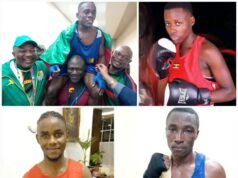
Clockwise from top left: Cuba's legend Teofilo Stevenson suffered a shocking defeat in Munich, Kamau Wanyoike lost in the round of 16, Ibrahim Bilali and Hussein Khalili qualified for the quarters in the middle of the photo collage Nigeria's first Olympic silver medallist Peter Konyegwachie

▪️Cuban legend Teofilo Stevenson’s 11-year unbeaten run was finally shattered by Italy’s Francesco Damiani at the 1982 IBA World Boxing Championships in Munich
▪️Eight African boxers – two each from Kenya, Nigeria, Tunisia and DRC – powered their way to quarters but only Nigeria’s Roland Omoruyi won a medal
▪️Cuba thwarts strong challenge from the US to win the overall world crown for the third year running

19/11/2025

Cuban legend Teofilo Stevenson won the heavyweight gold twice in the inaugural 1974 World Championships in Havana, Cuba, and at the 1978 World Championships in Belgrade.

Teofilo’s determined efforts to win his third world title in a row went up in flames when against all expectations he suffered a shocking 5-0 points defeat to Italy’s European champion Francesco Damiani in the super-heavyweight quarter-finals.

Damiani neutralised Teofilo’s powerful right punch and jabs by fighting him at close quarters shaking the Cuban several times. Teofilo was not his normal self, showing limited appetite for the fight. Damiani settled for silver, losing in the finals to Tyrell Biggs of the USA who became the first world super-heavyweight champion.

The late Teifilo Stevenson

Teofilo made up for the Munich disappointment in the 1986 World Championships in Reno, USA where he won the super-heavyweight gold with a points victory over home boy Alex Garcia.

Despite the unexpected defeat of Teofilo in Munich, Cuba shook off strong opposition from the US to emerge overall winners for the third year running with five gold, one silver and bronze apiece ahead of USA 3-2-2 and Soviet Union 3-2-1.

For the first time in the World Boxing Championships, Africa had eight quarter-finalists.

Expectations rose high among boxing followers in Africa hoping for a better performance than in 1978 when Kenya’s celebrated light-flyweight Steve Muchoki and Nigeria’s lightweight Davidson Andeh won two precious gold medals for Africa in Belgrade, Yugoslavia (Belgrade is now the capital of Serbia).

The eight African boxers in the quarter-finals were light-flyweight Ibrahim “Surf” Bilali, lightweight Hussein “Juba” Khalili (Kenya), bantamweight Joe Orewa, welterweight Roland Omoruyi (Nigeria), light-middleweight Kalongo Bolemi, middleweight Mwehu Beya (DR Congo), Lofti Belkhir and welterweight Khemai Refai both from Tunisia.

Competition at the 1982 World Championships was so stiff, featuring some of the top Cuban, Soviet Union, American, South Korea and German boxers.

Cuba had among others three-time world featherweight champion Adolfo Horta, welterweight Angel Herrera and two-time world light-heavyweight gold medallist Pablo Romero, a tall swarmer boxer who preferred engaging his opponents in close-quarter exchanges.

Among the star boxers in the US team included lightweight Pernell Whitaker and welterweight Mark Breland, both eliminating African boxers in the quarter-finals.

The going was not easy for the African boxers with only Nigeria’s Roland Omuruyi sailing to the semi-finals with a 3-2 points win over Tunisia’s Khemais Rufai.

Bilali lost 4-1 to Korea’s Yong-Mo Heo, Orewa went down 3-2 to Venezuela’s Jesus Poll, Khalili lost 5-0 to Pernell Whitaker, Cuba’s Angel Herrera stopped Tunisia’s Lofti Belkhir in the first round, Soviet Union’s Alexandr Koshkin beat DR Congo’s Kalongo Bolemi 5-0 and DR Congo’s middleweight Mwehu Beya lost 5-0 to Pedro Raamsdank from the Netherlands.

Already assured of a medal, Omoruyi was beaten in the semi-finals by Soviet Union’s 1980 Olympic Games silver medallist Serik Konakbayev who went on to lose to USA’s Mark Breland in the finals.

The eight losing finalists were among the 21 boxers from Africa who made it to the round of 16 with 13 of them losing their bouts.

Nigeria’s featherweight Peter Konyegwachie, now based in London, and Kenya’s Kamau Wanyoike were among Africa’s hot medal prospects unable to qualify for the quarter-finals.

Konyegwachie was eliminated in the round of 32 by Cuba’s Adolfo Horta while Wanyoike, the three-time King’s Cup champion, went down 3-2 to West Germany’s Polish-born Manfred Zielonka in the pre-quarters.

Wanyoike, now a farmer at his rural home in Komothai, Kiambu County, is still not convinced he lost to Zielonka.

“My opponent was fighting at home, they had to give it to him otherwise I beat him in all the three rounds,” Wanyoike told boxersworld.co.ke in a telephone phone interview as he harvested coffee.

Round of 16 results for the losing eight African quarter-finalists.

Light-flyweight Ibrahim Bilali (Kenya) beat Juan Molina (Puerto Rico) 5-0, flyweight Joe Orewa (Nigeria) beat Bogdan Maczuya (Poland) 5-0, lightweight Hussein Khalili (Kenya) defeated Tibor Puha (Czechoslovakia) 4-1, Lofti Belkhir (Tunisia) outpointed Tuncay Sipahi (Turkey), welterweight Khemais Refai (Tunisia) beat Bulgaria’s Ramis Yasharov, Nigeria’s Roland Omoruyi beat Norway’s Kristen Reagan on a walkover, light-middleweight Kalongo Bolemi (DRC) stopped Venezuela’s Daniel Urdanetta in the third round and middleweight DRC’s Mwehu Beya stopped Canada’s Kevin McDermott in the second round.

WBC GRAND PRIX FINAL SET FOR DECEMBER 2O IN RIYADH

0

16/11/2025

The roar of history echoed in Saudi Arabia during the semi-finals of the inaugural WBC Boxing Grand Prix.

A tournament that has forever changed the way global boxing is understood. Every bout was a display of power, technique, and heart, paving the way for a set of finals that promise to be legendary.

The finalists have been decided, and on Saturday, December 20th, we will know the champions who will hoist the José Sulaimán Trophy, the symbol of the highest honor in the World Boxing Council.

These are the finals that will decide the first monarchs of the WBC Boxing Grand Prix:

Featherweight

Muhamet Qamili vs Brandon Mejía

Both demonstrated that the knockout is their language. Qamili blasted Yoni Valverde Jr. with a precise and devastating combination, while Mejía did the same with a demolishing liver shot on Maite. Two predators of the ring ready to define who is the true king of the 126 pounds division.

Super Lightweight

Mujibillo Tursunov vs Carlos Utria

One of the most anticipated fights of the tournament will pit Uzbek discipline against Colombian grit. Tursunov overcame the always complicated Danylo Lozan by majority decision in a technical and physical war. In contrast, Utria ignited the arena with an explosive first-round knockout over Ntethelelo Nkosi. Maximum anticipation for a battle that could steal the show.

Middleweight

Derek Pomerleau vs Dylan Biggs

Intelligence and resistance will be tested in a final that promises to be a boxing clinic. Pomerleau survived a tough contest against the Colombian Carlos Sinisterra, taking the victory by majority decision. Biggs, for his part, convinced all five judges —a WBC innovation in this tournament— and authoritatively defeated the Frenchman Lancelot de la Chappelle by unanimous decision. Two distinct styles, one same ambition: the green and gold glory.

Heavyweight

Ahmed Krnjic vs Kevin Ramirez

The giants of the Grand Prix closed the semi-finals with pure fire. Krnjic imposed his power and control over the South African Keaton Gomes, taking a hard-fought split decision.

But the story of the day was the Argentine Kevin Ramirez, who surprised everyone by defeating the American Dante Stone, also by split decision. A high-voltage final between two colossuses who do not know the meaning of “backing down.”

The cards are on the table and the countdown has begun. This December 20th, the world will witness the outcome of this historic tournament. Only four names will be engraved on the José Sulaimán Trophy… and the rest, in the memory of all boxing fans.

48 AFRICAN COUNTRIES REGISTER FOR IBA CONGRESS IN DUBAI

0

▪️A senior Nigerian Boxing Federation official confirms the West African country will not be in Dubai

16/11/2025

The number of African countries to attend IBA Ordinary Congress in Dubai has increased to 48.

Somalia, Ghana and Equatorial Guinea are the latest countries to register for the IBA Dubai Congress on December 13, 2025.

While Nigerian Boxing Federation has confirmed they will not be in Dubai, there’s no word yet from Egypt and Benin.

A senior NBF official told boxersworld.co.ke that they have adhered to a government directive to remain in World Boxing and will therefore not attend the IBA Congress.

According to a report in the IBA website, the Congress will take place on the same day with the IBA Men’s Elite World Championships finals on December 13.

The 23rd edition of the Men’s World Championships will serve as both a global sporting showcase and a celebration of IBA’s 75-year legacy. The Championships will be accompanied by the IBA Business Forum (12 December) and the IBA Congress (13 December)—gathering a large contingent of National Federations in what promises to be a landmark week for the sport.

*Event Highlights*

• 2–13 December: IBA Men’s Elite World Championships

• 11 December: IBA Pro Face-Off & Arrivals Dinner

• 12 December: IBA Business Forum / IBA Pro Event

• 13 December: IBA Congress / World Championships Finals / Gala Dinner

A Message from IBA Leadership

As IBA enters this pivotal phase, Chris Roberts OBE, IBA Secretary General and CEO expressed gratitude to all National Federations for their ongoing support and collaboration.

“While challenges remain, our collective resilience and shared vision are shaping a bright future for boxing. Dubai will not only celebrate our athletes but also the progress we’ve made together as a global boxing family.”

IBA looks forward to welcoming all members and partners in Dubai this December for what promises to be a defining celebration of unity, excellence, and the enduring spirit of boxing.

The following are the 48 African countries which have already registered for the IBA Congress:

1. Algeria

2. Morocco

3. Libya

4. Sierra Leone

5. Ivory Coast

6. Liberia

7. Cameroon

8. Ghana

9. Sudan

10. South Sudan

11. South Africa

12. Mali

13. Niger

14. Burkina Faso

15. Guinea

16. Guinea Bissau

17. Gambia

18. Senegal

19. Chad

20. Central African Republic

21. Congo

22. DR Congo

23. Gabon

24. Equatorial Guinea

25. Tanzania

26. Togo

27. Burundi

28. Uganda

29. Ethiopia

30. Kenya

31. Mozambique

32. Malawi

33. Angola

34. Zambia

35. Lesotho

36. Namibia

37. Eswatini

38. Botswana

39. Comoros

40. Seychelles

41. Mauritius

42. Zimbabwe

43. Rwanda

44. Madagascar

45. Cape Verde

46. Somalia

47. Ghana

48. Equatorial Guinea

FIRE! FOR 🔥 FIRE! AN EYE👀 FOR AN EYE AND A TOOTH FOR A TOOTH AS FULLY-ARMED SOLDIERS AND POLICE DIG DEEP FOR A FIERCE SLUGFEST

0

16/11/2025

The battle lines are drawn. Defending champions Kenya Defence Forces and Police are set for a bruising 5th and last leg of the Kenya National Boxing League at the United Hall in Kisumu County from November 20-22, 2025.

KDF have won 3 of the last 4 legs but still trail Police by 10 points.

Will the soldiers close the 10-point gap to gun down Police before the final bell rings to retain the title? or will cops hold on to reclaim the title they lost to KDF in 2024?

Police have beefed up their team, bringing on board Africa Zone 3 bronze medallist Caleb Wandera and heavyweight John Oyugi and are therefore in no mood to let KDF have the last laugh.

Add hiyo so far in our latest story

It’s a blast in Kisumu…be ready to ruuuuuuuuuuumble!!!

#NdondiMashinani
*NOCK | IBA | WORLD BOXING*

THE 77th STRANDJA MEMORIAL TOURNAMENT FROM FEB 21, 2026

0

▪️World’s oldest boxing tournament will feature some of the top boxers in Europe

16/11/2025

The 77th edition of the Strandja Memorial Tournament will be held in Sofia, Bulgaria, between February 21 and March 2, 2026.

Bulgarian Boxing Federation President Krasimir Ininski invites all National Federations to participate in the oldest and most prestigious competition in the world, the Strandja Memorial.

First competition day will be on February 23 in Sofia while the finals are scheduled for March 1.

The next edition of the Strandja Memorial could be a platform to the new talents on their road for the qualifying events of the Los Angeles 2028 Olympics.

Bulgarian Boxing Federation has professional staff experienced in hosting big championships and top events every year.

The last 76th Strandja Memorial Tournament delivered emotional finals in Sofia. Local favourite Sevda Asenova, China’s Li Qian, Kazakhstan’s Torekhan Sabyrkhan and Uzbekistan’s Jakhongir Zokirov were among the star winners.


Top boxing nations such as Uzbekistan, Kazakhstan, China, England, Italy, France, Azerbaijan, Georgia, Bulgaria, Turkey, Chinese Taipei, Croatia and Ireland battled against the best of the best in 2025.

Here’s the schedule for the 2026 Strandja Memorial Tournament.

February 20-21, 2026 – Arrivals

February 21-22, 2026 – Sport Entries Check

February 22, 2026, 16:30 – Technical Meeting

February 22, 2026, 17:00 – Official Draw

February 23, 2026, 14:00 & 18-00 – Day1 competition

February 24, 2026, 14:00 & 18-00 – Day2 competition

February 25, 2026, 14:00 & 18-00 – Day3 competition

February 26, 2026, 14:00 & 18-00 – Day4 competition

February 27, 2026, 14:00 & 18-00 – Day5 competition

February 28, 2026, 14:00 & 18-00 – Day6 competition

March 1, 2016, 14:00 – Day7 competition with the finals

March 2, 2026 – Departure of the delegations

The LOC of the 2026 Strandja Memorial Tournament
Bulgarian Boxing Federation
Mr. Krasimir Ininski
Phone: +359 884440610
Email: strandja2026@gmail.com

AFRICA HAS WON 23 MEDALS IN MEN’S WORLD BOXING CHAMPIONSHIPS SINCE 1974

0
The four African gold medallists so far in Men's World Boxing Championships. Clockwise from far left Uganda's Ayub Kalule, Nigeria's Davidson Andeh, Morocco's Mohammed Rabii and Kenya's Steve Muchoki.

▪️The 23 medals include four golds by Uganda’s Ayub Kalule, Kenya’s Steve Muchoki, Nigeria’s Davidson Andeh and Morocco’s Mohammed Rabii
▪️Kenya and Nigeria are the best placed African countries on overall position, finishing joint fourth in 1978.

African boxers have done remarkably well in Men’s World Boxing Championships since the first edition held in Havana, Cuba, in 1974.

Despite facing challenges such as access to modern training facilities, lack of constant exposure, frequent changes in the international scoring system and economic hardships in most African countries, the continent has far won a total of 23 medals: four gold, four silver and 15 bronze medals.

Looking ahead to the 23rd edition of Men’s Boxing Worlds in Dubai from December 2-13, the African boxers are bubbling with confidence hoping to end the eight-year medal drought in the men’s boxing world championships and increase their total medals tally.

Morocco’s Mohammed Rabii (right) battling DR Congo’s David Tshama at the 2023 Africa Elite Championships. Rabii is the last African boxer to win gold in the World Championships in 2015 in Doha. There is hope Africa will win gold in Dubai

Uganda’s gifted southpaw Ayub Kalule, now aging gracefully in Kampala, stamped his name in the annals of boxing history becoming Africa’s first ever gold medallist in the inaugural World Championships in Havana, Cuba, in 1974.

Kalule, a boxer-puncher, put up a masterclass show to outpoint Bulgaria’s Vladimir Kolev in the finals at light-welterweight.

The quietly spoken Kalule has every reason to thank his buddy Vicky Byarugaba who accepted to move down to lightweight to pave way for Kalule in the light-welterweight division because he was having problems making the lightweight class.

Kenya’s celebrated Steve “Destimo” Muchoki, also punched his way to the finals but lost on points to Cuba’s Jorge Hernandez in the light-flyweight division.

Three bronzes by Ghana’s light-welterweight Amon Kotey, Uganda’s light-middleweight Joseph Nsubuga and Nigeria’s heavyweight Fatain Ayinla saw Africa finishing with a total of five medals, the highest collection so far by the African boxers.

Then followed Michoki and Andeh’s gold medals in the 1978 World Championships in Belgrade..

Nigeria’s welterweight Roland Omuruyi made it eight medals for Africa with a bronze in the 1982 World Championships in Munich, Germany.

Africa went through a barren spell of 37 years without winning a gold medal until 2015 when Morocco’s African champion then Mohammed Rabii won gold in Doha, outpointing Kazakhstan’s Daniyar Yeleussinov to win Africa’s fourth gold medal.

Rabii remains the last African boxer to win a gold medal in the World Championships. This should inspire the current generation of boxers to add another gold to end the 10-year dry spell.

Algeria’s Mohammed Flissi (left) at the 2020 Tokyo Olympics. Flissi has won silver and bronze in Men’s World Boxing Championships

African boxers have so far won medals in 10 of the 22 editions of the World Championships. This was in 1974, 1978, 1982, 1989,1991, 1993, 1995, 2005, 2013 and 2017..They missed out on medals 12 times in 1986, 1997, 1999, 2001, 2003, 2007, 2009, 2011, 2019, 2021 and 2023.

The 23 Alfrican medallists so far:

Gold: Ayub Kalule (Uganda), Steve Muchoki (Kenya), Davidson Andeh (Nigeria) and Mohammed Rabii (Morocco).

Silver: Steve Muchoki (Kenya), Nigeria’s Jacklord Jacobs, Nourreddine Medjehoud and Mohammed Flisi both of Algeria.

Bronze: light-welterweight Amon Kotey (Ghana), light-middleweight Joseph Nsubuga (Uganda), heavyweight Fatai Ayinla (Nigeria), welterweight Roland Omuruyi (Nigeria), light-middleweight Salem Karim Kabbary (Egypt), flyweight Hassan Mustafa (Egypt 2 bronzes), featherweight Houcine Soltani (Algeria), light-welterweight Moses James (Nigeria), flyweight, flyweight Hassan Mustafa (Egypt), middleweight Mohammed Misbahi (Morocco), light-flyweight Hamid Berhill (Morocco), middleweight Mohammed Hikal (Egypt), flyweight Mohammed Flisi (Algeria), middleweight Hosam Abdin (Egypt), and super-heavyweight Arsene Fosso (Cameroon)

PINA AIMS TO WIN AFRICA’S FIRST MEDAL IN EIGHT YEARS AT IBA MEN’S WORLD BOXING TOURNEY

0
Olympic bronze medallist David Pina leads the five-man Cape Verde team to Dubai

▪️ He’s leaving nothing to chance in his thorough preparations to end this medal drought for Africa in Dubai next month

12/11/2025

Cape Verde’s Olympic Games flyweight bronze medallist David Pina is fired up to win Africa’s first medal in eight years at the 2025 Men’s World Boxing Championships scheduled for Dubai from December 2-13.

Pina displaying the belt he won in the Les Ceinture tournament in France this year. It’s the only tournament he has participated in since winning bronze in Paris

Since Cameroon’s super-heavyweight Arsene Fokou Fosso won bronze in the 2017 Men’s World Championships in Hamburg, Germany, no African boxer has won a medal in the subsequent Men’s World Championships in 2019, 2021 and 2023.

Fosso, a super-heavyweight gold medallist inG the 2017 Africa Elite Championships in Congo Brazzaville where he beat Uganda’s David Ayiti in the finals, first defeated Moldova’s Alexel Zavatin 3-2 in the second round, KO’d Colombia’s Cristian Salcedo in the quarter finals and bowed out in the semi-finals, losing 5-0 to Kazakhstan’s eventual silver medallist Kamshybek Kunkabayev who went on to win a bronze medal at the Tokyo 2020 Olympics.

The 6′ 3″ Cameroonian is now an Australian citizen settled in Canberra fighting as a pro with a record of 5-5-0 3 KOs. He was one of the five Cameroon athletes who disappeared from the Games Village to seek asylum during the 2018 Commonwealth Games in Gold Coast, Australia.

As Pina ponders over Fosso’s bronze as the last one won by an African boxer in Men’s World Boxing Championships, Cape Verde’s first ever Olympic Games medallist is not amused by the eight-year drought Africa has gone through.

“Surely eight years is such a long long time, I must end all this in Dubai, it hurts me for Africa failing to win a medal since 2017,” says Pina as he sharpens his reflexes, a dance of anticipation and evasion throwing hundreds of jabs, hooks and crosses under the close watch of his long-time coach Bruno Carvalho in Lisbon, Portugal.

Cameroon’s Arsene Fokou Fosso is the last African boxer to win a medal in Men’s World Boxing Championships. He bagged a bronze at super heavyweight in 2017 in Hamburg, Germany. Since then no African boxer has won a medal in Men’s World Boxing Championships. Fosso is now an Australian citizen fighting as a pro from his base in Canberra
Photo courtesy of Daily Telegraph

Pina is based in Lisbon with his two children Hellen and Miller and wife Cindy. He relocated to Portugal in 2021 after competing at the Tokyo 2020 Olympics. “It’s more convenient here for me since I’m nearer my coach I trust so much,” Pina told boxersworld.co.ke in a telephone interview from Lisbon.

With coach Carvalho by his side, Pina made history in Paris, settling for a bronze medal to win Cape Verde’s first ever Olympic Games medal. “It’s an achievement I’ll cherish for the rest of my life, and it’s one of my inspirations as I plan to add another medal in Dubai,” says who believes in solid preparations as the key to success in major competitions.

Ahead of the final 2024 Olympic Qualifiers in Bangkok, Thailand, Pina’s training team comprised a psychologist, nutritionist, personal doctor, a variety of sparring partners and a physio.

“There’s no shortcut to success, you have to be strategic in your planning, without it then you’re planning for your failure,” says Pina who is following almost the same Paris pattern in his preparations for Dubai Men’s Worlds, and talks more on the role of a psychologist in his preparations.

“A psychologist has a very important role during my training to prepare me mentally, you can be fit physically but mentally you’re not okay,” explains Pina who spars with different type of opponents from left-handed boxers, right-handed, heavy hitters, speedy boxers, brawlers, tall and short opponents, southpaws and even heavier opponents than him.

“I’ve been preparing for the World Championships since August, I wanted to take part in the Africa Elite Championships as a build-up towards Dubai but it’s postponed to next year

“My preparation is going okay so far. I’m doing a lot of training physical, technical and lots of sparring. For now, I’m training in Lisbon with my coach Bruno and physical trainer.

“Like I did in my preparations for Paris I have a physical coach, nutritionist, psychologist, doctor and others to work with me all day long for this tournament.

“If my budget permits I’m likely to go to Brazil or Cuba for further training.”

Cape Verde’s Olympic bronze medallist David Pina (right) battling Uzbekistan’s Hasanboy Dusmatov in the 2024 Paris Olympics flyweight semi-finals. He lost on points. In Dubai Men’s Worlds Pina will fight in the bantamweight division.

Pina has a lot of trust and confidence on his Portugal coach Carvalho. “Coach Bruno is my master strategist in training and during competitions, what I’ve achieved is through his guidance,” says Pina

“My coach makes sure I have different sparring partners from different nationalities,” says Pina, adding: “Sometimes when my coach goes out to some tournament, I get a chance to train with the other guys from a different gym. When he was at European Youth Championships I had two sparring sessions outside the gym. This is important to build confidence and prepare for different type of opponents I’m likely to meet in Dubai.”

He’s grateful the Cape Verde government is supporting him fully in the Dubai Worlds.

“My government is funding my training and participation in the World Championships, I’m very grateful for their support,” says Pina, now the most popular sportsman in Cape Verde and a role model to hundreds of youth who want to emulate him following his historic achievement at the Paris Olympics.

This will be the second time Pina is taking part in Men’s World Championships. He made his debut in the 2023 Men’s Worlds in Tashkent, Uzbekistan, losing in the round of 64 to Jabaly Breedy of Barbados who lost in the round of 32 to Spain’s Martin Molina.

On his way to the semis in Paris, Pina (right) saw off Zambia’s Patrick Chinyemba (left).

It was at the 2023 Tashkent Worlds that African boxers came close to ending the medal drought in Men’s World Championships.

Two Zambian star boxers, African Games flyweight champion Patrick “Baddo” Chinyemba and 2022 African lightweight champion Andrew Chilata, and Ghana’s bantamweight Amadu Mohammed powered their way to the quarter-finals.

The gallant sons of Africa went down fighting with eyebrows raised over Chinyemba’s 4-3 loss to Spain’s Martin Molina. Chilata was beaten 5-0 by eventual silver medalist, Cuba’s Erislandy Alvarez while Amadu lost 5-0 to Kazakhstan’s gold medallist in Tashkent Makhmud Sabyrkhan.

Over you Pina. You’re carrying the hopes of thousands of African boxing fans. Go! go! for the GOLD Pina.

OLYMPIANS CALL ON IRAN TO HALT EXECUTION OF BOXING CHAMPION 

0
Mohammad Javad Vafaei Sani was arrested for taking part in protests in 2019. The boxer and coach is the latest of several Iranian sports stars to face execution. Photograph: Iran Human Rights

11/11/2025

Sports personalities including Martina Navratilova and the swimmer Sharron Davies sign letter condemning Mohammad Javad Vafaei Sani’s death .

More than 20 Olympic medallists, coaches and other international athletes, including the tennis player Martina Navratilova and the swimmer Sharron Davies, have signed a letter calling for a halt to the execution of a boxing champion and coach, who is on death row in Iran.

Amid growing international outrage over Iran’s escalating use of capital punishment as a tool of oppression, the strongly worded letter condemns the Iranian regime’s decision to uphold the death sentence of Mohammad Javad Vafaei Sani.

Vafaei Sani, 30, from Mashhad in north-east Iran, was arrested for taking part in nationwide protests in 2019 and accused of supporting an opposition group, the People’s Mojahedin Organisation of Iran (MEK). He has spent five years in prison, where he has been tortured and kept in solitary confinement.

“Sport is meant to inspire hope, unity, and courage,” the signatories wrote. “The execution of a champion for his political views is a direct assault on these values and a warning to every athlete who dares to speak out.

“We call on the United Nations, international sports federations and governments to act immediately to save the life of Mohammad Javad. The world must not stand by while Iran silences its champions.”

The letter said Vafaei Sani’s case was not an isolated one and noted Iran’s history of executing athletes for their beliefs, including Habib Khabiri, captain of the national football team, and Fourouzan Abdi, captain of the national women’s volleyball team. In 2020, Navid Afkari, a 27-year-old Iranian wrestling champion, was also executed.

Other signatories to the letter include the UK’s Tracy Edwards, who skippered the first all-female crew in the Whitbread Round the World Yacht Race, and was the first woman to receive the Yachtsman of the Year Trophy; the former captain of the Australian football team Craig Foster; and Bahram Mavaddat, a footballer who was in the Iranian squad for the 1978 World

Vafaei Sani was arrested in March 2020. The charges against him included “spreading corruption on Earth through arson and destruction of public property”. His sentence has been overturned twice but on 4 October it was upheld on the third occasion. His trial was condemned as “grossly unfair” by human rights activists and organisations, including Amnesty International.

The appeal to halt Vafaei Sani’s execution comes after a 2023 letter to the UN high commissioner for human rights, Volker Türk, signed by more than 100 human rights experts and organisations, calling for action to prevent the athlete’s execution.

According to Amnesty International, there is an “execution crisis in Iran, which has reached horrific proportions”. In 2023, authorities executed at least 853 people – a 48% increase on 2022. Last year, Amnesty recorded 972 executions, marking the highest number since 2015. More than 800 people have been executed so far in 2025.

Political prisoners and dissidents are targets, especially in the aftermath of the 2022 Woman, Life, Freedom uprising. Experts say the Iranian authorities have used the death penalty to suppress dissent, instil fear among the population and tighten their grip on power.


Courtesy of the Guardian.com

ALGERIA TOPS AFRICA WITH 5 MEDALS IN ISLAMIC SOLIDARITY GAMES BOXING TOURNAMENT

0
Algeria's Jugurtha Ait Bekka (left) in a past fight with Richarno Colin of Mauritius (right) won silver in Riyadh

▪️ African boxers won a total of 9 medals with two of them gold by Egypt’s Kelany Amir and Algeria’s Ichrak Chaib. Algeria was first followed by Egypt, Nigeria and Uganda.

11/11/2025

Algeria won five medals to become the top-placed African country in the Islamic Solidarity Games boxing tournament which ended on Sunday, November 9, 2025, in Riyadh, Saudi Arabia.

The Algerian boxers won one gold, two silvers and two bronze medals.

Egypt placed second with one gold and a bronze, Nigeria third on silver while Uganda was fourth with one bronze.

Overall, Algeria was fourth behind winners Turkey 3-2-1, Uzbekistan second 3-1-2 and third-placed Azerbaijan 1-3-2. Egypt finished fifth 1-0-1, Nigeria joint seventh with Kyrgyzstan each with a silver and Uganda were joint 11th with Iran, Iraq and Palestine each having a bronze.

Algeria’s reigning African Games champion Ichrak Chaib won gold in the Islamic Games.
Photo by Duncan Kuria aka Sugar Ray

Reigning African Games light-welterweight champion and two-time AFBC Elite Championships title holder, Ichrak Chaib was the toast of Algeria, winning welterweight gold by outpointing Turkey’s Kabak Berlin 3-2.

Chaib is one of Algeria’s most decorated boxers. She also won bronze in the 2022 World Championships in Istanbul, Turkey and a gold medal in the 2022 Mediterranean Games.

Algeria’s two-time Africa champion Jugurtha Ait Bekka also made it to the final but settled for silver on losing 5-0 to Uzbekistan’s Madaminov Abdullah in the light-welterweight division.

Another Algerian in the finals Mohammed Abbas lost 4-1 to Egypt’s sole gold medallist Kelany Amir at bantamweight.

Nigeria’s Zainab Adeshina won flyweight silver in Riyadh

Nigeria’s African Games silver medallist Zainab Adeshina went home with another silver. She was stopped in the third round by Turkey’s Topliz Rabia in the flyweight division.

The bronze medallists were Algeria’s flyweight Fatiha Mansouri and featherweight Chahira Selmouni, Uganda’s light-heavyweight Alfred Ojok and Egypt’s light-middleweight Hekal Ahmed.


KENYA’S 1991 AFRICAN GAMES DEBACLE IN CAIRO SPARKS OFF OUTRAGE AND WHITEWASH

0
Photo: Kenneth "Valdez" Ochieng, in the main pic in this 1991 Kenya Boxing Yearbook, was robbed of victory in the semi-finals in Cairo.

▪️After the 1987 African Games historic achievement in Nairobi, the Kenyan boxers failed to win even a single gold medal in Cairo

09/11/2025

Expectations were high when Kenya’s 12-man boxing team left the country for the 1991 African Games in Cairo, Egypt.

The Kenyans had stamped their authority in the 1987 African Games in Nairobi, winning an unprecedented eight gold and two bronze medals to retain the overall title they had won at the 1978 African Games in Algiers.

Contrary to the high expectations from Kenya’s boxing fraternity, the bubble burst in Cairo. For the first time since Kenya’s participation in the inaugural African Games in 1965 in Congo Brazzaville, there was no gold for Kenya!

A silver by heavyweight Joseph Akhasamba and three bronze from light-flyweight James Wanene, light-middleweight Kenneth “Valdez” Ochieng and middleweight Charles “Ironman” Waithaka were the only four medals brought back home by the Kenyan boxers.

Akhasamba, who had moved up to heavyweight after winning light-heavyweight gold in the 1990 Commonwealth Games, dropped a suspicious points decision in the finals to Nigeria’s David Izonritei.

Wanene, Valdez and Waithaka bowed out in the semis but the defeat of Valdez was controversial. He dominated Egypt’s Salem Bakary but surprisingly it was the Egyptian who sailed to the finals.

Valdez did not take his defeat by the Egyptian lightly.

“My opponent was always holding me but I was surprised the referee did not warn him, he knew I was better than him so he resorted to holding me because if he didn’t do that I was going to knock him out, l beat him clean,” Valdez told me on return home.

The other victims of dubious officiating were light-welterweight Caleb Kuya and welterweight Nick ” Computer” Odore, prompting officials from the International Amateur Boxing Association (AIBA) now renamed International Boxing Association (IBA) to question the standard of refereeing and judging. They reportedly suspended some of the judges who officiated Kuya’s and Odore’s bouts.

In addition to Kuya and Odore, other Kenyan boxers who returned home empty-handed were flyweight Duncan Karanja, bantamweight and skipper Maurice “Kawata” Maina, featherweight David “The Destroyer” Gakuha, lightweight John “Duran” Wanjau, light-heavyweight Omar Ahmed aka Kasongo and super-heavyweight Chris “Teofilo” Sirengo.

So, what went wrong in Cairo?

In the KENYA BOXING YEARBOOK I produced in 1991, and which is my source for this story plus more info l gathered later, among the factors cited for the Cairo debacle were biased officiating, poor coaching, unfair selection in two weight categories, over-training, lack of build-up matches and low morale following the mismanagement of the entire Games contingent by the Management Committee.

Boxers expressed lack of confidence in coaches Peter Mwarangu and Charles Anjimbi whom they said must go.

The boxers suggested Eddie “Papa” Musi, Patrick “Mad” Okoth who was in Cairo as trainer, KCC’s Elias Gabiraari, Posta’s Peter Morris, Nanyuki’s Peter Manene and former Prisons’ boxer Sammy Kipkemboi should be considered to replace Mwarangu and Anjimbi.

“Our coaches have run out of ideas, no new techniques and they’re also rude to us when we’re in the ring,” said a senior boxer, adding:”The only thing they tell us is to go flat out without giving us any strategy.”

A former international John Omollo, then a zoology lecturer at the Kenyatta University, said there was need to review the training system.

“They should start using video films for training including aerobic machines,” said Omollo. He further dug deeper with body blows at the two coaches.

“Our coaches have no ideas, even during my days in the ring I had no respect for them. Coaching is not just road work and sparring as it happens in Kenya.

“Boxers need to be taken to a classroom and lectured on the finer details of the sport.”

A former boxer at Nakuru Amateur Boxing Club, Philip Mainge, was not left out in sharing his views on what he felt was lacking in the coaching system in Kenya.

Said Mainge: “Our coaches must give lectures on different skills and how various blows land through the target like hooks, uppercuts, sliding below punches and overall ring craftsmanship.

“The boxers must be taught how to tackle a crouching opponent, a tall and short boxer, a southpaw, a swinger just to mention a few of the different types of boxers.”

Mainge also said the pads had been overused by the coaches.

“The pads give some boxers imaginary confidence. Watching them hitting the pads one would take them to be highly skilled boxers but when in the ring they don’t hit the target as they do on the pads.

“The other thing is that boxers in the national team have complained of injured hands. This is because the coaches push the pads forward so that a boxer hits with that powerful thud as the coach keeps on turning the pad in different directions oblivious of the harm therein.”

The two coaches were however unshaken by the heavy round of criticism.

“Our achievements speak for themselves” said Mwarangu, fondly known to the boxers as Orango.

The Dallas-bred Anjimbi told me: “Johnny wasare hawa wapige kelele zao, usiku watalala, look at Maina (Maurice) for example. Maina refused to follow instructions. He boxed badly, he was slow and inaccurate.”

Maina and Wanjau were the only defending champions in Cairo among the eight gold medallists in the 1987 African Games in Nairobi.

Former internationals, Sammy Kipkemboi and Albert Matito, also joined the chorus for an overhaul of the technical bench.

Said Matito:”The standard of boxing in Kenya now is very low. Something needs to be done before things run out of hand.” Kipkemboi felt former internationals should be included as coaches of the national team.

The ABA of Kenya blamed the Ministry of Culture and Social Services for being uncooperative on their preparations of the team.

Kenya failed to send a team to Namibia for East and Central Africa Championships. This was one of the tournaments earmarked in their preparations for Cairo, and therefore the ABA felt it was the government’s responsibility to ensure they were in Namibia.

A furious President Moi took a swipe at the ministry, saying it was shameful for a country which had produced the first black African boxer to win an Olympic gold medal to miss the Namibia tournament.

All in all, the team in Cairo was strong enough to enable Kenya retain their title save for the controversy surrounding the selection of Maina and Sirengo.

Ring analysts felt Commonwealth Games heavyweight champion George “Foreman” Onyango was given a raw deal despite explaining he could not take part in the trials because he was unwell.

The coaches, ring analysts argued, should have included Onyango and gauge his performance against Sirengo during the sparring sessions. Onyango had earlier defeated Sirengo in a league match between Police and Breweries. Sirengo too had defeated Onyango before that league match.

It’s reliably understood the coaches differed on the selection of Onyango and Maina. Mwarangu reportedly insisted Breweries’ Sirengo should be replaced by Onyango but Anjimbi, affectionately known as Anji to the boxers, put his foot down.

Anjimbi said if Sirengo is to replaced by Onyango, Prisons’ Maina should also be dropped.

Maina’s selection caused a stir having lost in the trials to Duncan Karanja in the flyweight division but moved up to bantamweight to replace George Omondi of Rivatex who had beaten Breweries’ Bernard Njuguna in the trials.

Finally club interests among the two coaches prevailed with Maina and Sirengo travelling to Cairo for the African Games.

MOST COMMENTED