






Home Blog Page 17

MURAT GASSIEV TO DEFEND HIS WBA HEAVYWEIGHT CROWN AGAINST TONY YOKA AT IBA PRO 19 IN MOSCOW
0

▪️“The IBA is incredibly proud to bring a heavyweight super fight of this magnitude to Moscow. Murat Gassiev and Tony Yoka represent the absolute pinnacle of boxing excellence – one an incredible WBA world champion defending his crown at home, the other an Olympic gold medallist fighting for the professional history of his nation,” says IBA President Umar Kremlev

May 27, 2026

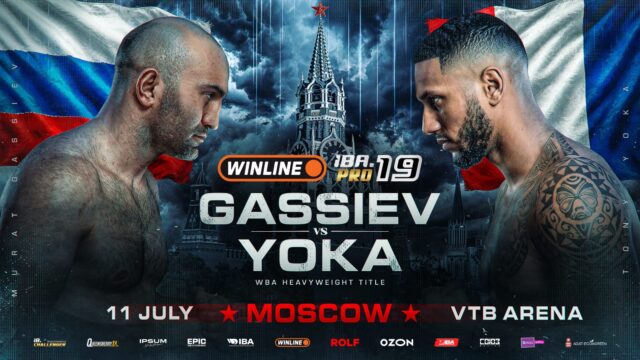
WBA Heavyweight Champion Murat “Iron” Gassiev (33-2, 26 KOs) will defend his title against Rio 2016 Olympic gold medallist Tony Yoka (15-3, 12 KOs) in the main event of IBA PRO 19 on Saturday, July 11, 2026, at the VTB Arena in Moscow.

The heavyweight showdown will headline one of the strongest IBA PRO fight cards of the year, featuring world title fights, top contenders, Olympic champions and rising stars from across the globe.

For Gassiev, the bout will represent the first defence of the WBA heavyweight title he captured with a sixth-round knockout victory over Kubrat Pulev at IBA PRO 13. The 32-year-old Russian became his country’s first heavyweight world champion in more than a decade and now returns to fight on home soil in front of Moscow fans. Now, the man fittingly nicknamed ‘Iron’ returns home to defend the belt that Russia waited thirteen years to reclaim.

Yoka, meanwhile, enters the fight aiming to become France’s first-ever professional heavyweight world champion. The 34-year-old Olympic champion coached by Don Charles, who brought up and led to the top of heavyweight stars Derek Chisora and Daniel Dubois, remains one of the most recognisable heavyweight names in European boxing thanks to his elite amateur pedigree, technical style and knockout power.

*Murat Gassiev, WBA* *Heavyweight champion:*

“Tony Yoka is an Olympic Champion. He is a big, strong, experienced boxer with a solid amateur background. He is an Olympic champion, and this definitely won’t be an easy fight. That said, I believe I have a greater desire to retain my title and to beat him. That is the most important thing – what you bring into the ring. Every time I step into the ring, I come with the desire to win and do everything possible to get that victory. I would like to thank both my team and the IBA President, Umar Kremlev, for this opportunity. On July 11, the people of Moscow will see the best version of Murat Gassiev – and I promise them fireworks.”

*Tony Yoka, Olympic champion, BoxRec #1 Heavyweight in France:*

“I’m going to win this world title for all my people in France and Congo that have not only stuck with me, but still believe in me becoming a professional world champion. I’ve been working hard for over two years now with Don Charles and I’m ready to showcase to the boxing world the changes in my professional boxing. I want to thank Don and my team for backing me 100% through this period, as well as Frank and George Warren at the best promoters in the world, Queensberry, for getting me this opportunity which I will make the most of.”

*Umar Kremlev, President of the International Boxing Association (IBA):*

“The IBA is incredibly proud to bring a heavyweight super fight of this magnitude to Moscow. Murat Gassiev and Tony Yoka represent the absolute pinnacle of boxing excellence – one an incredible WBA world champion defending his crown at home, the other an Olympic gold medallist fighting for the professional history of his nation. This event represents everything the IBA stands for: providing the ultimate platform for the world’s premier talent to compete at the highest level.”

Tickets for IBA Pro 19 are available at the link.

Courtesy IBA

LAGOS FALLS IN NAIROBI: KENYA DOMINATES NIGERIA IN 1971 RING CLASSIC PACKED TO CAPACITY

0
Kenya's Sammy Mbogwa (left in another international bout) won both his bantamweight fights against Nigeria's Monday Addis in Lagos and Nairobi. Kenya defeated Nigeria 9-2 bouts in a Jamhuri Cup International match at the City Hall in 1971.

▪️Gallant Kenyan boxers hammer Nigeria 9-2 bouts in a Jamhuri Day celebrations match

May 27, 2026

The highly anticipated return leg match between Kenya and Nigeria in 1971 was packed to capacity at City Hall. Charges were Ksh5, 10/-, 15/- and 20/- .

I was among the fans who witnessed this exciting Jamhuri Day celebrations match. The boxing bug had already caught up with me. So my dad, a staunch boxing fan, had no choice but to take me along for the show. We watched the action from the balcony of the packed City Hall.

Nigeria defeated Kenya 7-4 bouts in the first leg contest in Lagos. The Kenyans were armed to the teeth for the return match, eager to avenge the Lagos defeat.

Back in the team was 1970 Commonwealth Games welterweight silver medallist John Olulu who clinched the Kenya Open title at the YMCA, Shauri Moyo Gym ahead of the Kenya vs Nigeria contest. Olulu beat the tough Airforce soldier Joseph Onyango in the finals.

Most of the boxers who represented Kenya in Lagos skipped the Kenya Open with an exception of flyweight Peter Munyogi, light-heavy Steve Thega and heavyweight Zack Amalemba. Munyogi outpointed George Findo in the finals, Thega beat Henry Muchorwa and Amalemba lost to his rival Fred “Sachi” Sabat.

Newly-crowned national lightweight champion Karilus Owino,
who was named the Best Boxer in the Kenya Open, replaced the injured Kamau Mbugua while Olulu stepped in for Stephen Baraza whose cut sustained in Lagos had not yet healed.

The Kenyans camped at the Prisons Staff Training College Gymnasium under coach Sammy Ouma.

Nigeria also made slight changes, bringing in warhorse Kayin Armah for 1966 Commonwealth Games and Africa bantamweight champion Eddie Ndukwu at featherweight and 1966 Africa light-heavyweight champion and 1970 Commonwealth Games gold medallist Fatai Ayinla to face heavyweight Fred Sabat with Armah pitted against the stylish John Nderu, a bronze medallist in the 1966 Commonwealth Games. Armah met Kenya’s legendary Philip Waruinge in the 1966 Africa Championships in Lagos, giving Waruinge some anxious moments but the Kenyan prevailed with a unanimous points victory. Waruinge, who won gold and the Best Boxer Trophy, told me in one of our several interviews the Nigerian was the toughest boxer he fought in the Lagos event.

In addition to John Olulu, other top boxers in the Kenya team were 1970 Commonwealth Games bantamweight silver medallist Sammy Mbogwa, Commonwealth Games bronze medallist David Attan and Steve Thega, a dreaded body puncher.

Kenya taught Nigeria painful boxing lessons, winning by 9-2 bouts and an aggregate of 35-31 points in the two-legged match. It was total massacre.

The Kenyans started forcefully, winning the first four bouts through light-flyweight Peter Kangethe, flyweight Peter Munyogi, bantamweight Sammy Mbogwa and featherweight John Nderu.

Kangethe put up a masterclass show to outpoint Saliou Ishola for the second time having beaten the Nigerian in Lagos. He was named the Best Boxer.

Southpaw Munyogi avenged the Lagos defeat by Quarsi Martins, dictating the fight in the first and second rounds. Martins made a late rally in the third round but by then a tired Munyogi, who received an eight count, had done enough spadework to win on points.

Mbogwa dominated the bantamweight bout for his second consecutive win over Monday Addis while John Nderu outpointed Kayin Armah.

Nigeria finally won their first fight of the night when their dangerman lightweight Obisia Nwankpa floored debutant Karilus Owino twice and then the towel came flying in. Owino carried the fight to the southpaw Nwankpa soon after bell with rapid combinations that it seemed Nwankpa had met his match. He however changed the tide midway through the first round landing good left shots forcing the referee to give Owino an eight standing count. He floored the Kenyan twice before coach Sammy Ouma threw in the towel to save Owino from Nwankpa’s ruthless fists.

John Olulu put Kenya back on the winning trail outpointing Carl Bobo in an action-packed light-welterweight bout.

Welterweight soldier Dick “Tiger” Murunga avenged the Lagos defeat by Joe Mensah who made one trip to the canvas in the second round, courtesy of Murunga’s heavy left punch to the chin. It was the second international fight for Murunga who made his debut in the first leg, and from his impressive show he won the hearts of fans and the selectors. The following year Murunga won gold in the Africa Championships in Nairobi and a bronze medal in the Munich Olympics.

Skipper David Attan punished Vincent Igbokuru throughout the fight to win the light-middleweight duel on points while at middleweight Frank Theuri outpointed M.Hassan.

Light-heavyweight Steve Thega maintained his sterling performance he displayed in Lagos where the bow-legged Kenyan beat the highly regarded Isaac Ikhuoria. This time Emmanuel Duke dropped down to light-heavy after stopping Kenya’s Zack Amalemba in Lagos in the heavyweight division.

The first round saw the Kenyan digging deep with a short uppercut to Duke’s solar plexus dropping him to the canvas. Thega upped his workrate in the second round in which the Nigerian got a standing count of eight after which Thega again dug in with another right punch to the solar plexus that forced the referee to stop the fight to avoid a possible disaster.

In an interview with Thega at Biafra Estate in Nairobi before he passed on, he told me he really felt sorry for some of his opponents whom he said urinated blood after fighting him as a result of his energy-sapping body punches. He remains Kenya’s most lethal body puncher.

Nigeria notched their second win through heavyweight Fatai Ayinla who easily stopped Fred Sabat in the first round. The Kenyan was warned by the referee for persistent holding.

Battered and bruised, the Nigerians quietly returned home looking ahead to the 1972 Africa Championships in Nairobi.

IS EATING A WAY OF LIFE IN AFRICAN SPORTS OR IT’S JUST PURE GREED?

0

◾Ghana’s African Games hit by $40m audit bombshell over inflated costs and missing works

May 26, 2026

A forensic audit into Ghana’s hosting of the 2023 African Games has uncovered more than $40 million in avoidable expenditure, casting a shadow over one of the continent’s biggest multi-sport events.

The audit, commissioned by President John Dramani Mahama and sighted by Joy Sports, detailed widespread irregularities, inflated claims and questionable variations tied to infrastructure projects for the Games, which were staged from February to March 2024.

According to the report, the biggest concerns centred around the Borteyman Sports Complex, where auditors estimated an “opportunity cost for scope shrinkage” of $34.43 million from the project’s original contract value of $145.09 million.

The Audit Service revealed that several key components initially captured in the contract were either omitted completely or drastically reduced despite the huge financial outlay.

Among the omitted works were a warm-up football field valued at $3.213 million, lecture hall conversions worth $3.06 million, and both single and double-lane access roads, each estimated at $11.22 million.

Drainage systems, electrical substations, sidewalks, playgrounds, CCTV installations and irrigation systems were also either scaled down or removed from the final scope.

In spite of the reduced scope of work, consultant supervision fees reportedly increased from three percent to 3.83 percent after the rescoping exercise, a development auditors flagged as questionable.

The report also scrutinised the redevelopment of the University of Ghana Stadium, where claims amounting to $2.814 million were classified as avoidable costs arising from delays and contract variations.

Auditors highlighted over $388,000 in interest on delayed payments, $1.136 million in prolongation costs due to a 10-month extension, and nearly $770,000 linked to cost adjustments.

Although the stadium project reportedly achieved 108 percent of its intended scope, the audit pointed to discrepancies between consultant records and Interim Payment Certificates.

The Games Village project, centred on the refurbishment of University of Ghana hostels, also came under severe criticism.

Auditors estimated an additional $1.717 million in avoidable expenses, with one of the most contentious claims being $1.176 million for repainting works already covered under the original contract.

The Audit Service questioned how the hostel facilities could have deteriorated within a few months to justify repainting at such enormous cost.

Additional expenses for canteen works, bedding materials, transportation bay coverings and extension of project timelines were also flagged, with auditors stating there was insufficient documentation to verify the reasonableness of several claims.

Elsewhere, the construction of the access road to the Achimota Cricket Oval drew intense scrutiny after auditors estimated potential savings of GH¢4.376 million if standard Department of Urban Roads rates had been used.

Major disparities were discovered in excavation, road surfacing, pavement and drainage costs charged by contractors, while auditors also questioned whether the swampy site conditions cited to justify some costs actually existed.

The Achimota Cricket Pavilions project was similarly criticised for unconventional Bills of Quantities structures and arithmetic inconsistencies that auditors said made proper valuation difficult.

Overall, the Audit Service estimated avoidable costs exceeding $38.96 million and GH¢6.33 million across the African Games infrastructure projects reviewed, raising fresh concerns over transparency and financial accountability in the organisation of the continental sporting event.

Source: Joy Sports

Author: Maxwell Kumoye

ESWATINI NAMES KINGDOM’S BEST BOXERS TO JAB AND JIVE THEIR WAY TO VICTORY IN NAMIBIA

0
Eswatini's captain Thabiso Dlamini (left) at the 2018 Commonwealth Games in Gold Coast, Australia. He leads a strong team of 10 boxers to Namibia for the 2026 Zone 4 Boxing Championships from June 15-21.

Countdown to the 2026 IBA Africa Zone 4 Boxing Championships in Namibia, June 15-21

▪️Longest-serving international Thabiso Dlamini leads a strong team of 10 boxers in this year’s Zone 4 Boxing Championships 

May 25, 2026

The wait is over. It’s now the fists to do the talking as Eswatini names a formidable national boxing for the IBA Africa Zone 4 Championships in Katima Mulilo, Namibia, from June 15-21.

Katima Mulilo is the capital of the Zambezi Region in Namibia. The charming tourist town is located on the banks of River Zambezi. It’s been picked to host Zone 4 Championships because of its proximity to other Southern African countries some of which can even travel by road.

Announcing the 10 boxers – two women and eight men – heading to Namibia, Eswatini Boxing Association Secretary-General Nkosinathi Dlamini said the regional tournament will serve as a crucial build-up and development platform for Southern African boxers preparing for the 2026 Commonwealth Games in Glasgow.

“They’re currently training at Eswatini Fitness Centre in Matsapha next to Police College, all the boxers are in high spirits,” Nkosinathi told boxersworld.co.ke in a telephone interview.

Leading Eswatini’s quest for glory is the longest- serving international boxer Thabiso Dlamini, one of the three medallists in the 2025 Zone 4 event in Maputo retained in the team. He has represented the national team from 2010 and is the face of Eswatini boxing.

Thabiso won a silver medal in last year’s Zone 4 Championships at light-welterweight but has now moved up to welterweight.

Eswatini finished second with five silver and three bronze medals in the 2025 Zone 4 in Maputo with hosts Mozambique retaining the overall title winning 10 gold, five silver and three bronze medals, Botswana placed third 2-2-3, Lesotho 2-2-1 and Seychelles fifth 1-1-0.

In addition to Thabiso, the other two medallists in the Maputo event retained in the Namibia-bound squad are Mandela Cup silver medallist Veliswa “Shotgun” Magaya and light-middleweight Lindelwa Fakudze both of whom won silvers in Maputo 2025 and are the two female boxers picked to do duty in Namibia. Veliswa has moved up from flyweight to featherweight.

Newcomer in the team is middleweight Tsepo Dlakudze who is making his international debut.

Flyweight Lihle Sithole and bantamweight Siboniso Vlakati previously represented the national team in the Region 5 Youth Games in Namibia but have now graduated to the senior team. It will be their first time to take part in an elite tournament.

Light-middleweight Sibonelo Ndzimandze is another long-serving international in the team heading to Katima Mulilo.

Here’s Eswatini’s team heading to Namibia:

1. Lindelwa Fakudze (female ) – 70 kg

2. Veliswa Magaya (female) – 57 kg

3. Lihle Sithole – 51 kg

4. Siboniso Vilakati – 54 kg

5. Mukelo Dlamini – 57 kg

6. Qhawe Gamedze – 60 kg

7. Phelindaba Gamedze – 63.5 kg

8. Thabiso Dlamini – 67 kg

9. Sibonelo Ndzimandze – 71 kg

10. Tsepo Dlakudze 75 kg

Coaches

1. Mbingo Mpendulo head coach

2. Zikalala Douglas assistant coach

Eswatini’s medallists in the 2025 Zone 4 Championships:

Silver

Thabiso Dlamini 63.5kg

Andiswa Sibandze 60kg

Lindelwa Fakudze 70kg w

Veliswa Magaya 54kg w

Nhlanhla Dlamini 51kg

Bronze

Sifiso Ngwenya 71kg

Mpilo Dlamini 57kg

Khayelihle Mkhambela 67kg

Eight countries have so far confirmed participation, according to Zone 4 Secretary-General Taolo Tlouetsile. They are Namibia, Malawi, Lesotho, Zambia, Seychelles, Comoros, Eswatini and South Africa.

Countries yet to confirm are defending champions Mozambique, Botswana, Madagascar, Mauritius, Angola and Zimbabwe.

Photo courtesy Getty Images

AFRICA GIVEN ONLY 14 SLOTS IN 2028 LA OLYMPICS WITH THE LUCKY ONES BANKING ON UNIVERSALITY QUOTAS

0

▪️Africa has officially been allocated 14 direct qualification slots (one per weight category) for the Continental Qualifier of the 2028 Los Angeles
Olympic Games.

May 24, 2026

The International Olympic Committee (IOC) and World Boxing have confirmed a total of quota places spanning across equal weight categories.

Africa and Oceania have each been allocated 14 quotas. In their continental qualifiers, each will provide exactly 1 quota spot per weight class.

The regional qualifiers distribute 112 quota places (56 for men, 56 for women). The allocation per continent is based on the number of quota spots awarded in each of the 14 weight classes.

At the 2024 Paris Olympics, Africa was represented by 23 registered boxers following the last-minute withdrawal of Ethiopia’s Yadesa Leta who replaced injured Nigerian featherweight Omole Dolapo. Eventually the number was reduced to 22 after Nigeria’s African Games lightweight champion Cynthia Ogunsemilore was removed on doping allegations.

Initially, the qualifiers were 24. Algeria led with five boxers, Morocco and Egypt three each, DR Congo, Nigeria, Cape Verde, Mozambique and Zambia two each with Mali and Tunisia having one each. In the continental qualifiers, Africa was allocated 18 slots. For LA Olympics they’ve been cut down to 14.

The 2028 LA Olympics slots:

Africa: 14 places (1 spot per weight class per gender)

Asia: 28 places (2 spots per weight class per gender)

Europe: 28 places (2 spots per weight class per gender)

Oceania: 14 places (1 spot per weight class per gender)

Pan-America: 28 places (2 spots per weight class per gender)

Women’s classes: 51kg, 54kg, 57kg, 60kg, 65kg, 70kg, and 75kg.

Men’s classes: 55kg, 60kg, 65kg, 70kg, 80kg, 90kg, and +90kg).

Qualifying for the Olympic Games will take place across four phases, giving African boxers multiple opportunities to secure a spot:

The World Boxing Championships scheduled for April, 2027, in Astana, Kazakhstan, will be the first opportunity, offering a combined total of 44 spots.

To be eligible to participate in the LA28 Olympic Games boxing tournament, athletes must have been born between 1 January 1988 and 31 December 2009.

2027 World Championships (44 Quotas)

The World Championships will be the first Olympic qualifying event, offering 44 quota spots across the 14 medal events — 4 spots each in 8 categories and 2 spots each in 6 categories.

All the semi-finalists in the first four Olympic weight categories (both men’s and women’s) will secure a quota spot, while only the finalists will earn quotas in the remaining categories.

Note: In boxing, the quota spot belongs to the individual boxer who earns it, which means that the same boxer will represent their country at the Olympics.

2028 Regional Qualifiers (112 Quotas)

After the World Championships, each of the five federations – Africa, Asia, Europe, Oceania, and Pan-America will hold its Individual Continental Qualifiers.

Africa and Oceania qualifiers will offer 1 quota spot in each of the 14 weight categories, while Europe, Pan-America, and Asia will offer 2 quota spots in each category per gender.

2028 World Qualifier-1 (46 Quotas)

The boxers who have yet to qualify for the Olympics via the World Championships & Continental Qualifiers will fight at the World Qualifiers-1.

It will offer 4 quotas each in 9 weight categories (Women’s 57-65-70-75Kg & Men’s 65-70-80-90-90+Kg) and 2 quotas in the other seven weight categories.

Host Quotas (1-6 Quotas)

The host country will be guaranteed a maximum of six quota places, three for women and three for men.

After the completion of the respective continental qualification tournament and the first World Qualification Tournament, the host country will be asked to confirm any quota places allocated to it via this tournament.

If the host nation has not won any quota spots earlier, it will be allocated up to 6 quotas. If it has already earned some, that number will be deducted from 6 to determine the remaining host quotas available.

Universality Quotas (8 quotas)

Eight universality places (four per gender) are made available to eligible NOCs, but that particular boxer has to participate in at least one of the above-mentioned boxing qualification tournaments.

2028 World Qualifier-2 (28-36 Quotas)

The second World Qualifier will be the last chance for the boxers to earn an LA Olympics Quota.

There will be 2 to 4 quota spots available at the final qualifier, depending on how many hosts quota USA will be taking on prior to this tournament.

Example: If the USA has already won a men’s 55kg quota through any of the qualifying events, there will be 3 quotas in this category at World Qualifier 2. But if they secure it via the host quota, then only 2 will be allocated.

boxersworld.co.ke

SPARKLING SIERRA LEONE’S JOSEFIEN BETIST WINS HER THIRD GOLD MEDAL IN GERMANY

0
Josefien Betist is enjoying top form ahead of the 2026 Commonwealth Games in Scotland

▪️Josefien stood proudly on the top of the podium with Sierra Leone’s national anthem ringing out around the stadium. She was thrilled with her win, and said the three gold medals are a big morale booster in her preparations for the Commonwealth Games in Scotland

May 22, 2026

Sparkling Sierra Leone”s top female boxer,Josefien Betist, has taken her tally to an amazing three gold medals in the last six months.

It all started at the Winter Box Cup Manchester, England, in December 2025. She maintained her tremendous form with her second gold at Riga Ladies international Box Cup Latvia in March 2026 and added her third gold medal in Rostock Germany, winning 60kg Elite Female class at the Internationaler Greifenpokal 2026.

Josefien stood proudly on the top of the podium with Sierra Leone’s national anthem ringing out around the stadium. She was thrilled with her win, and said the three gold medals are a big morale booster in her preparations for the Commonwealth Games in Scotland later in the Summer where she hopes to bring home a Commonwealth gold medal to Sierra Leone.

“I’m very happy with the progress we made over the last year. So the gold medals are just the proof for me that everything is working and that with enough patience I’ll get better and better each day,” Josefien told boxersworld.co.ke in a phone interview.

So what’s next for Josefien after minting three gold medals?

“I’m now focusing on the Commonwealth Games in Glasgow. As to who my rivals will be? I don’t know,” she said, adding:” I don’t really care either. I want to focus on being the best boxer I can possibly be right now and show everyone that I belong at this level of boxing. So I’m not busy with who my rivals might be, I’m busy with who I might still become before it’s go time.”

Her burning ambition is to qualify for LA 2028 to become Sierra Leone’s first female boxer to participate in the Olympic Games.

As usual, Josefien is in Ireland where she spends six days a week, two sessions per day to try and fulfill her dream. She is grateful for the support from her government, Sierra Leone Boxing Association and the SLE National Olympic Committee.

Josefien is indeed an inspiration to the current and upcoming Sierra Leone female boxers who are eager to emulate her.

AYALA STOPS MAMA; NIGERIA’S OYEKOLA TKO’s ROMERO AS IBA PRO 18 DELIVERS DRAMATIC NIGHT IN MEXICO CITY

0

▪️Ridwan “Scorpion” Oyekola stings Mexico’s Manuel Romero with a barrage of earth-shaking combinations forcing the referee to wave it off in the first round

May 22, 2026

IBA PRO 18 delivered a dramatic night of professional boxing at Arena CDMX, with a series of stoppages, strong performances from Mexican fighters and a decisive finish in the main event.

The stacked fight card brought together boxers from Mexico, the Philippines, Colombia, Argentina and Nigeria, with prospects, established contenders and international match-ups across several weight divisions.

Chris Roberts OBE, CEO of the International Boxing Association, said:

“Mexico City has always been a place where boxing culture thrives, and bringing IBA PRO 18 to the iconic Arena CDMX reflects our continued commitment to professional boxing on the global stage. Tonight, we showcased not only elite athletes, but also the strength, passion and unity of our sport. The supporters and fans witnessed a truly spectacular night of boxing.”

Ayala Lardizabal finishes Mama with body shot

The evening was headlined by Mexico’s Angel Ayala Lardizabal, known as “Cameleon”, who stopped the Philippines’ Jayson Mama with a body shot in the fifth round of their bantamweight contest.

From the opening round, the two fighters produced a fast-paced battle, with both men trying to win the contest of speed. Ayala Lardizabal made good use of his longer reach, while Mama boxed intelligently on the counter and remained dangerous in the exchanges.

In the second round, Ayala Lardizabal began to put his punches together in combinations and increased the power in his attacks. Mama stayed competitive, but the Mexican took more of the key moments and worked effectively to the body.

Mama slowed his opponent slightly in the third round, forcing Ayala Lardizabal to work harder for his openings. The Mexican briefly changed his approach, switching to southpaw and trying to draw Mama on to him, before returning to front-foot pressure.

The decisive moment came in the fifth round, when Ayala Lardizabal landed a devastating shot to the liver. Mama went down and was unable to recover, giving the Mexican a knockout victory in the main event.

Fierro overwhelms Sanchez in co-main event

In the co-main event, Jonathan Fierro produced a dominant performance against Sergio Chirino Sanchez. Fierro started aggressively, pushing Sanchez towards the ropes and landing short, powerful combinations, with his left hand doing serious damage to both head and body.

Sanchez showed toughness and tried to fire back, but Fierro was faster, sharper and heavier-handed. By the fourth round, Fierro was still in full control, repeatedly breaking through Sanchez’s guard.

The fifth round opened with another heavy left hand from Fierro, who continued to land strong single shots and powerful two-punch combinations. Sanchez absorbed plenty of punishment, but the pressure was one-sided, and his corner decided not to send him out for the sixth round.

Mercado makes statement in Mexico City

Mexico’s Yamileth Mercado, one of the most accomplished fighters on the card, also delivered a statement performance against Colombia’s Flor Valentina Rodriguez. Mercado, a WBC champion with multiple title defences and a résumé that includes a bout with Amanda Serrano, used her size, experience and pressure from the opening bell.

Rodriguez defended well in the first round but could not match Mercado’s output. In the second, Mercado increased the tempo and overwhelmed her opponent with a wave of attacks, forcing the referee to step in and stop the bout.

Martinez shows speed and precision

Another standout Mexican performance came from Miguel Angel Martinez, who stopped Argentina’s Nicolas Blanco in the third round. Martinez, still early in his professional career but with a strong amateur background, immediately took control as a southpaw, pushing Blanco towards the ropes and beating him with speed, volume and accuracy.

Two knockdowns in the second round showed the growing gap between the fighters. In the third, Martinez continued to attack the body with force, and after another heavy sequence, Blanco dropped to his knees and could not continue.

Oyekola strikes early against Romero

Nigeria’s Ridwan Oyekola, known as “The Scorpion”, made a strong impression against Mexico’s Manuel Alex Romero. Romero took the centre of the ring early, but Oyekola repeatedly punished him with sharp jabs before suddenly increasing the tempo late in the opening round. With Romero under heavy pressure, the referee intervened to stop the contest.

Mendoza forces stoppage after Eusse cut

In the lightweight division, Tomas Mendoza defeated Cristian Alberto Eusse after a strong start. Mendoza, boxing from the southpaw stance, quickly found his distance and landed clean straight shots. Eusse responded and the bout became an open exchange, but Mendoza’s left hand caused serious problems in the second round.

By the end of the round, Eusse had suffered a cut near his right eye. After the interval, the doctor examined the Spaniard and the contest was stopped.

Cantabrana uses size and pressure

Earlier in the evening, Francisco Cantabrana stopped Jordi Omar Villa Soto in their light heavyweight bout. Cantabrana used his height and physical advantages from the start, landing heavy shots to the body and head while Soto spent long spells behind a high guard.

Soto tried to make the contest more uncomfortable in the third round, but Cantabrana continued to attack in combinations until the referee stepped in.

Mendez opens the night with stoppage win

The opening bout saw Julian Mendez stop experienced Joseph Martinez in the third round of their super welterweight contest, setting the tone for a night defined by pressure, pace and decisive finishes.The night also featured the appearance of legendary ring announcer Jimmy Lennon Jr., adding another major boxing touch to IBA PRO’s first major showcase in Mexico City.

Courtesy IBA

IBA PRO 18 TO SET ABLAZE MEXICO CITY HEADLINED BY HOMEBOY ANGEL AYALA VS FILIPINO JAYSON MAMA

0

▪️The card also features a 10-round women’s featherweight bout, as Mexico’s Yamileth Mercado takes on Colombia’s Flor Valentina Rodriguez

May 21, 2026

The final formalities are complete ahead of IBA PRO 18, as the fighters took part in the official weigh-in in Mexico City before Thursday’s fight night at Arena CDMX, which will be broadcast live on the official IBA YouTube channel.

The weigh-in was staged at Plaza Garibaldi, one of the capital’s most recognisable cultural locations, adding a distinctly Mexican atmosphere to fight week. With mariachi music, public access and a strong local turnout, the ceremony underlined the scale of IBA PRO’s arrival in Mexico.

IBA PRO 18 will be headlined by Mexico’s Angel Ayala Lardizabal, known as “Cameleon”, who faces Filipino contender Jayson Mama in a 10-round bantamweight bout. The main event brings together Ayala’s technical quality and Mama’s aggressive, high-pressure style in one of the key international match-ups of the night.

Another major attraction will see Jonathan Fierro meet Sergio Chirino Sanchez in an eight-round lightweight contest between two experienced Mexican fighters with strong knockout records.

The card also features a 10-round women’s featherweight bout, as Mexico’s Yamileth Mercado takes on Colombia’s Flor Valentina Rodriguez.

The fight card brings together boxers from Mexico, the Philippines, Colombia, Argentina and Nigeria, with prospects, established contenders and international match-ups across several weight divisions.

*IBA PRO 18 fight card*

Angel Ayala Lardizabal vs Jayson Mama — bantamweight, 10 rounds

Jonathan Fierro vs Sergio Chirino Sanchez — lightweight, 8 rounds

Yamileth Mercado vs Flor Valentina Rodriguez — featherweight, 10 rounds

Miguel Angel Martinez vs Nicolas Blanco — welterweight, 6 rounds

Manuel Alex Romero vs Ridwan Oyekola — welterweight, 8 rounds

Cristian Alberto Eusse vs Tomas Mendoza — lightweight, 8 rounds

Jaqueline Calvo vs Luz Elena Gerardo — super flyweight, 8 rounds

Francisco Cantabrana vs Jordi Omar Villa Soto — light heavyweight, 6 rounds

Julian Mendez vs Joseph Martinez — super welterweight, 6 rounds

NIGERIA’S FORMER CHICKEN SELLER OYEKOLA TODAY BATTLES MEXICO’S ROMERO IN STACKED IBA.PRO CARD

0

▪️”My life has totally changed in Mexico people appreciate me unlike back home. I’m now living in my own house not like in Japan where I was sleeping in the gym,” says Oyekola

May 21, 2026

Former Nigerian poultry hawker and commercial motorcycle (okada) rider, Ridwan “Scorpion” Oyekola today, May 21, 2026, faces Mexican boxer Manuel Alejandro Romero in a stacked IBA Pro card welterweight clash. The thrilling showdown takes place at the iconic Arena CDMX in Mexico City, Mexico.

“I know nothing about my opponent, I’ll just go there fight him and win,” Oyekola told boxersworld.co.ke in an interview from Mexico.

“They know me here as a tough fighter, so my opponent should be ready to absorb punishment.”

Oyeko is fighting in one of the undercards of IBA.Pro 18 card headlined by Mexico’s Angel Ayala aka Chameleon vs Filipino contender Jayson Mama in a 10-round bantamweight fight.

The Nigerian boxer moved to Mexico from Japan where he says life was not a bed of roses.

“In Japan I used to sleep in a gym, a lot happened to me there it was not easy. I was badly managed, people back in Nigeria think I was living well but I can say with a big NO!, life was not easy I was badly handled by my countryman he was speaking Japan, I didn’t understand anything so he signed a contract behind my back.”

Moving to Mexico changed all this for the 29-year-old Oyekola.

“Life in Mexico is good I’m living comfortably in my own house, and people here appreciate me unlike back home in Nigeria,” says Oyekola

Oyekola’s journey to the international boxing stage is a remarkable tale of grit and determination. Before becoming a celebrated professional pugilist, Oyekola navigated the bustling streets of Nigeria as a poultry hawker and later an okada (motorcycle) rider. Today, his formidable punching power and relentless work ethic have earned him the nickname “Scorpion.” He is stepping into enemy territory in Mexico City, eager to prove that champions can be forged from the humblest of beginnings.

Standing opposite “Scorpion” is Manuel Alejandro Romero, a tough Mexican fighter ready to defend his home turf.

Which is Oyekola’s lowest moment in life?

He recalls one fateful rainy day, while carrying live chicken and turkey in Lagos, he slipped and fell directly into an open drainage gutter. Soaking wet and covered in dirt, cradling the surviving bird in his arms, the sheer humiliation and struggle of his situation hit him hard.

At that moment, he decided the chaotic streets of Lagos weren’t going to break him. He pivoted away from the daily grind of the city and headed back to his familiar base in Ibadan, Oyo State, and ventured into motorcycle business.

“It was a very sad day for losing all my chicken and turkey when I fell in the gutter, I went back to Ibadan to collect installment bike to feed myself before boxing gave me a future,” recalls Oyekola.

Every day, he navigated the dusty roads of Ibadan, splitting his time between riding the bike to make daily boundary payments and enduring grueling practice sessions in the gym.

His relentless discipline inside and outside the gym culminated in him capturing the World Boxing Federation (WBF) International Super Featherweight Championship in December 27, 2020 at the Ilaji Sports Resorts in Ibadan with an impressive unanimous points win over Argentine Lucas Mattias Montessino.

“He was a good boxer I respect Montessino but I was better than him, and the cheering crowd inspired me.”

And when did Oyekola start boxing?

“I started boxing in 2007, my coach was called Habeeb that’s how people used to call him then, that’s my first coach in Ibadan,” Oyekola told me in our phone chat.

A beating he got from a boxer who bullied him with his girlfriend pushed him to the gym to learn the sport.

“There’s a day I was walking with my girlfriend in the streets then one small boy misbehaved to my girlfriend, I tried to fight him but he beat up because he was a boxer, and I decided to go to the gym to learn boxing.”

He turned pro in 2017 after winning several accolades in amateur boxing.

I ask Oyekola who is his inspiration in the bare-chested game?

“The best Nigerian boxer who inspired me is now dead, he was called Akeem Sadiku Dodo,” he says

Oyekola told boxersworld.co.ke the Mexican pro boxing body has cleared him for today’s fight, and has been training at the Garmes Gym under coach Jonathan Ricardo Garcia.

Oyekola’s parting shot before stepping into the ring tonight was to shower the IBA with praise for their remarkable contribution to the growth of boxing worldwide, urging the illustrious and successful world body to keep on including more African boxers in IBA.Pro series expressing his delight for the good purse.

“I thank the IBA for inviting me to their card to represent the rest of Africa, they’re doing a very good for our continent under President Umar Kremlev,”

NAMIBIA’S NDEVELO DISAGREES WITH AFRICAN BOXING BODY ON BOXERS BOYCOTTING IBA TOURNAMENTS

0
Namibia's star boxer Tryagain "The Issue" Ndevelo (left) in a past international tournament. He has told officials not genuinely interested on the welfare of the African boxers to shape up or ship out.

▪️”Boxers need hope and more tournaments, not boycotts. If they truly care about African boxing, they would strengthen tournaments, not sabotage them,” says Ndevelo

May 19, 2026

Namibia’s African featherweight champion, Tryagain “The Issue” Ndevelo, has disagreed with WB-affiliated African Boxing’s directive barring their affiliates from taking part in IBA Africa tournaments.

And while the African Boxing body leaders caution their affiliates on taking part in IBA Africa tournaments, boxersworld.co.ke has reliably been informed World Boxing – now under celebrated boxer Gennadiy Golovkin – has never issued any official directive stopping its affiliates from taking part in IBA tournaments.

“This is absolutely not within WBs constitution, it’s just Africans foolishly eating themselves up directly,” says an authoritative source.

“Boxers need hope and more tournaments, not boycotts. If they truly care about African boxing, they would strengthen tournaments, not sabotage them,” says Ndevelo.

In a letter doing rounds on social media, the Secretary-General of African Boxing, Cyprien Tamo, cautions their affiliates from hosting or taking part in IBA tournaments. Here’s the letter which, surprisingly, is not in the organisation’s letterhead.

Dear African Boxing Leaders

We use this opportunity to strongly call on all National Federations affiliated with World Boxing to exercise utmost caution regarding the hosting of, or participation in, any IBA-organized event in any capacity. Such actions may constitute a violation of the African Boxing Disciplinary and Ethics Code, World Boxing policies on National Federation alignment, and IOC recommendations.

All member federations are therefore urged to take this matter with the utmost seriousness and ensure full compliance with the governing regulations and directives.

Cyprien TAMO

Secretary General African Boxing

Contacted for confirmation on phone, African Boxing President Solomon Kargbo, did not respond. At the time of publication he was still mum.

Reacting to this directive, Ndevelo, a gold medalist in the featherweight division at the 2024 African Elite Men’s and Women’s Championships in Kinshasa, DR Congo, said he was totally against the directive because it’s the boxers who will suffer not IBA, suggesting the proponents of this boycott should quit if they don’t have the interests of boxers at heart.

“Boycotts only make sense when they protect athletes. But these pessimists are doing the opposite — they’re trying to limit opportunities, not expand them,” said Ndevelo in a telephone interview with boxersworld.co.ke from his base in Namibia.

He went on: “African boxing is still developing; every international ring is a classroom, a showcase, and a stepping‑stone. Cutting boxers off from IBA tournaments doesn’t punish IBA — it punishes the African boxers who needs exposure, ranking points, and experience. If they truly cared about African boxing, they would strengthen tournaments, not sabotage them.”

Ndevelo, speaking for the silent majority, said African boxers are fed up of these turf wars between some African boxing leaders who seem to have their own selfish agenda not focused on benefiting the boxers.

“African boxing has suffered enough from internal sabotage. If an official’s ego is bigger than their commitment to athletes, they should step aside and let genuine leaders with a passion for boxing take charge.

“Boxers want fights, rankings, medals, exposure and lucrative opportunities.”

He moves on: “No boxer trains at 5 am to boycott tournaments. No boxer bleeds in sparring to stay home. No boxer dreams of politics — they dream of podiums.

Ndevelo said Southern Africa boxers were all looking forward to IBA Africa Zone 4 Championships to be hosted by Namibia.

“Zone 4 is not just another tournament — it’s:

– a ranking opportunity

– a scouting opportunity

– a development opportunity

– a unifying platform for Southern Africa.”

The Namibian top pugilist and a host of other leading African boxers are wondering why the newly-created African Boxing body – still at its crawling stage – is not thinking big by focusing on introducing prize money tournaments to benefit the boxers rather than being petty, using boxers as pawns to settle scores which boxers are less interested in because they want genuine change in African boxing.

“What we want now from our leaders is motivation and bright ideas giving us boxers hope but telling us not to participate in IBA tournaments when we know that we have no constant competition in Africa is very demoralizing to boxers,” said Ndevelo, adding: “The fact that we have two bodies one under IBA and another one under WB is positive to me with each one of them coming up with their own tournaments to benefit boxers but not again engaging in unknown individual personal issues at our expense. As boxers we want our freedom to participate in any quality event with prize money or no prize money, we’re fed up and suffered long enough as a result of tussles which don’t benefit African boxers.”

A long-serving official in African boxing has revealed that one of the AB officials has gone full throttle to sabotage IBA Africa Zone 3 & 4 boxing tournaments to be held in Gabon and Namibia respectively.

“It’s just unbelievable how we Africans are sabotaging our own tournaments despite the fact we have a shortage of regular boxing events in Africa,” he exclusively told boxersworld.co.ke in a telephone interview, preferring to remain anonymous owing to the sensitivity of the issue and the position he holds.

“This official has contacted NOCs and the federations of Gabon and Namibia to spread malicious propaganda on IBA Africa. I’m told IBA Africa have no problem with the existence of African Boxing organisation, and are ready to work together to develop boxing in the continent.”

I ask him what’s the motive behind the AB official’s intention to scuttle the zonal tournaments.

“You see these people of AB have no money and can’t host any serious boxing event for now, so they feel embarrassed IBA Africa will be in the limelight holding two important tournaments while they’re not doing anything, in essence their aim is to see IBA Africa dormant like them, that’s how I look at it otherwise it’s a big shame for Africans to behave in such unprofessional manner fighting each other.”

That’s the sad state of Africa boxing which has for many years seen officials battling for power, back-stabbing and undercutting each other at the expense of development.

Ever since the first African boxing body was formed in 1960, no major sponsor has supported African boxing. Observers attribute the incessant wrangles, poor marketing and publicity, opportunistic officials not genuinely interested in boxing other than their selfish interests and lack of regular competitions as some of the contributing factors keeping the sponsors away.

Against this background, the big question remains: *WHICH WAY AFRICA BOXING?*