

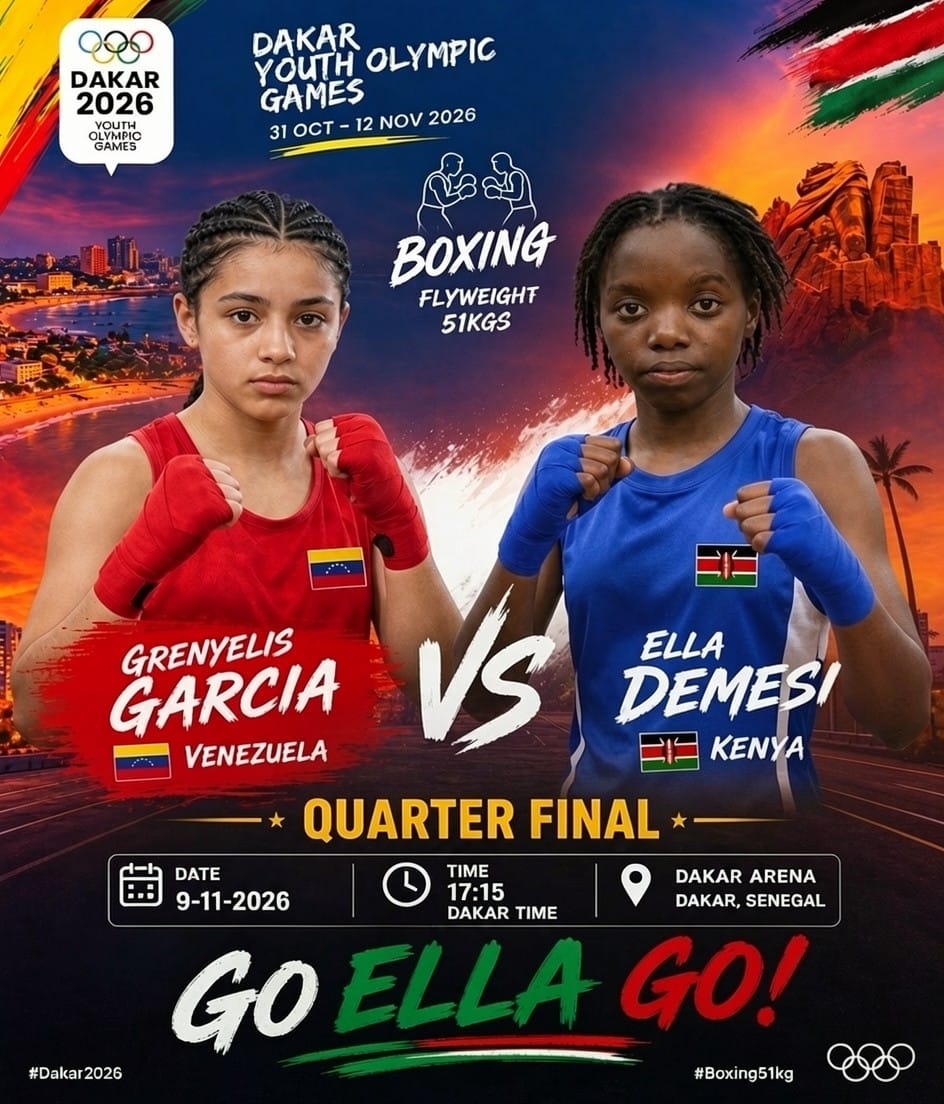
▪️”Many of us only get one or two international outings a year, whereas our opponents in Europe, Asia and Americas are constantly competing in various tournaments abroad,” says Demesi
November 24, 2026
Youth Olympian Ellah Demesi spoke to boxersworld.co.ke on her experiences in Dakar
QUESTION: What was your most memorable experience at the Youth Olympics?
ANSWER: Walking into the arena as the first-ever Kenyan boxer to qualify for the Youth Olympic Games was a feeling I will carry for the rest of my life. Coming from Kibra and seeing my name alongside the best young boxers in the world and having the Kenyan contingent cheering me on was a marvelous experience. It was a special feeling hard to describe. Even outside the ring, meeting boxers from other countries and realizing I belonged on that same stage was unforgettable.
Q: You watched most of the boxing matches. How can you compare the boxing approach of boxers from Europe, Asia, and the Americas to African boxers?
A: There is a clear difference in tactical discipline and ring tempo. Boxers from Asia especially countries like India and Uzbekistan fight with tremendous speed, sharp footwork, and high-volume combinations from the opening bell. European boxers are very structured; they control distance well, use straight punches, and rarely waste energy. Boxers from the Americas bring strong pressure, angles, and physicality. As African boxers, we have raw heart, power, and natural athleticism, but we often rely too much on trading punches rather than setting traps, managing rounds, and scoring cleanly under international judging standards. Technically we’re still behind.
Q: Africa did not win gold out of 28 boxers and had only one finalist. What’s your observation here?
A: Seeing Algeria’s Bouthaina Bensalah reach the women’s 48kg final showed that African boxers have the talent to get to the top, even though she fell short against India. However, the overall medal table tells us that the rest of the world is operating at a higher competitive frequency. Most of the medalists from Asia, Europe, and the Americas had already fought in dozens of high-level international tournaments before arriving in Dakar, so the Olympic stage felt like another day in the office for them.
Q: In your opinion, why do you think African boxers did badly, failing to win even a single gold medal?
A: It comes down to exposure, preparation, and belief. Many of us only get one or two international outings a year, whereas our opponents in Europe, Asia and Americas take part in various international tournaments. Earlier this year after competing in Bangkok, I noticed that as Africans, we sometimes defeat ourselves mentally before the bell even rings just because of the reputation of top boxing nations. Until we get consistent international training camps and frequent test matches, we will always be playing catch-up at major championships.
Q: Focusing on your bout, you shed tears after the fight. Why did you cry?
A: I cried because I knew how much work my coaches, my family, and I had put into getting to Dakar, and I felt I didn’t get the chance to show everything I am capable of. Stepping into the ring to represent an entire country comes with a lot of pride. When the fight ended in the first round, it hurt because I wanted to go the distance and bring a medal back home to Kenya. Those tears were out of pure passion and disappointment, not giving up.
Q: Was the stoppage justified according to you, or did you feel the referee rushed to stop the fight?
A: At this level, the referee’s first job is to protect young boxers, so I respect the official’s decision. Of course, as a fighter, your instinct is always to keep going and feel like you can recover and turn the tide. Looking back objectively, my opponent, who went on to win the gold medal, caught me cleanly early on, and I didn’t give the referee enough reason to let it continue. It is a tough pill to swallow, but I accept it and learn from it.
Q: Your opponent was all over you while you looked inactive, hardly carrying the fight to her. What happened that you didn’t box well like you did in Bangkok? Were you scared of her, or was it stage fright?
A: I wasn’t scared of her at all, and it wasn’t stage fright. One big factor was that I received a first-round bye, so the quarterfinal was my very first time stepping into the Olympic ring, whereas Garcia had already shaken off her nerves and beaten New Zealand’s Lea Newman 5–0 in the previous round. She was also taller, used her reach well, and started at a very fast pace before I could settle into my rhythm. She punched me repeatedly and I did not respond. By the time I tried to adjust, the bout was already over.
Q: What were your mistakes in the fight?
A: My biggest mistake was starting too slowly and waiting to read her instead of establishing my jab right from the opening seconds. Against a taller, aggressive pressure fighter who already had a bout under her belt, giving away the center of the ring early allowed her to dictate the pace. I also needed to keep my guard tighter and move my head off the centerline after throwing. She was the better boxer on that
particular day. I accept defeat. I was sure in the next rounds I would have changed the tide of the fight but the referee decided otherwise.
Q: Generally, what lessons have you learned taking part in the Youth Olympics boxing event?
A: The biggest lesson is that at the Olympic level, there is no “feeling-out” round. You have to be sharp, switched on, and ready to impose your game plan from the very first second. I also learned that qualifying was just the first step; staying at the top requires world-class conditioning, tactical versatility, and mental toughness. Losing to the eventual gold medalist showed me exactly where the bar is set.
Q: Dakar is behind you Ellah. What are you focusing on now?
A: Right now, my coaches and I are going back to the drawing board in Nairobi to sharpen my fundamentals. I am working heavily on starting fast in the first round, improving my defensive footwork, and dealing with taller, high-pressure opponents and being more aggressive, showing that hunger to win which I didn’t in Dakar. Youth Olympics opened the door for Kenyan youth boxing. Now my goal is to build on this experience, dominate at the continental level, and prepare myself for the senior ranks and future Olympic cycles. I thank God at least l got the opportunity to represent my country in the Youth Olympics.


