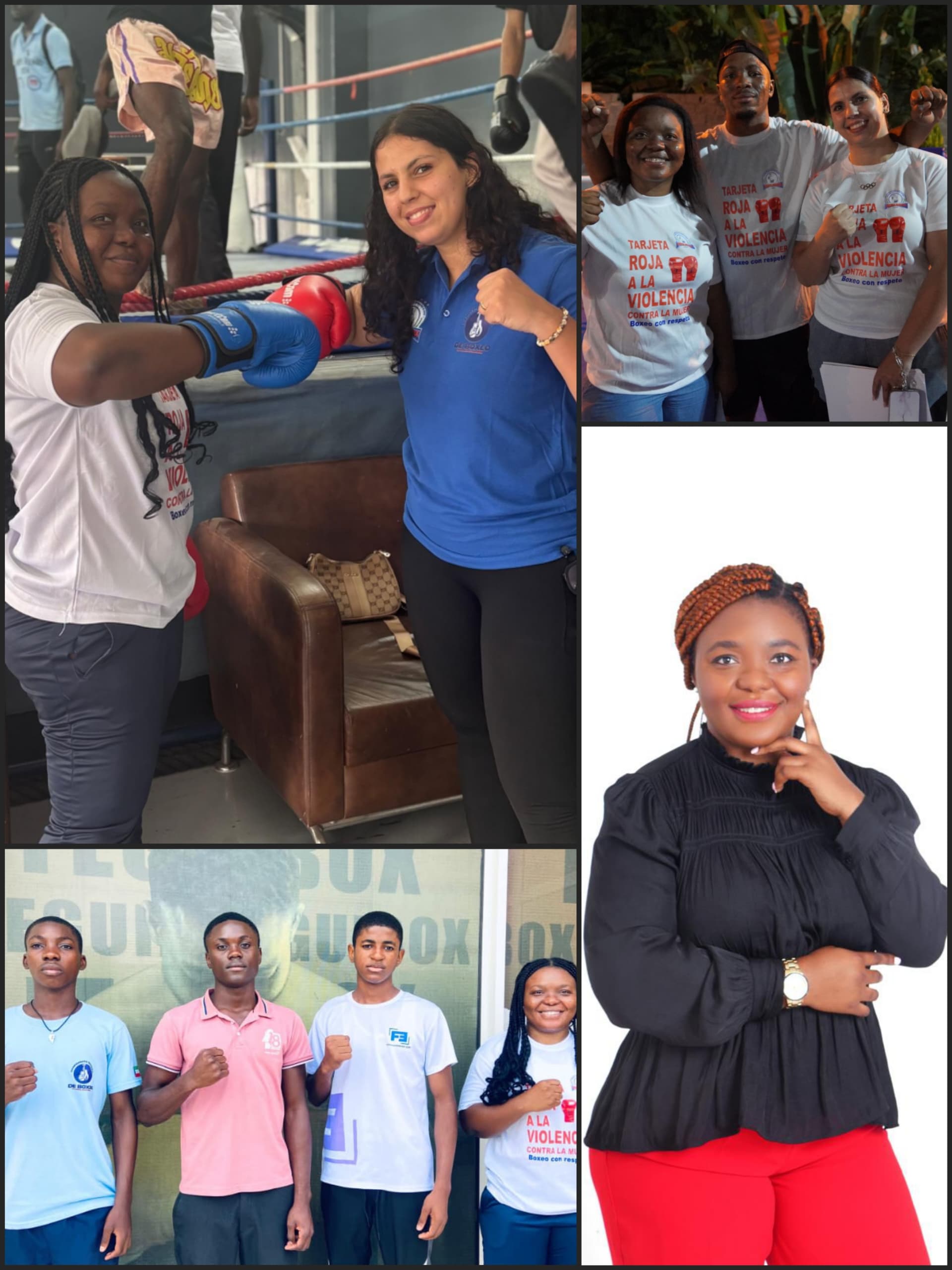
▪️“Innovation is at the heart of my leadership. We will introduce a national ranking system to bring order and meritocracy, youth leagues to create a real talent pipeline, digital transformation of the federation and continuous education for all technical staff.”
11/02/2026
Maria Obono Edu Andeme is the new President of Boxing Federation of Equatorial Guinea. She becomes the third woman to lead a national boxing federation in Africa after Eswatini’s Pearl Dlamini and South Sudan’s Tereza Athian Abdelbagi.
Maria was interviewed by boxersworld.co.ke
Question: What does your election as the first female president of the Boxing Federation of Equatorial Guinea mean for Africa?
Answer: My election represents a turning point. It shows that African sport is entering a new phase—one where leadership is defined by competence, vision and accountability rather than tradition or gender.
For me, this is bigger than boxing. It’s about proving that African institutions can evolve, that women can lead high performance sports structures and that the continent is ready to embrace modern governance.
If Africa wants to compete globally, it must open the door to new leadership styles. My election is part of that evolution.
Q: How many men did you KO to win the presidency during the federation elections?
A: I competed against three male candidates and won with a clear and decisive margin. But the real story is not the vote count—it’s the message.
The boxing community demanded a new direction: more structure, more professionalism, more transparency. The vote was not just for me; it was for a new era.
Q: As the third woman to lead a national boxing federation in Africa, what challenges do you expect?
A: The biggest challenge is not being a woman in a male dominated sport. The real challenge is modernizing systems that have been stagnant for decades. We need governance, transparency, long term planning and technical excellence. Gender is not the obstacle—old habits are.
The challenges are deep and structural:
• Cultural inertia: Many still see boxing as a male-only space.
• Institutional fragility: In several countries, federations lack long-term planning.
• Technical gaps: Coaches, referees and judges often lack continuous training.
• Governance issues: Transparency and accountability are still developing across the continent.
But I don’t see these challenges as obstacles—I see them as opportunities. Africa is full of young talent. What we need is leadership that can turn potential into performance.
Q: What is your game plan for boxing development in Equatorial Guinea?
A: We are building a national system from the ground up. My plan includes:
1. Technical modernization: certification programs, coaching clinics, referee development.
2. Territorial expansion: boxing must reach every province, not just the major cities and community centers.
4. A structured annual competition calendar: athletes need regular, predictable events to grow.
5. Data-driven management: rankings, athlete monitoring and digital licensing.
This is not improvisation. It’s nation-building through sport.
Q: What new ideas will you inject in your leadership?
A: Innovation is at the heart of my leadership. We will introduce:
• A national ranking system to bring order and meritocracy.
• Youth leagues to create a real talent pipeline.
• Digital transformation of the federation.
• Continuous education for all technical staff.
The biggest obstacle is not funding—it’s the absence of a long-term institutional culture. My mission is to create a system that survives beyond any individual leader.
Q: Funding is a major challenge in Africa’s boxing Federations. How will you address it?
A: By changing the way we think about sport. Boxing is not a cost—it’s an investment in youth, health, discipline and national identity.
My strategy includes:
• Building private-sector partnerships.
• Ensuring transparent governance to attract trust.
• Leveraging international development programs.
• Creating events that generate revenue and visibility.
When institutions are credible, funding becomes possible.

Q: Will you introduce prize money in your tournaments?
A: Incentives matter. Athletes need motivation, recognition and tangible rewards.
We will introduce:
• Prize money in selected national tournaments.
• Scholarships for promising athletes.
• Material support for clubs and coaches.
This is how you build a competitive ecosystem.
Q: How is women’s boxing in Equatorial Guinea?
A: Women’s boxing is still emerging, but the potential is enormous. The issue has never been talent—it has been opportunity.
We will launch a national women’s boxing program, create dedicated competitions and ensure that female athletes have access to the same resources as men.
My goal is simple: the next generation of champions must include women.
Q: What are the main obstacles to boxing development in Africa?
A: Africa’s challenges are structural:
• Unstable funding.
• Limited technical training.
• Weak governance.
• Insufficient infrastructure.
• Lack of regional competition circuits.
What needs to be done?
Professionalize. Plan. Invest in coaches. Build regional leagues. Treat boxing as both a sport and a lucrative money-minting industry.
Q: What was the significance of hosting the WBC eliminator in Malabo in 2025?
A: It was a landmark moment. Hosting a WBC eliminator placed Equatorial Guinea on the global boxing map.
It showed that we can organize world-class events and that our country is ready to be part of the international boxing ecosystem.
For amateur boxing, it was transformative: it inspired young athletes, created visibility and brought technical exchange with international professionals.
Q: How would you describe the boxing structure in your country, and what needs improvement?
A: The structure exists, but it needs modernization. We must:
• Strengthen the competition system.
• Improve training facilities.
• Expand technical education.
• Decentralize the sport.
• Introduce monitoring and evaluation systems.
My goal is to build a structure that is modern, efficient and sustainable.
Q: Which is Equatorial Guinea’s most significant international achievement?
A: Two achievements stand out:
• The qualification of an Equatoguinean boxer for the Tokyo Olympic Games, a historic milestone for our nation to have our middleweight Raul Abaga represent us in Tokyo. He won gold in the 2020 Zone 4 Championships and bronze in the 2022 Zone 4
• At the 2023 African Games in Accra Yann Mike Alogo gave us a silver medal in the super-heavyweight division, proving that our athletes can compete with the best in Africa.
These achievements are not isolated—they are the foundation of a new era.
Q: Are you satisfied with what has been achieved so far?
A: I am proud, but not satisfied. Progress is visible, but we are far from our potential.
My vision is long-term: consistent results, a strong national system and a new generation of champions.
We are building something that will last.
Q: What about your national team’s performance in major tournaments?
A: We can and must do better. The talent is there, but the structure has not supported it adequately.
We will introduce:
• Centralized training camps.
• International sparring opportunities.
• A stronger technical monitoring system.
• More competitions at home and abroad.
Performance is not accidental—it is the result of planning.
Q: What do you have to say on the performance of your predecessor Claudio Vazquez Elo?
A: First, I want to express my gratitude to my predecessor for his service and for keeping the federation alive during challenging years.
Every leader faces different realities.
My focus is not on pointing out failures—it is on building a modern, transparent and results driven federation.
The future is my priority, and I intend to lead with unity, professionalism and ambition.