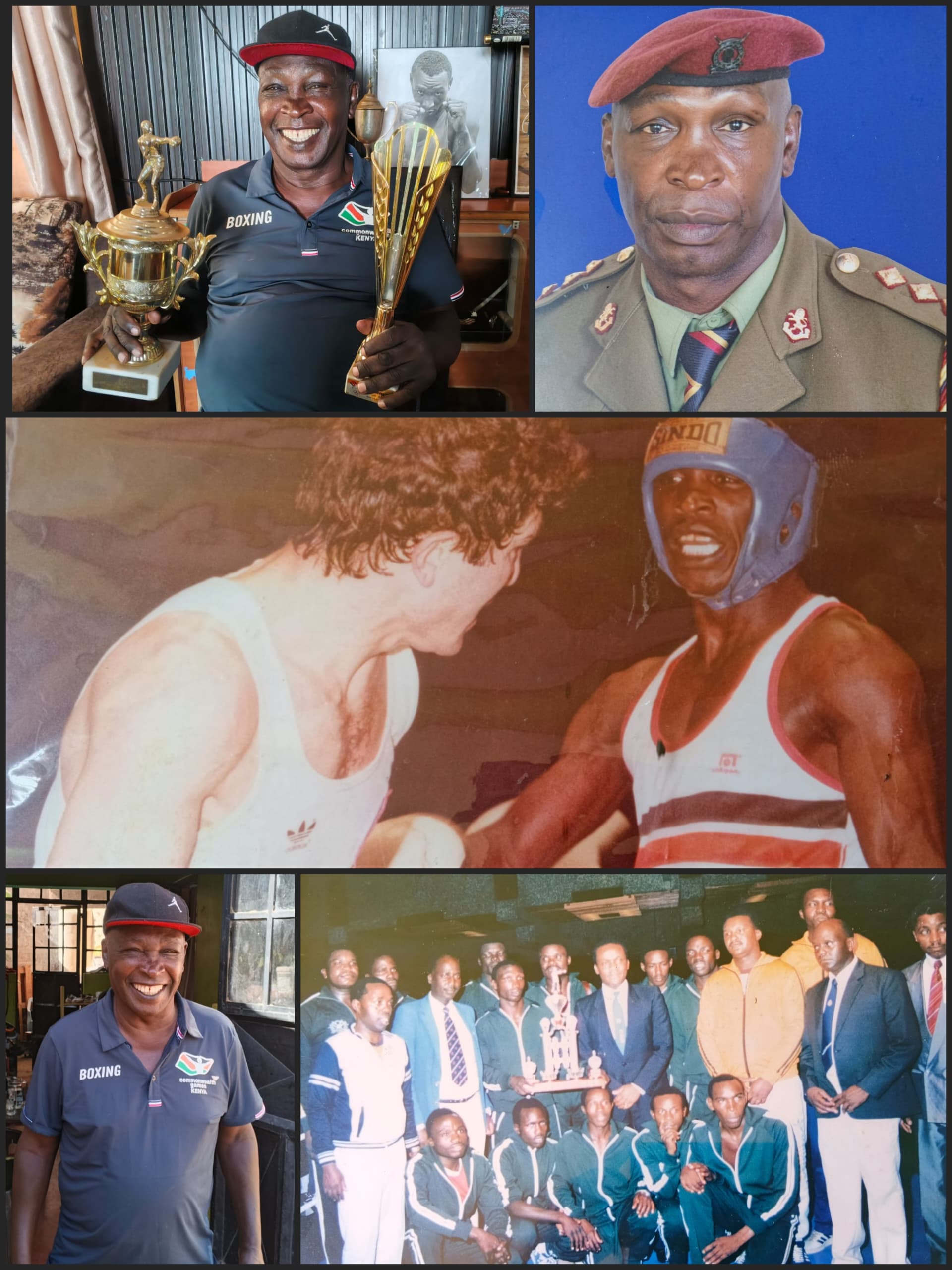
▪️Waweru recalls the night the lights went out when a Danish opponent he had defeated severally knocked him out cold with a temple punch that was a masterclass in pain
April 30, 2026
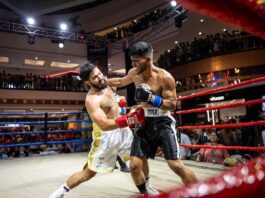
A devastating right punch lands flush on Patrick “Mont” Waweru’s temple in one the several matches he fought during trips by Kenyan boxers to the Scandinavian countries in the 1970s and 1980s.
The canvas warmly welcomes a dazed Waweru. Lights have gone out. Waweru is helped back to his corner by coach Charles Anjimbi, he isn’t just defeated; he has been schooled.
The temple punch from Waweru’s Danish opponent is a masterclass in pain- a hard lesson that exposed a fatal flaw in his approach.
Yet this was an opponent Waweru had defeated severally in the Scandinavian tour, and he accepts on that night he must have been careless in the ring.
“Since I had beaten him I think like three times, I knew he wasn’t a threat to me. I relaxed only to be hit hard on the temple,” Waweru told boxersworld.co.ke at his residence in Kahawa West on the outskirts of the Central Business District of Kenya’s capital city Nairobi.
“Unlike other boxers who take long to regain consciousness after being KO’d, I was okay walking back to the dressing room but I could still feel the pain of that temple punch,” recalls Waweru.
The knockout was brutal, sending the Kenyan back to the drawing board. That sharp blinding pain on the temple – a soft spot that can paralyse a fighter – was indeed the turning point that made Waweru build a strong wall around his head.
On returning home, Waweru realized his power and speed would not save him especially against tactful European opponents some of whom possesed massive punching power.
“I decided to change my approach, and told myself no punch would land there again,” said Waweru.
Waweru developed a watertight guard that turned out to be his signature in the sport. He began fighting with guard high up, glued to his temples and forehead, creating an unbreakable shield.
This structural change to his game allowed him to absorb punishment while moving forward, eventually turning him into one of Kenya’s most successful, disciplined and durable fighters representing the national team for 12 years from 1976 to 1988.
“Before the KO defeat in Denmark I didn’t bother much about guard, once in the ring I just attacked frequently and relied on my footwork,” said Waweru who was unaware of the temple punch.
“I knew nothing about the temple punch but that night in Denmark is when I was told about it and its effectiveness.”
To the uninitiated, the temple is a high-risk boxing target located on the side of the head, just above and slightly behind the ear, known for its ability to cause immediate knockouts or severe disorientation. Due to its thin skull structure and underlying arterial system, it is considered one of the most vulnerable areas for inducing maximum trauma and interrupting an opponent’s balance.
It’s a strategic target in boxing due to its physiological impact and its role in disrupting an opponent’s equilibrium.
While the chin is often the primary focus for generating a knockout, the temple is a secondary high-percentage target for causing disorientation. A precise strike to the side of the head can affect the inner ear and vestibular system, leading to a sudden loss of balance and coordination. The bone structure at the temple is thinner compared to the front or back of the skull, making the impact more effective.
Punches to the temple, such as hooks travel fast around an opponent’s frontal guard, making them difficult to see and defend against. Lead or rear hook are the most common punches used to target the temple as the looping trajectory allows the glove to land flush on the side of the head.
An overhand right or left can be effective for landing on the temple, particularly when an opponent is leaning forward or using a high, tight guard.
Regular strikes to this area carry significant risks of concussions or long-term neurological damage resulting in a permanent injury.
Away from the temple punch, the Scandinavian tours in the 1970s and 1980s took the Kenyan boxers to Denmark, Norway, Sweden and Finland and at times they would even cross over to Germany. But Denmark was a regular destination for Kenyans some of whom competed in semi-professional contests organized by the late Danish promoter Borge Andersen, the chief organiser of the Scandinavian trips.
These tours were pivotal for Kenyan fighters to gain exposure, experience, and sometimes professional income. Many boxers, including legends like Steve Muchoki and his brother Mike “Stone” Irungu transitioned to the professional scene in Denmark under promoter Mogens Palle. Among other beneficiaries of the Scandinavian and Nordic trips include Kenneth “Valdez Ochieng, Sullu Okello now a permanent resident in Norway where he’s working, Kamau Wanyoike, Napunyi Oduori, Isaiah Ikhoni, Billy Kiremi, Nasser “Silencer” Athumani, Mohammed Abdullah Kent, Hussein “Juba” Khalili and Caleb Kuya to mention but a few.
“The Scandinavian tours were very beneficial to us, they hardened boxers, opening opportunities and giving us more confidence against
European boxers as well as enabling us learn a lot of boxing tricks, they opened our eyes,” said Waweru in our interview.
“I wish the tours can be revived, the main problem now is that the main man, Borge Anderson, has passed on.” In addition to Kenya’s national team’s annual visit to the Nordic countries, Kenyan clubs notably Breweries and Prisons also toured the Scandinavian countries .

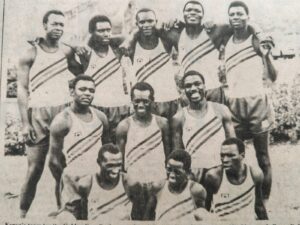
Middle row from right is light-welterweight Ali “Ojukwu” Athumani, bantamweight Isaiah “Danicho” Ikhoni and middleweight Charles “Dixie Kidi” Oduori.
Back row standing from left is super-heavyweight Mohammed Abdullah Kent, welterweight Kamau “Pipino” Wanyoike, light-heavyweight Wandera Okwaro, heavyweight James “Demosh” Omondi and light-middleweight Tabu Lumumba.
Here’s more info on Scandinavian and Nordic countries:
What countries make up Scandinavia?
Scandinavia refers specifically to a region in Northern Europe that includes three countries: Norway, Sweden and Denmark.
What countries make up the Nordic region?
The Nordic region comprises a broader group of countries located in Northern Europe. The region includes five countries: Denmark, Norway, Sweden, Finland and Iceland. All these nations share historical, cultural and political ties as well as the iconic Nordic cross on their flags.

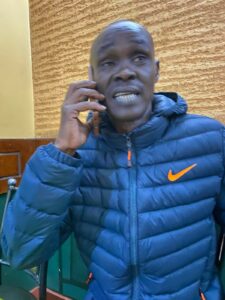
Back to Waweru. He was born in June 9, 1956, and started boxing in the 1960s while still in primary school at Starehe Boys Centre under the tutelage of coach Jimmy Zablon, a former Kenyan international in the 1950s and early 1960s. At Starehe, Waweru was later to be joined by a former pro boxing promoter Michael Kanyango, a swift light-flyweight during his hey days at Starehe Boys Centre.
“We mostly fought YMCA at their hall in Shauri Moyo, these days I don’t know whether boxing happens at YMCA Hall,” wondered Waweru.
Enter Michael Kanyango. He takes us back to the 60s when he was a schoolmate of Waweru at Starehe Boys Centre.
“I first met Waweru at Starehe Boys’ Centre when I joined in 1968. At that time, he was still in Starehe Primary School. Back then, Jimmy Zablon, who was the lightweight champion of Kenya in the 1950s to early 60s, was the acting games master at the school.
“It was during that period that I got used to going to the field to watch boxing training. I was greatly impressed by how Waweru and another boxer, Mathenge Hunja, sparred. By the end of 1968, I joined the boxing team myself.
“From then on, I trained alongside Waweru, Hunja, former international Peter Munyogi, his brother Nivan Ngatia, and a very talented featherweight and lightweight boxer named Francis Peter Kinuthia.
“We continued competing as the Starehe boxing team in different boxing tournaments around Nairobi. At the time, Waweru and Mathenge fought in the paperweight division, I was a light- flyweight, Munyogi in flyweight, his brother Nivan Ngatia in bantamweight alongside Ngige Wanjiku, while Kinuthia fought at featherweight, Mbiru Wilson lightweight, and Peter Magina in middleweight. That was the complete Starehe Boys Centre boxing team then.
“Many times when we had matches against YMCA, Waweru was matched against James Njoroge. But on the day of the contest, Njoroge would refuse to fight Mont. He used to say Waweru was too tough and far too sharp for him.
“Throughout all the competitions until I reached Form Four and stopped boxing, I never saw Waweru lose a single fight while at Starehe. Then, in 1970/71, through his boxing potential he became one of the Starehe boys who got the opportunity to join the General Service Unit boxing team. The late Patrick David Shaw, the famous crime buster, is the one who made it possible for Waweru to join GSU.
“From there, Waweru continued training with the police boxing team until he was officially employed by GSU in 1973. Waweru made headlines when he scored an upset points victory over Peter Manene of the Prisons team in 1972. Manene was the national flyweight champion and a reputable international boxer from Nakuru but by then he had joined Prisons. Waweru moved up to bantamweight and then featherweight. made his intentions known with another upset victory over seasoned Prisons international Kamau Mbugua.
“I can confidently say that Waweru reached that level and held the position of Kenya’s national boxing team captain because of his hard work, discipline, and the strong foundation he received at Starehe Boys’ Centre. The most significant asset he had was speed and good footwork always on the move.”
As Kanyago said, on completion of his secondary education at Starehe Boys, Waweru’s boxing skills earned him a job with the General Service Unit (GSU), a highly trained paramilitary wing of the National Police Service of Kenya designed to handle special operations, civil disorders, and high-risk security emergencies.
Known as the “Maroon Berets,” they operate under the Kenya Police Service, focusing on internal security, VIP protection, and rapid response to armed threats. He underwent training at Embakasi.
“Among the boxers I met there were Peter Dula, Alex Gathumbi, Peter Kangethe and George Findo,” Waweru told boxersworld.co.ke.
“We were training at Embakasi and at times Dallas Muthurwa, it was not easy especially sparring with tough boxers such as Findo, he would hit the stomach hard. Findo was the best boxer on body punches, that hardened me more.”
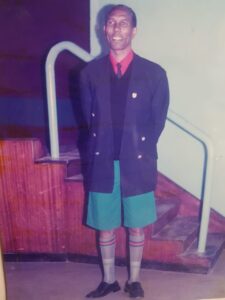
Waweru maintained his ascendancy, showing his class in the 1975 Inter-Services Championships in which he won the lightweight title. The following year he joined the national team,
making his debut in the 1976 East and Central Africa Boxing Championships that attracted Kenya, Tanzania and Ethiopia. The latter brought five boxers.
He was paired against Ethiopia’s Lemma Yemane in the semi-finals. Waweru dominated the Ethiopian, flooring him twice but double cuts on his eyebrows forced the referee to stop the fight in the third round for Waweru to win a bronze, his first medal in boxing.
“I was excited to have won a medal for the first time in boxing, I had just been seeing boxers hanging medals round their necks.”
The regional tournament ushered him into the world of big-time boxing. He eventually made a successful breakthrough at the 1978 Commonwealth Games in Edmonton, Canada, where he won a silver medal after losing in the finals to Northern Ireland’s Gerald Hamill.
Waweru’s next stop was in Libya for the 1979 Africa Elite Championships. He was unlucky losing to a Nigerian who knocked out Waweru, the second KO defeat after the one in Denmark.
What inspired Waweru is the impressive performance of his teammates who enabled Kenya win the continental tournament for the first time with four gold medals, two silver and one bronze by bantamweight Napunyi Oduori.
The gold medals came from flyweight Sande Odanda, featherweight George Findo, light-welterweight Ali Athumani and light-middleweight Athman Abdulrahman while light-flyweight David Wacheru and welterweight Philip Mathenge settled for silvers.
For Waweru, the sting of defeat in Libya didn’t turn him to despair; it turned to a cold calculation, fueling a hunger that breakfast, lunch and dinner could not satisfy.
Gold! Finally Waweru wins his first gold for Kenya at the prestigious annual King’s Cup Championships in Bangkok, Thailand in 1980. Injury forced out his Italian opponent paving the way for his gold with welterweight Kamau Wanyoike winning the second gold for Kenya. Bantamweight Isaiah Ikhoni and heavyweight James Omondi brought home two silver medals.
Towards the end of 1980, Kenya hosted the biggest ever amateur boxing event on African soil sponsored by the USA for countries which had boycotted the Moscow Olympics.
The Golden Cup International Tournament attracted over 30 countries. Waweru captained the Kenya team which finished second to the Americans with two gold, four silver and three bronze medals with USA winning five gold, three silver and one bronze while third-placed Puerto Rico finished with one gold, a silver and a bronze.
Waweru was one of the four silver medallists who lost in the final to South Korea’s southpaw In-Chang Kim.

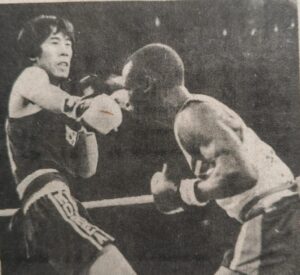
“The Korean southpaw I can say is the toughest opponent I’ve fought in my boxing career, he totally confused me, he also hit me with clean punches I felt the pain after our bout,” said Waweru.
In total Kenya finished with nine medals. Bantamweight Isaiah Ikhoni was in spanking form, winning Kenya’s first gold and was declared the Best Boxer while heavyweight James “Demosh” Omondi added the second gold. In addition to Waweru’s silver, the others came from featherweight Napunyi “Tottoh” Oduori, welterweight Kamau “Pipino” Wanyoike and super-heavyweight Mohammed Abdullah Kent. The three bronze medallists were light-flyweight John “Poison” Kamau, flyweight Hussein “Juba” Khalili and u7middleweight Charles “Dixie Kidi” Oduori.
The Golden Cup team was then invited by Borg Anderson for the annual Scandinavian tour with Waweru captaining the team. Coaches were Charies Anjimbi and Sammy Mbogwa.
Waweru’s next stop was New Zealand where the six Golden Cup finalists shone with him. Wanyoike and Napunyi scooping gold medals and a bronze from Ikhoni. From New Zealand, they flew to the USA to hook up with their compatriots for an invitational tour. But, Waweru did not fight following a wrist injury he sustained in the New Zealand tournament.
The injury forced Waweru to take a break for two years. He returned to the ring in 1984 and won gold with Augustine Oga in the annual King’s Cup in Bangkok, Thailand. That was Waweru’s second gold in the King’s Cup.
“I told coach Wamzee I needed to be released to return to work at GSU so that I recover fully, I’m happy he was a very understanding coach.”
On his return, Waweru made it back to the national team beating all his opponents including the 1983 African lightweight champion Titus Omondi of Prisons.
He then travelled with Kenya’s contingent to the USA for the 1984 Los Angeles Olympics. Making his debut in the Games, he lost his first fight to SouthKorea’s Chil Sung Chun.
The following year Waweru captained Kenya’s team to victory in the 1985 Fescaaba Championships at Nairobi’s City Hall. In the finals, Waweru needed only two minutes, 17 seconds of the first round to stop Tanzania’s Herman Mabale. Kenya retained the title with seven gold, two silver and three bronze medals followed by Zambia and third-placed Uganda.
The Ugandans returned to Nairobi in October that same year to face Kenya in the Nairobi International Show match, losing 7-5 to their hosts with Waweru beating Patrick Kamya at lightweight.
Later, Waweru travelled to Seoul, South Korea, to represent Africa in the World Cup with light-flyweight Dan Mwangi, flyweight Steve Mwema and featherweight David Ouma. Owing to a communication breakdown, Waweru, who was to fight at light-welterweight, did not take part in the World Cup because Cameroon had brought Ebanga Ndongo. Taking into account Kenya had four boxers, it was decided to give the Cameroon boxer a chance.
“I took no offense at all. We were united as Africa so I enjoyed myself in Seoul,” said Waweru, unaware he would return to the country for the 1988 Olympic Games. The star of the tour was Robert Wangila who became the first black boxer from Africa to win an Olympic gold medal. Prior to the Seoul Games, Waweru had guided the Kenya team to overall victories in the 1987 African Games and Fescaaba Championships in Nairobi. Kenya went on to retain the regional title in 1988 in Nairobi again.
The Seoul Games were Waweru’s last international appearance for the national team. The following year, Waweru suffered an upset points defeat by Nasser “Silencer” Athumani in the 1989 Commonwealth Games trials at the Police Pavillion, South “C”.
After a 12-year illustrious career with the national team, Waweru finally stepped out of the ring in 1992 and replaced Jairo “Wamzee” Omuholo as the head coach of Police “Chafua Chafua” team.
He retired from the Police service in 2010 as Chief Inspector.
Commenting on the current state of boxing in Kenya, Waweru said: “BFK are doing a very good job under President Jamal. They have some good boxers coming up I’m sure they’ll have their own level of success.
“I’ve seen some fans and former boxers comparing them to us during our successful era. That’s wrong. That was a different generation of boxers, it happens everywhere in the world even the US are currently doing badly but let’s continue encouraging our young boxers. They will make it.”
Waweru is however unimpressed by the mode of training in most of the current generation of boxers.
“They don’t put more effort in training, they should always go an extra mile, most of us had our own punch bags at home. From the gym we would also have our training at home.”
Waweru has suggested the revival of the Inter-Services Championships which brought together Police, KDF and Prisons, and would also like to see more inter-club contests.
“The revival of Inter-Services will contribute a lot in uplifting our standards and creating jobs for the youth. Clubs should also have friendly matches to keep their boxers in shape.”
Waweru may have stepped out of the ring but the family is still represented in BFK by John Waweru, son of Waweru’s sister.
Nicknamed Mr Rulebook, Waweru is full of praise for his uncle.
“It’s through Mont I got my job in Police and he encouraged me a lot to take up the sport,” said the hard working BFK’s Competition Secretary.
“My uncle Mont made me what I am today, and together with the late Albert Matito, they taught me a lot of things on how to become an efficient competitions secretary.”
On the health of former international boxers, the senior Waweru urged BFK to negotiate with the government for a medical cover.
“Of course it’s not possible for all boxers to have medical insurance but they can pick on the deserving ones because most of the international boxers suffer silently on quitting the boxing through various ailments associated with boxing especially joints.As one becomes older is when the injuries recur. The government also needs to remember us with tokens of appreciation.”
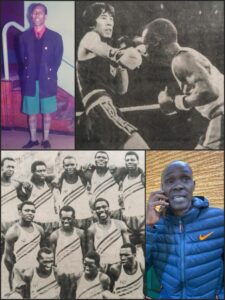
We hope the government will implement Waweru’s suggestion on medical cover and substantial rewards for the big achievers in the ring just like they have done to the athletes and footballers during Nairobi’s CHAN tournament in 2025.