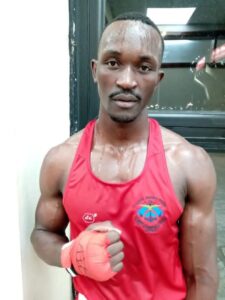
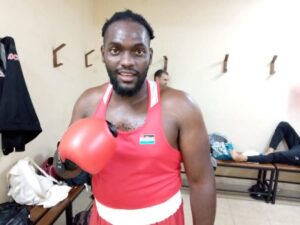
▪️She’s tuned for a cracking rematch against Nomusa Ngeme
November 28, 2025
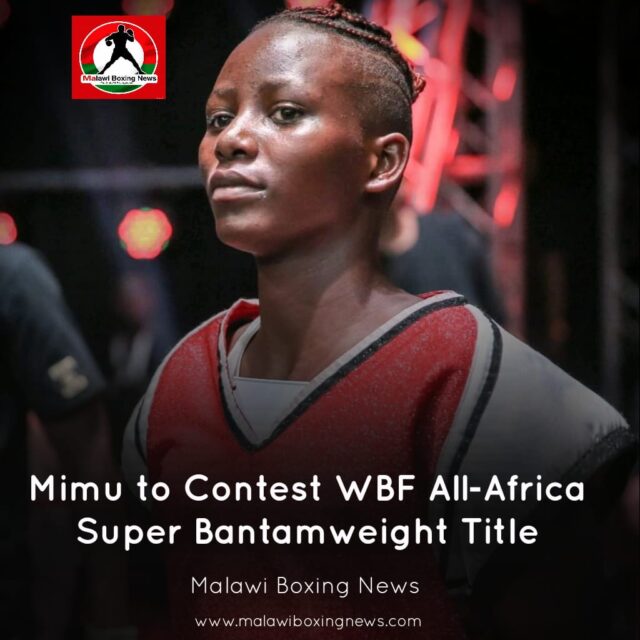
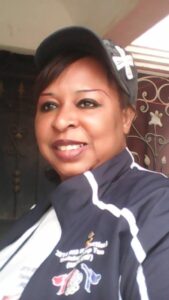
Malawian female boxing star Adidya Mimu will face Nomusa Ngeme for the World Boxing Federation (WBF) All‑Africa super bantamweight title on November 29, 2025 in Durban, in what promises to be a high‑stakes rematch.
The bout has all the trappings of a thrilling encounter, with both fighters boasting impressive records.
Mimu, who trains with coach Vusi Mtolo, brings a professional record of 5 wins and 3 losses to the bout, ranked number 32 in the world super bantamweight category, while Ngeme carries a ledger of 7 wins and 1 loss, holding number 30 in the world super bantamweight category.
Speaking about her preparations, Mimu expressed confidence and a desire for revenge.
“My training is progressing well with my coach Vusi Mtolo, no complaints. I wanted this rematch for a long time because the first time I fought her I had just 10 days’ notice, and it ended on the judges’ scorecards. I was not satisfied with the result, I felt robbed,” she said.
“I cannot promise a knockout, but by any means I am going to claim this title, either by knockout or on points. My fans should trust me because I am bringing this title hobme.”; Mimu said.
With experience and determination fueling her drive, Mimu eyes history in Durban. This electrifying rematch is set to showcase African boxing prowess and could cement Mimu’s place among Malawi’s elite.
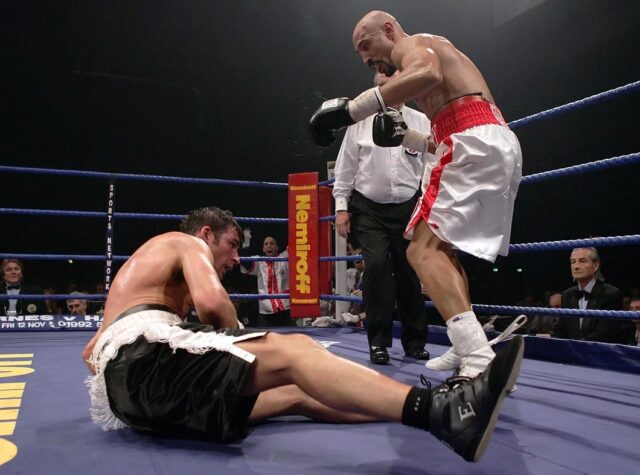
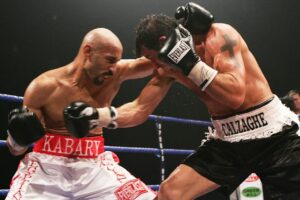
Big punching Egyptian Kabary Salem decks fancied Welshman Joe Calzaghe in the fourth round of their 2004 WBO super middleweight title fight won by Calzaghe who was head butted severally by Salem, described as one of the dirtiest pro boxers at the time. Salem was accused by the family of American boxer Randie Carver for head butting their son to death when they fought in 2019.
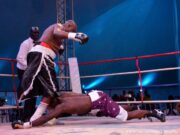
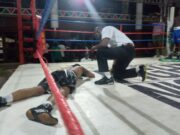
▪️Carver was sent to the canvas by Salem’s overhand right in the 10th round. He tried four times to climb off the canvas but he couldn’t manage forcing the referee to stop the fight. He died three days later, and in the earlier rounds of the fight, he was head butted several times by Salem
November 28, 2025
Randie Carver was a promising Super Middleweight American boxer climbing the ranks of the division in the hope of one day becoming World Champion. Carver had a record of 23-0-1 going into his fight with Brooklyn based Egyptian, Kabary Salem and Carver’s home town crowd were excited to watch their hero continue on his unbeaten run.
Kabary Salem, had a reputation as a tough, but dirty fighter who had a tendency to headbutt was bound to be a tough opponent to overcome, but many believed Carver’s superior skill and athleticism would be more than enough to get the win.
In the fight footage, Salem was seen head butting Carver numerous times in the early rounds of the fight as well as continuously holding.
Although Salem was deducted a total of 2 points for holding, the head butting went unpunished. Many of those who watched the fight believe the butting was intentional and Salem should have been at the very least penalised and should it have continued, then a disqualification would’ve been the only option.
Carver began to tire and round 10 saw Salem land an overland right and left cross which put Carver down. Carver tried 4 times to climb off the canvas but was in no condition to continue and referee, Ross Strada stopped the fight. It was then that things took a turn for the worse as Carver’s eyes rolled back in his head and he lost consciousness. Paramedics frantically worked on Carver before rushing him to hospital.
Head butt specialist Kabary Salem
Carver underwent brain surgery and was placed on life support but sadly he passed away 3 days later. An inquiry was launched but the Missouri regulators concluded there was no wrongdoing and a lawsuit filed by Carver’s mother against Ross Strada was unsuccessful.
The would not be the last time however, that Salem’s head butting would cause controversy.
In 2004 The WBO Intercontinental contest between Salem and Rudy Markussen would be ruled a No Contest. An apparent accidental head butt by Salem cut Markussen and the fight was stopped.
Later that year, Salem was penalised 2 points for heat butting Mario Veit in the 5th round of their Interim WBO World Super Middleweight contest. Bizarrely, Salem also broke the referee’s nose in the 7th round with an apparent clash of heads.
Again in 2004, Salem challenged WBO Super Middleweight Champion, Joe Calzaghe for the title and deducted a total of 2 points for deliberate heat butting in the 3rd and 11th round.
Salem retired in 2005 after being stopped by Lucian Bute in the 8th round of their contest. Salem came in 5.5lbs overweight and was therefore ineligible for the NABF and WBC Continental Titles up for grabs.
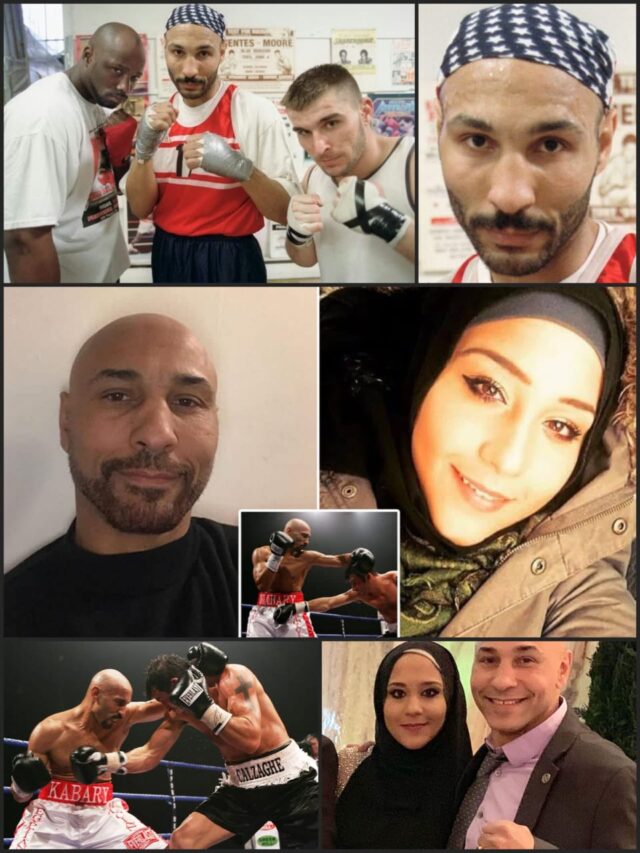
A photo collage of Egyptian boxer Kabary Salem two of them with his lovely daughter Ola Salem whom he murdered in 2019 through strangulation reportedly annoyed by his daughter befriending a non-Muslim boyfriend after divorcing with her husband.
▪️Kabary Salem put up a sterling show losing in the semi-finals and settled for a bronze medal in the 1989 5th World Championships in Moscow ▪️He has been sentenced to life in prison in the USA for the 2019 murder of his daughter Ola Salem ▪️Salem defeated Kenya’s Kenneth “Valdez” Ochieng in the semis and beat Tanzania’s Joseph Marwa to win a gold medal at the 1991 African Games in Cairo.
28/11/2025
Egyptian boxer Kabary Salem is a mix of a hero and villain.
He is one of Egypt’s most accomplished boxers, and is well remembered for winning Africa’s only medal – a bronze – at the 1989 World Championships in Moscow, Russia.
Among his other achievements was a gold medal he won at the 1991 African Games in Cairo and represented Egypt in the 1992 and 1996 Olympic Games.
He later turned pro in 1997 in the USA, and was accused of head-butting one of his opponents to death.
For all his accomplishments, Kabary Salem turned into a villain in 2019 when he killed his own daughter Ola Salem and disposed of the body in Staten Island park, New York in 2019. He is now serving life imprisonment for this unbelievable act which shocked the entire New York in 2019.
First let’s look at his success at the 1989 World Championships, and then later dwell on why killed his daughter.
At the 1989 World Championships, Salem was enjoying top form. In the round of 32 he eliminated Germany’s Alexander Kuemler 15-14.. He then saw off Mongolia’s Khaidan Gantulga 16-12 in the round of 16.
Joe Calzaghe (right) battling head butt specialist Kabary Salem (left) in the 15th successful defence of his WBO super-middleweight title in 2004 in Edinburgh. The Welshman was made to work overtime for his unanimous points victory over awkward Egyptian Kabary Salem. And he even suffered the indignity of being dumped on the canvas for only the second time in his career in round four. Calzaghe admitted: “I was ring-rusty and over-eager and I made it hard for myself. “I thought I learnt my lesson against Byron Mitchell but I got caught again my hands were down, my chin was in the air and I was caught off balance. “In the Mitchell fight I was stunned but in this one I was embarrassed. I got straight back up and I was OK once I started using my boxing skills.”
With that brilliant victory, Salem punched his way to the quarter-finals. He sent packing Billy Walsh of Ireland with 18-9 points victory to qualify for the semi-finals where he met him waterloo.
Pitted against East Germany’s Torsten Schmitz, Salem lost 15-2 to settle for a bronze medal, the only one for Africa after the 1986 indifferent showing by the African boxers in Reno, USA, where none
of them won a medal.
Salem received a heroe’s welcome on returning home in Egypt. His next major assignment was in the 1991 African Games at home in Cairo.
He fought his way to the finals winning a gold medal in the light-middleweight division. On his way to the final, Salem fought two boxers from East Africa in the semi-finals and finals.
Against Kenya’s Kenneth “Valdez” Ochieng in the semis, Salem scored what Valdez describes as a controversial points victory. Valdez, now coaching at his own club, Kayole Rapid, in Nairobi spoke to boxersworld.co.ke on his fight against Salem.
“I had watched him in action in the previous fights, he was a hard hitter and liked mixing punches with his opponents when he’s close,” recalls Ochieng whose gameplan, he says, totally frustrated Salem.
“My strategy was to score points on the retreat avoiding close range exchanges with him,” says Ochieng.
“He had a powerful right punch, I felt him severally in the fight because there’s no way a boxer can just be punching his opponents without also being hit.
“From the way I fought I thought I had won but it’s the Egyptian boxer who was given the decision.”
In the dressing room, Ochieng was so disappointed and asking himself how the Egyptian won.
“Maybe the judges gave him victory because of his hard punches, I know during those days they looked at the boxer punching hard. This is wrong. It encouraged more brutality in the ring.
“So long as a boxer is scoring by hitting the target he should be given the points.”
In the finals, Salem outpointed Tanzania’s Joseph Marwa to win a gold medal.
Salem went on to represent Egypt in the 1992 and 1996 Olympic Games, losing in the first round in both Games.
After the 1996 Olympics, Salem turned pro in 1997, and relocated with his family to the USA where he settled in New York as a pro boxer.
In his toughest fight ever , Salem lost by a unanimous decision to Welshman Joe Calzaghe who made the 15th successful defence of his WBO super-middleweight title in Edinburgh, Scotland, in 2004.
Throughout his fairly successful pro boxing career, Salem was described as one of the dirtiest fighters in the barechested game and was known for head-butting his opponents like he did in his 2019 fight against Randie Carver who later died but the referee ruled out head-butting as the cause of his death.
He retired in 1997 following three successive defeats with a record of 23 wins, 12 on KOs and five losses.
KABARY SALEM SENTENCED TO LIFE IMPRISONMENT FOR MURDERING HIS DAUGHTER
Lebanon Daily News
November 26, 2025
A former New York Olympic boxer will spend the rest of his life in jail after being sentenced for the murder of his daughter in Palmyra before dumping her body in a Staten Island park in 2019.
Lebanon County Court of Common Pleas Judge Bradford Charles on Nov. 26 sentenced Kabary Salem to life imprisonment without parole for the death of Ola Salem. Kabary Salem was found guilty of first degree homicide after a four-day trial in October.
During his sentencing, Kabary Salem could be seen weeping and saying that police officers were lying about his case.
“I say the truth,” he said to Charles.
Charles rebutted Kabary Salem’s claims during sentencing, saying that the truth is that Ola Salem died by strangulation, her body was transported by a rental car, and the car and videotape shows Kabary Salem was in possession of that car during the time of the incident.
“The circumstantial evidence in this case was overwhelming, and the truth that you now have to confront is that a jury found that you committed first degree murder,” he said to Kabary Salem. “That’s the truth. That’s what the jury found, and there was more than enough evidence to support that finding.”
Get the York on the Move newsletter in your inbox.
Keep up to date with the latest opening, closings & food trends!
Delivery: Second and Fourth Thursday of each month
Your Email
Chief Deputy Attorney General Brian Zarallo said that a life sentence was “certainly justice in this case.”
“Ola Salem, while she had her fair share of problems, certainly did not deserve to spend the last seconds of consciousness of her life not just struggling, but being acutely aware that the person who murdered her was in fact her father,” Zarallo said to Charles during sentencing.
Kabary Salem was also sentenced to serve a minimum of one year for the strangulation charge, which Charles said would be served concurrently with his homicide sentence.
The case
At 8:48 a.m. Oct. 24, 2019, the body of 25-year-old Ola Salem was found by two passersby covered with leaves and branches in Bloomingdale Park in Staten Island. Court documents said she was fully clothed, and her New York state identification card was in her pocket.
An autopsy was performed Oct. 25, 2019 by Dr. Anne Hoffa of the New York Office of the Medical Examiner. Her report indicated that there were bruises and contusions to Ola Salem’s body, including the right eye, neck and legs. Bruising and scrapes were found along Ola Salem’s mouth.
“That signifies pressure that was placed on her mouth,” Hoffa testified Oct. 21, 2025. “It could be from a blunt impact or from something covering her mouth.”
Hoffa determined that the cause of death was asphyxia, and the manner of death was homicide.
Kabary Salem told the New York City Police Department on Oct. 24, 2019, that he recently co-purchased a restaurant in the 600 block of East Main Street in Palmyra. He went to New York on Oct. 22, 2019 to pick up Ola Salem to help him paint the establishment.
According to Kabary’s police interview, the last time he saw Ola was when she got into an unknown black sedan away from the restaurant the evening of Oct. 23, 2019. Kabary Salem said this was the last time he saw Ola, and that he spent the night painting the Palmyra establishment.
The New York City Police Department learned that Kabary Salem had rented a Toyota Camry in Piscataway Township, New Jersey, that was equipped with GPS tracking. GPS data indicated that Salem’s vehicle left Palmyra around 2:15 a.m. Oct. 24, 2019, and arrived in Bloomindale Park at 4:40 a.m., around the same area as where the body was found later that morning.
After leaving Staten Island at 4:59 a.m., Kabary Salem traveled to a nearby Wawa. Video footage showed him entering the facility and purchasing several items in the store.
At 8:47 p.m. Oct. 23, 2019, Kabary Salem traveled to the Palmyra Lowe’s hardware store and purchased a blue Kobalt shovel. During his testimony, Kabary Salem said he had purchased the shovel to clean up dust and debris at the restaurant.
A blue Kobalt shovel was located by a Staten Island resident Oct. 24, 2019 in a wooded cul-de-sac, 100 yards diagonally from where Ola Salem’s body was found.
Through GPS tracking, police determined that Kabary returned to Palmyra around 7:33 a.m. Oct. 24, 2019. After trips to the Knights Inn and the Main Street restaurant, he then left the area for a final time around 11 a.m.
Salem then returned the vehicle to the New Jersey Avis Car Rental around 3:52 p.m., hours before meeting with New York City Police for an interview.
Several days after the voluntary interview of Kabary Salem by the NYPD, he left the United States. Law enforcement said that he was located in Kuwait a year later, and he was extradited back to New York City.
The case was referred to the Office of the Pennsylvania Attorney General by Lebanon County District Attorney Pier Hess Graf on June 19, 2024, according to court documents.
Jay Nigrini, Kabary Salem’s attorney, told reporters in October that his client is likely to appeal the verdict
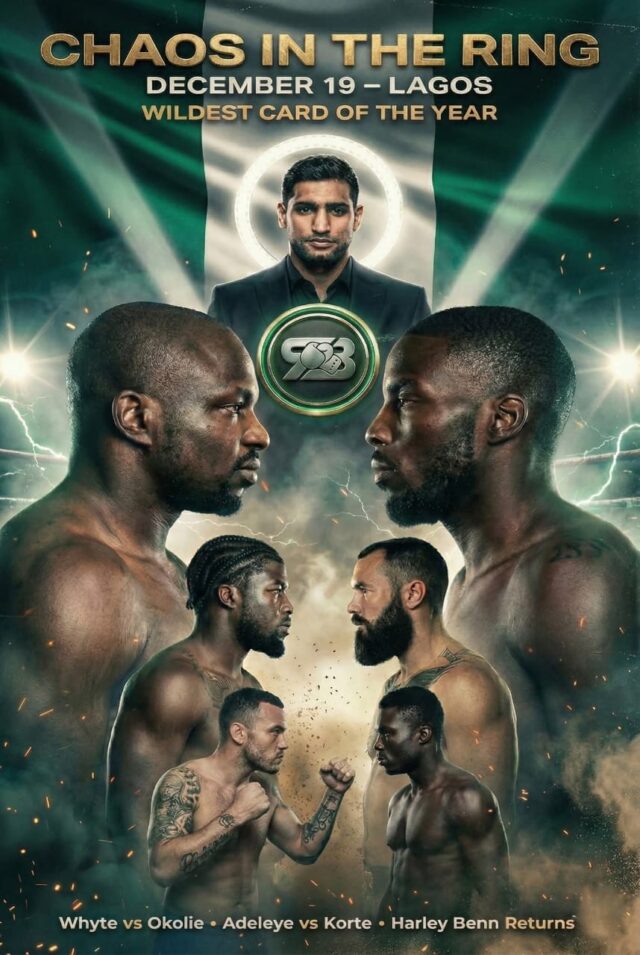
▪️Amir Khan’s December 19 Lagos card just got even wilder and fans are buzzing about what’s being lined up.
26/11/2025
Dillian Whyte has officially been offered a headline clash with former WBO cruiserweight champion Lawrence Okolie. If this one gets confirmed, Lagos is getting a true heavyweight grudge night.
David Adeleye returns to Nigeria for a big homecoming fight against German powerhouse Patrick Korte a veteran with 19 KOs and dangerous early-round power.
Adeleye (14-2, 13 KOs) looks to bounce back strong after his loss to Filip Hrgovic, while Korte brings 10 years of experience and a fresh first-round TKO on his record. Expect a serious shootout: 32 combined knockouts between them.
Harley Benn brother of Conor Benn is back after a long break, relaunching his career against Ghana’s Elvis “Soldier” Ahorgah, a heavy-handed contender with 13 stoppages and rounds under his belt with Callum Simpson and Tyler Denny. A real test.
The card is loaded with African and regional talent too, with names like Agbaje, Odiase, Adeleye, Defreitas and more looking to steal the show.
Amir Khan, Balmoral Group Promotions & Queensberry are building a platform for African boxing to shine and December 19 is shaping up to be a landmark night.
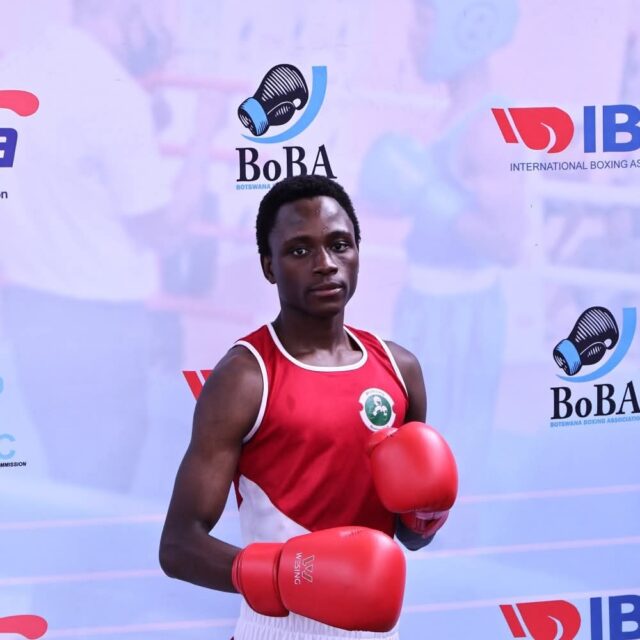
▪️The team includes Zone Four champion Kobamelo Molatlhegi who is a silver medalist in the inaugural Mandela Cup tournament
27/11/2025
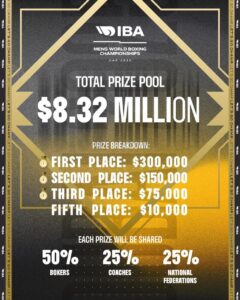
The Botswana Boxing Association (BoBA) is pleased to unveil the national team that will represent Botswana at the 2025 IBA Men’s Elite World Championships, taking place 2–13 December at Dubai’s iconic Tennis Stadium. The event will headline the IBA’s historic two-week ‘Festival of Boxing’, featuring an unprecedented $8 million prize pool.
Training for the Botswana squad officially begin today, 27 November 2025, and the team is scheduled to depart for Dubai on Saturday.
🇧🇼 Selected boxers:
• Katlego Keorapetse – 54kg, Titans Boxing Club
• Modise Ribbin – 51kg, Prisons Boxing Club
• Kobamelo Molatlhegi – 48kg, DTCB Boxing Club
👨🏫Technical Team:
• Head Coach: Choga Ntoti – Francistown Boxing Club
• Assistant Coach: Gibson Rauwe – Prisons Boxing Club
BoBA VP Mr Phetogo Tsheko is the Team Manager.
The International Boxing Association (IBA) has positioned this year’s Championships as one of the biggest events in the sport’s history, proudly presenting a blockbuster global showcase set to elevate athletes, expand competition opportunities, and celebrate world-class boxing at the highest level.
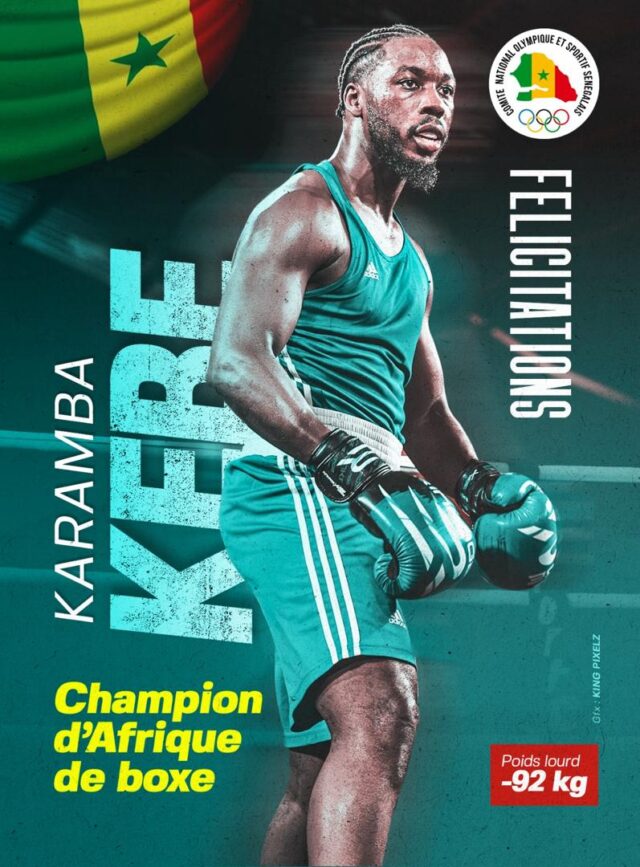
Senegal's reigning Africa heavyweight champion Karamba Kebe taking part in his second Men's World Boxing Championships in Dubai from December 2-13, 2025.
▪️Senegal Boxing Federation Secretary-General Anta Gueye names two boxers to do battle in $8.32 million IBA World Boxing Championships
26/11/2025
Senegal will be represented by two boxers in the 23rd edition of the $8.32 million IBA World Boxing Championships set for the glittering city of Dubai from December 2-13, 2025.
The Secretary-General of the Senegal Boxing Federation Anta Gueye told boxersworld.co.ke they have picked on Africa heavyweight champion Karamba Kebe and welterweight Cheikh Tidiane Diop to represent the West African country with a rich boxing tradition.
Welterweight Cheikh Tidiane Diop has improved tremendously.
“The choice of our two boxers is justified by their continental record and their current technical level,” said the towering Gueye, a former taekwondo black belt player.
“Karamba is a wise choice, being the Africa champion and Cheikh Tidiane Diop has some experience at the World Championships having participated in the Tashkent Games in 2023. He also defeated our Kinshasa 2024 African vice-champion, Mouhamed Abdalah Diallo by knockout in a professional boxing match in October.”
Gueye is optimistic the two boxers will excel in Dubai against the world’s best boxers vying for the top prize money of $300,000 for gold medallists, $150,000 and $75,000 for silver and bronze medallists respectively. There’s also $10,000 for quarter-finalists in the richest ever amateur boxing tournament on earth.
“We hope they can achieve a satisfactory result in Dubai. If they can’t reach the podium, at least 5th place,” said Gueye, a former board member of the Africa Boxing Confederation (AFBC).
Cheikh won a gold medal in the 2023 Africa Zone 2 Championships and finished fifth at the 2023 African Championships in Yaounde, Cameroon. He has improved significantly.
Senegal Boxing Federation Secretary-General Anta Gueye released the names of the two boxers for Dubai Worlds.
Kebe, based in France, is still basking in glory following his historic achievement in the 2024 Africa Elite Championships in Kinshasa, DR Congo. The southpaw Kebe won Senegal’s first gold in 26 years since 1998 in Algiers where lightweight Mama Sow outpointed South Africa’s Elvis Makama to win Senegal’s first ever gold medal in the Africa Elite Championships.
“It’s one of my greatest achievements because I have already won titles that did have as much impact as this one in Kinshasa,” Kebe told me in an interview. He’s now campaigning as a pro boxer in Toulouse, France.
Kebe and Cheikh are among the four boxers who represented Senegal in the 2023 IBA Men’s World Boxing Championships in Tashkent, Uzbekistan.The other two were middleweight Alphonce Mendy and light-heavyweight Seydina Mouhamed Konate. They all lost 5-0 in their first fights..
Kebe was eliminated by Mexico’s Rodriguez Moreno, Konate lost to Frenchman Bauderlique Mathieu Albert Daniel, Mendy was beaten by Mongolia’s Jargal Otgonjargal and Cheikh went down to Spain’s Orozco Ojeda.
A total of 102 boxers from 29 African countries took part in the Tashkent Worlds with Kenya leading by sending the highest number of boxers – eight – to the former Soviet Union state.
Africa has gone through an eight-year drought in the Men’s World Championships since Cameroon’s super-heavyweight Arsene Fokou Fosso, now a pro boxer in Australia, won a bronze medal in 2017 in Hamburg, Germany.
Zambia Boxing Federation President Boniface Sokoni (far left) with Minister of Sports Elvis Nkandu (middle) and IBA Africa flyweight champion Patrick "Baddo" Chinyemba, one of the African boxers expected to be in the money bracket in the Men's World Boxing Championships taking place in Dubai from December 2-13.
▪️Sokoni lauds IBA for empowering boxers financially through prize money and welcomes the move for the cake to be shared between boxers, coaches and NFs
25/11/2025
Zambia Boxing Federation President Boniface Sokoni does not mince his words on the advent of commercialisation of sports.
Commenting on the jaw-dropping total prize money of $8 32 million at stake in IBA Men’s World Boxing Championships in Dubai, Sokoni told boxersworld.co.ke, this is the way to go for boxing to be at par with other well-paying disciplines such as athletics and football.
“The era of boxers fighting for medals and certificates at big international competitions is long gone,” says Sokoni who plans to emulate the IBA by having boxers paid in some tournaments in Zambia.
“As the President of the Zambia Boxing Federation, I welcome any initiative that benefits our boxers and promotes the growth of the sport. The introduction of significant prize money is a positive development, as it can motivate boxers and provide them with the financial rewards they deserve for their hard work and dedication.
“We’re always looking for ways to support our boxers , and initiatives like these can help elevate the sport in Zambia and globally.”
Sokoni is delighted by IBA embracing commercialisation of sports which is now the in-thing in most developed countries.
“Boxers can’t eat medals and certificates, times have changed, and it’s encouraging to see boxing evolve to recognize athletes’ achievements more substantially,” says Sokoni.
The Zambian boxing boss went on: “Boxers dedicate themselves to intense training and competition, and it’s fitting that they receive rewards that reflect their efforts.
“We’re seeing a shift towards more substantial recognition, including financial rewards, and that’s a positive trend for the sport’s growth and for motivating boxers.”
Sokoni lauds the move by the IBA to make it official the Dubai prize money will trickle down to the coaches and National Federations.
“For African National Federations like Zambia, receiving a share of the revenue or support from events like the World Championships can be a game-changer,” he says, adding: “It can help us invest in our programs, support our athletes’ development, and improve our infrastructure. We’re hopeful that such initiatives will contribute to strengthening boxing in Africa and provide more opportunities for our boxers to compete at the highest level.”
Sokoni is optimistic some of the Zambian boxers such as African Games flyweight champion, Patrick “Baddo” Chinyemba, will make it to the money bracket.
While acknowledging IBA’s generous gesture to increase the prize money in the Dubai tournament, Sokoni knows coaches and NFs will only get a share of the cake if their boxers are in the cookie jar.
“IBA’s efforts to increase financial support for boxers, coaches, and National Federations are steps in the right direction.
“Any initiative that puts more resources into the sport can have a positive impact on development and growth. We’re encouraged by these developments and look forward to seeing how they can benefit Zambian boxing and the broader African boxing community.”
Longest-serving international Shaffi Bakari brought on board Kenya's Dubai-bound national team. He teams up with Dennis Muthama in the bantamweight division.
▪️He joins KDF’s Dennis Muthama in the bantamweight class for team training before the selectors decide who will make it for the World Championships
Africa bronze medallist Shaffi Bakari has been brought on board the Dubai-bound Kenya’s national team for this year’s World Boxing Championships from December 2-13.
National team head coach Musa Benjamin said they have put into account Shaffi’s experience and decided to include him at bantamweight with Dennis Muthama.
Africa Zone 3 silver medallist Mwinyi Kombo (left) is also in the mix with Paul Omondi (right) at featherweight
“Muthama still remains in the team, we will monitor them during our training sessions and decide who’ll finally travel to Dubai because both of them are good boxers,” said Musa.
Muthama and Shaffi were due to have met in the finals of the last leg of the national league in Kisumu on November 22, 2025, but the Police boxer was unable to fight due to a recurring injury.
It would have been their third encounter this year. They first met in the second leg of the league in Mombasa with Muthama outpointing Shaffi. In their second fight during the fourth leg of the league in Nanyuki, Shaffi avenged the defeat with a deserved points win over Muthama who is the reigning African Military Games bantamweight champion.
Kelvin “Young” Maina – the self declared flyweight landlord – still has Emmanuel Chondo to contend with in the flyweight class
The other weight classes with two boxers are flyweight Kelvin Maina and Emmanuel Chondo, featherweight Paul Omondi and Mwinyi Kombo, light-heavyweight Robert Okaka and Humphrey Ochieng and heavyweight Peter Abuti with John Oyugi.
The Kenya team trained together for the first time today, November 24, at Police Depot in Mathare. They will be there this week before departure to Dubai.
Twice Africa Championships bronze medallist Robert Okaka aka Man Man Ngori is with Humphrey “Jakababa” Ochieng at light-heavyweight
Kenya’s team for the World Championships:
Minimumweight: Silas Onyango (Police)
Flyweight: Kelvin Maina (KDF), Emmanuel Chondo
Bantamweight: Shaffi Bakari (Police), Dennis Muthama (KDF)
Cheerful new national league champions Kenya Police in Kisumu
▪️Promising teams such as Nairobi, Kisumu and Siaya counties skipped some League matches due to lack of funds for transport and full board accommodation ▪️With steady funding of the league, cash incentives to inspire the boxers will be introduced and no team will miss the series owing to financial hiccups. This will ensure the league becomes more competitive
23/11/2025
The inconsistent participation of some promising teams was the black spot in the just concluded Kenya National Boxing League which ended on Saturday, November 22, 2025 in Kisumu.
As expected, Police Boxing Club and Kenya Defence Forces, dominated the five-leg league with Police regaining the overall title.
The cops finished with a total of 110 points followed by defending champions KDF on 94 points, Nairobi County 37, Prisons 28, Nakuru County 25 and Nakuru Amateur Boxing Club 24.
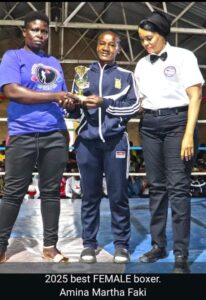
Africa light-middleweught champion Boniface “The Hammer” Mogunde and African Games bantamweight bronze medallist Amina Martha Faki further added more accolades to the Police team, winning the male and female Best Boxer awards.
The standards of the league may not have been very impressive but what’s evident is that talent abounds in the league. What’s lacking is massive sponsorship to give it more sparkle.
The most promising new find in the league was Wiseman Kavondo of Kayole Rapid Boxing Club, coached and owned by former star international.boxer Kenneth “Valdez” Ochieng.
The southpaw Kavondo caught the selectors eyes in the third leg of the league in Nakuru where he displayed qualify boxing in the final light-welterweight bout against top homeboy Caleb Wandera who was pushed to the brim before outpointing the gutsy Kavondo.
Africa Zone 3 silver medallist Mwinyi Kombo (left) lost on points to Paul Omondi (right) of Police at featherweight
Kenya’s national team head coach Musa Benjamin was so impressed by the two boxers, giving them their first call-ups to the national team that took part in the Africa Zone 3 Championships in Nairobi.
Kavondo put up a sparkling show causing a major upset by outpointing Cameroon’s top welterweight Oumarou Mohamed in the semi-finals.
He eventually settled for silver and Wandera a bronze medal. Both have now landed jobs at the Police Service including Kibra’s Paul Omondi who outpointed Africa Zone 3 featherweight silver medallist Mwinyi Kombo in Kisumu.
What’s more inspiring for Kavondo, Wandera and Omondi is that they’re all in the national team to participate in next month’s World Championships in Dubai.
Africa light-middleweight champion Boniface Mogunde receives the Best Boxer award from national team head coach Musa Benjamin.
The back spot of the league was the inconsistent participation of some teams with Nairobi, Siaya and Kisumu counties lamenting lack of financial support from their counties.
Kisumu County head coach Vincent Odongo was furious when they pulled out at the last minute for the fourth leg in Nanyuki.
“As a coach I’m.very annoyed with my county for failing to.fund our trip to Nanyuki,” Odongo told boxersworld.co.ke in an interview.
“My boxers are so demoralised, they work so hard in the gym only to be told there’s no money.”
Equally disappointed is Siaya County coach Joseph Ochieng aka D4.
“Siaya is the boxing home of champions in Western Kenya, big names such as the late James “Demosh” Omondi are from Siaya, there’s a lot of potential but our leaders have let us down,” said Ochieng, also known as Guard Malo.
While the Boxing Federation of Kenya (BFK) have done a remarkable job in running the league without funding, they should now be more aggressive and bring on board a major sponsor for the 2026 national league to inspire talented upcoming boxers eager to use boxing for a decent living.
Significant boxing talent often goes undeveloped and unrecognized due to a lack of substantial sponsorship and financial support.
This financial gap is a major barrier to the sport’s growth and the professional success of its boxers.
Without adequate funding, talented boxers struggle to access essential resources like quality coaching, professional-grade equipment, proper nutrition, and medical support.
Many boxers, especially those in the early stages of their careers, must juggle training with full-time jobs to make a living, preventing them from dedicating themselves fully to their sport. Others give up the sport on realising boxing cannot put food on the table.
Insufficient sponsorship limits opportunities for boxers to compete on a larger stage, gain exposure, and attract the attention of promoters to recruit them in the paid ranks.
Not that BFK haven’t made efforts to secure sponsorship. They have tried their best but have yet to succeed. To speed up the process, they should now seek partnership with one of the established marketing firms which are well connected in the corporate world..
With steady funding of the league, all teams will be consistent in their participation and cash incentives will be introduced to motivate the boxers. Transport and accommodation for the referees and judges will be availed and they will.also be receiving allowances to boost their morale.
Signs of things to come in Dubai? National team captain Boniface "The Hammer" Mogunde (third right) joined by teammates to celebrate winning gold at the 2024 Africa Elite Championships in Kinshasa. Mogunde is one of Kenya's hot favourites for a medal in the Dubai World Boxing Championships set for December 2-13, 2025
▪️Africa light-middleweight champion Boniface Mogunde named captain of Kenya’s Hit Squad for the $8.32 million Dubai Worlds
23/11/2025
Kenya will be represented by a full team of 13 boxers in the 23rd edition of the prestigious IBA World Championships scheduled for Dubai from December 2-13.
Kenya’s national team head coach Musa Benjamin announced the 13 boxers after the 5th and final leg of the Kenya National Boxing League in Kisumu on Saturday, November 22, 2025.
Africa light-middleweight champion Boniface “The Hammer” Mogunde will captain the team that includes nine boxers making their debut in the richest ever boxing tournament on earth with $8.32 million at stake.
Mogunde ( left) in a past international tournament
The winners prize money of $300,000 will see the boxer taking home 50% with 25% each going to the coaches and National Federations.
Mogunde, who started representing the national team in 2019 at the Rabat African Games, is a favourite for a medal at the peak of his career in the squared circle. He’s enjoying top form and therefore a podium finish will be in order.
“I believe this is my time to shine in Dubai, I’ve seen it all I’m confident of winning Kenya a medal,” a confident Mogunde told boxersworld.co.ke from Kisumu where he maintained his seven-year unbeaten run locally and was named the Best Boxer of the 2025 national league. This is Mogunde’s third participation in the World Championships.
“I have so much faith and I believe with God all things are possible,” says the modest, humble and reserved Mogunde who normally avoids unnecessary limelight.
Head coach Musa has injected new blood in the team giving a chance to nine boxers to make their debut in the World Championships.
The nine are minimumweight Silas Onyango, flyweight Kelvin “Young” Maina, bantamweight Dennis Muthama, featherweight Paul Omondi, lightweight Washington Wandera, light-welterweight Caleb Wandera, welterweight Wiseman Kavondo, cruiserweight Chrispin Ochanda and super-heavyweight Clinton Macharia.
Dubai-bound national team regulars from left Robert Okaka, Peter Abuti and Boniface Mogunde
In addition to Mogunde, the other three Dubai-bound regulars in the national team are African Games middleweight champion Edwin Okong’o, two-time Africa Championships silver medallist Robert Okaka aka Man Man Ngori and Africa Zone 5 heavyweight silver medallist Peter “The Beast” Abuti.
Sgt Edwin Okong’o (left) on his way to the final of the 2024 African Military Games in Abuja, Nigeria. He won middleweight gold
Musa lauded the government through the sports ministry headed by Salim Mvurya for their consistent support of Kenya’s participation in the World Championships.
Africa Zone 3 cruiserweight silver medallist Chrispin Ochanda is one of the nine boxers appearing in the World Boxing Championships for the first time
“I must thank the government for their continued assistance to the national team.You can’t teach experience so these competitions will help us improve a great deal,” Musa told boxersworld.co.ke
This is Kenya’s delegation to Dubai:
Minimumweight:Silas Onyango
Flyweight: Kelvin Maina
Bantamweight: Dennis Muthama
Featherweight: Paul Omondi
Lightweight: Washington Wandera
Light-welterweight: Caleb Wandera
Welterweight: Wiseman Kavondo
Light-middleweight: Boniface Mogunde (captain)
Middleweight: Edwin Okong’o
Light-heavyweight: Robert Okaka
Cruiserweight: Chrispin Ochanda
Heavyweight: Peter Abuti
Super-heavyweight: Clinton Macharia
Head coach: Musa Benjamin
Deputy head coach: David Munuhe
Trainer: John Waweru
Head of delegation: Anthony Otieno Ombok
Communication Director: Duncan Kuria
Reserves: flyweight Emmanuel Chondo, featherweight Mwinyi Kombo, heavyweight John Oyugi and light-heavyweight Humphrey Ochieng
Africa super-heavyweight silver medallist Clinton Macharia is also a first-timer in the World Championships. He made his debut for the Hit Squad at the 2024 African Championships in Kinshasa.
Kenya has so far won two medals in the World Boxing Championships, all of them by the legendary Steve Muchoki who won light-flyweight silver in the inaugural World Championships in 1974 in Havana, Cuba.
Muchoki added gold in the 1978 World Championships in Belgrade. That was Kenya’s first gold and the only one so far by Kenya in the global event.
Kenya’s best ever performance in the boxing Worlds was in Belgrade 1978 with bantamweight Modesty Napunyi Oduori, featherweight George “Mosquito” Findo and middleweight Stephen “The Black Bomber” Moi losing in the quarter finals.
Kenya’s other fine show was at the 1982 and 2013 World Championships.
In Munich 1982, light-flyweight Ibrahim “Surf” Bilali and lightweight Hussein “Juba” Khalili lost in the quarters while Kamau “Pipino” Wanyoike was eliminated in the pre-quarters.
At the 2013 worlds in Almaty, Kazakhstan, Rayton “Boom Boom” Okwiri was the star of the Kenya team, winning three fights before losing in the pre-quarters or the round of 16.
Other boxers who made it and lost in the pre-quarters were flyweight Simon Mulinge and bantamweight Benson Gicharu following one victory each while middleweight Abaka won one fight and bowed out in the second round.
In the ensuing Men’s World Boxing Championships featuring the Kenyans in 2017, 2021 and 2023 none of them have won a single fight.
Over to you captain Boniface Mogunde and your team. Make Kenya proud in Dubai.