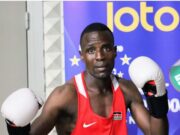
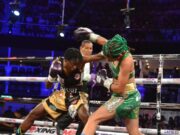
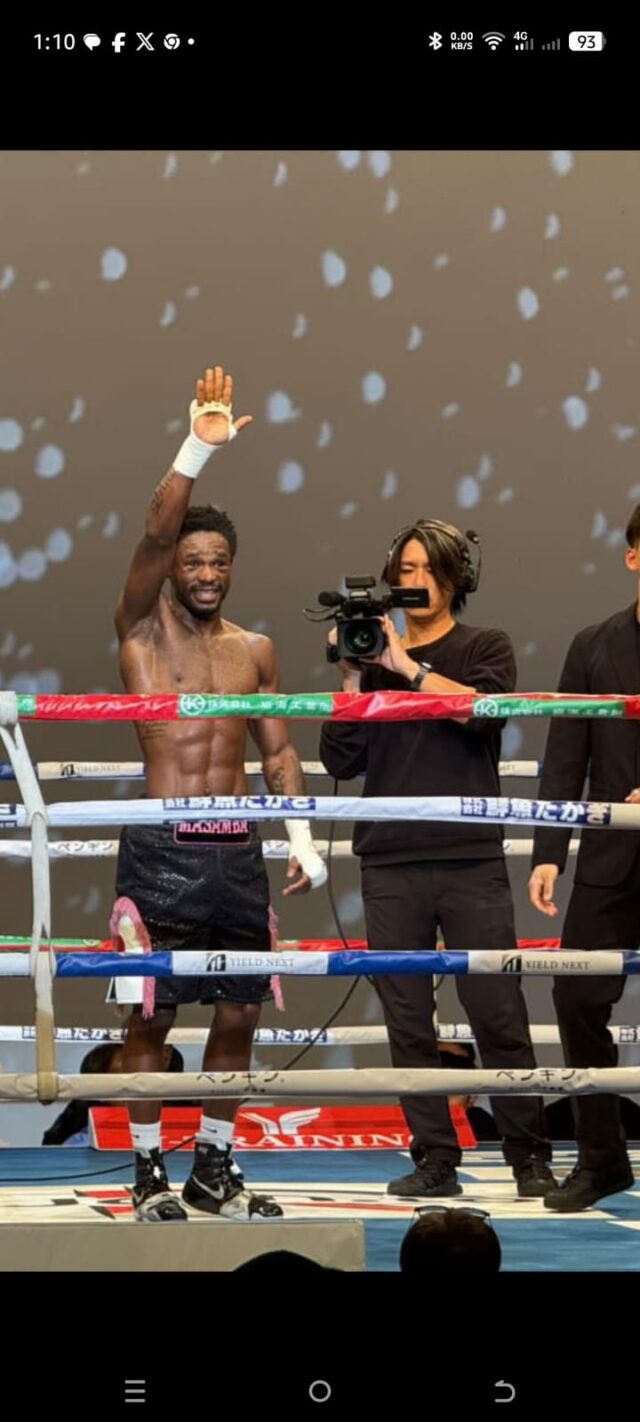
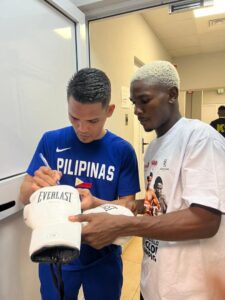
South Africa's John Paul Masamba waives to his fans after winning his third fight in Osaka
▪️The South African pro boxer outpointed a Venezuelan opponent in his latest fight, and now looks ahead to the 2026 season with confidence after making his presence felt in Japan ▪️”I’m also looking for my own sponsor to assist in my training camp and meals, pro boxing is business my promoter has no problem with this arrangement,” says Masamba
Africa light-welterweight champion John Paul Masamba has stamped his authority in Osaka, Japan.
With three wins under his belt so far since turning pro in Osaka, Masamba is the man to beat in his respective weight category.
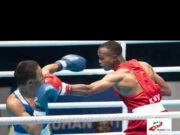
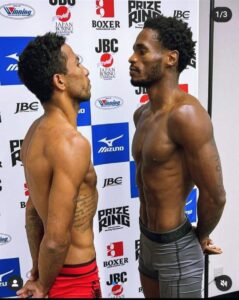
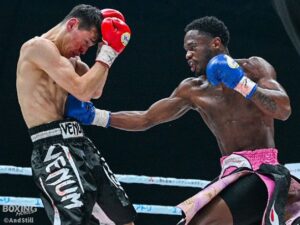
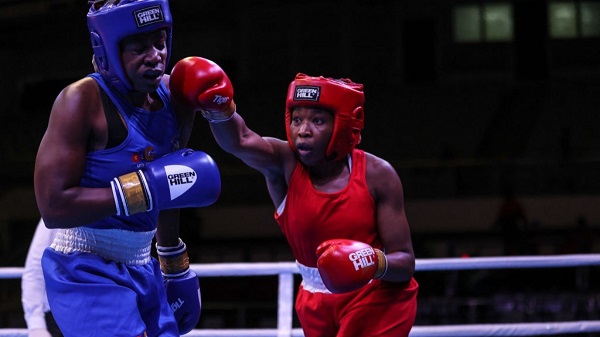
John Masamba (right) in a face-off with Venezuelan opponent Luis Millan whom he outpointed on December 3, 2025
It’s becoming increasingly difficult for the talented South African to get opponents in the B category in Japan.
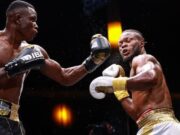
In his third fight on December 3, 2025, Masamba (3-0-0, 1 KO) outpointed experienced Venezuelan David Luis Millan (32-10, 26 KOs) over eight rounds to maintain his unbeaten run.
“He was a good opponent, he absorbed some of my strong shots but I took him to school,” Masamba told boxersworld.co.ke in an interview from the comfort of his house in Osaka.
“I knocked him down three times he still kept coming.”
It was Masamba’s third consecutive victory since he turned pro in Osaka after winning light-welterweight gold at the 2024 Africa Elite Men’s and Women’s Boxing Championships in Kinshasa, DR Congo.
Masamba, now training at TMK Gym owned by former world champion Tomoki Kameda, is under Warrior Ascent and TMK Promotions. He outpointed tall Chinese Yesibolati Nasiyiwula in his first fight over six rounds.
In his second fight, Masamba stopped Japan’s Takuya Hashimoto (7-8-1, 7 KOs) in the first round.
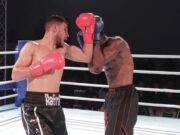
John Masamba (right) on the offensive against China’s Yesibolati Nasiyiwula in his six-round pro debut he won on points.o
Masamba let loose the bees on Hashimoto from the first bell, forcing the Japanese boxer to burry his head under both gloves like a tortoise.
On realising Hashimoto was not responding to Masamba’a onslaught, the referee wisely stopped the fight.
“If I wanted to knock him out immediately after the bell I would have done it because of his awkward fighting style,” says Masamba who graduated to 10 rounds following his victory over Hashimoto.
Masamba will soon be ranked by the Oriental and Pacific Boxing Federation (OPBF), a professional boxing organisation that sanctions fights in the Asian and Pacific Region. He will vie for a title later this year probably against the reigning OPBF light-welterweight champion.
“I will be back in the next three months for my fourth fight, for now I’m planning to embark on serious training after the December break,” said the 24-year-old Masamba.
“I have now settled well in Osaka, I like it here the security is good you can even leave your door open at night and you’ll find everything in the house intact,” says Masamba.
“The Japanese are very honest people unlike back home, I do meet my fellow South Africans here talk to them now and then but I prefer mingling with the Japanese and other Asians to learn and connect.”
In addition to Africa Elite Championships gold, Mandela Cup silver medal and turning pro in Japan, Masamba’s career highlights include being part of the WBC Warrior Ascent Program, which supports his professional journey towards WBC glory.
“At the moment my main goal is to be signed by Top Rank and be based in Japan having international training camp with Shakur Stevenson and he’s team,” says Masamba nicknamed Masaki Kameda in Osaka.
“At the moment I’m in search of own sponsors to help me with my training camp, meals and training gear, I’m very okay with my promoter he’s taking good care of me but I just want my own sponsor, my promoter has no problem in me having own sponsor, pro boxing is business.
“I don’t have any challenge here my life is smooth and peaceful but it’s the culture difference which I’m learning to cope up with, I’m also okay with the fights I’m getting.”
Masamba has ruled out the possibility of defending his African light-welterweight title given that these days pro boxers are allowed to feature in amateur competitions.
“Well, I can’t go back to the amateurs since South African boxing body,
SANABO, don’t allow pro boxers to compete in amateurs and my team in Osaka I’m not sure if they will allow this but if I were to compete I will win it with ease.”
He’s okay with the current system of pro boxers allowed to take part in amateur tournaments.
“I think it opens doors again for boxers who missed a chance to go to the Olympics,” says Masamba.
▪️Almeida returns to the ring to settle a controversial rivalry and build the future of women’s boxing in Africa ▪️The first encounter in which they vied for women’s International Boxing Association (WIBA) and World International Boxing Federation (WIBF) welterweight unification title ended in a disputed technical draw in the third round in 2015 at the Government Complex in Lusaka
Sandra Almeida, South Africa’s first-ever female professional boxer, is returning to the ring to settle one of the most disputed outcomes in African women’s boxing history—while using the moment to drive the sport forward for the next generation of female fighters.
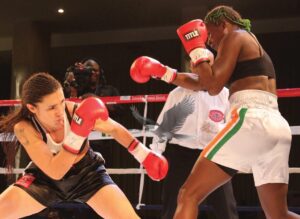
Sandra Almeida (left) and Esther Phiri in their 2015 controversial world title fight
In 2015, Almeida, now 43 years, challenged Zambian boxing pioneer Esther Phiri, 38, for a welterweight WIBA and WIBF unification world title bout that resulted in a highly controversial technical draw.
The fight ended in the third round after Almeida sustained a deep cut below the right eye, claiming Esther head-butted her but the Zambian boxer denied using her head.
“I beat her with my powerful right punches I didn’t headbutt her as she claims, I’m the champion,” Esther was quoted as saying in the Times of Zambia, demanding a rematch to silence the big-talking South African boxer.
The decision sparked outrage and debate, with Esther publicly stating she was robbed—a claim that followed her into retirement from professional boxing. Almeida also retired shortly after, as life beyond boxing took priority.
A war of words preceded the tension-charged fight. Almeida arrived in Lusaka breathing fire, warning Esther to prepare for a fifth-round knock out.
“I’m a tough lady who loves a good challenge though I’ve never knocked out any opponent I aim to KO Esther in the fourth or fifth round,” declared Almeida, describing the Zambian as a little hyena that had woken up a sleeping lion.
“I’m going to chew her alive and go back to South Africa with the two belts,” roared Almeida.
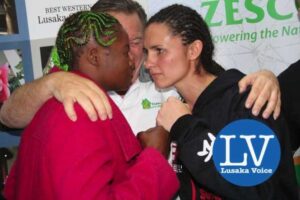
Esther Phiri and Sandra Almeida during the 2015 face-off. The long awaited rematch takes place on March 27, 2026, in Lusaka
Esther remained calm ignoring her opponent’s verbal warfare.
“She’s a coward just making noise to intimidate me but I will roast her,” said Esther who had fought in 18 fights, winning 16, lost and drew one while Almeida had won five fights, lost four and drew one.
The controversy surrounding the highly publicised fight, promoted by Exodus International Promotions, never disappeared.
In a dramatic twist, Esther’s camp has now called for a rematch, reigniting a rivalry that has lingered for years. Almeida accepted immediately.
“People have talked long enough,” says Almeida. “I know what happened in that ring. Had that fight continued, Esther would not have survived it. This rematch is about truth—raw, undeniable truth.”
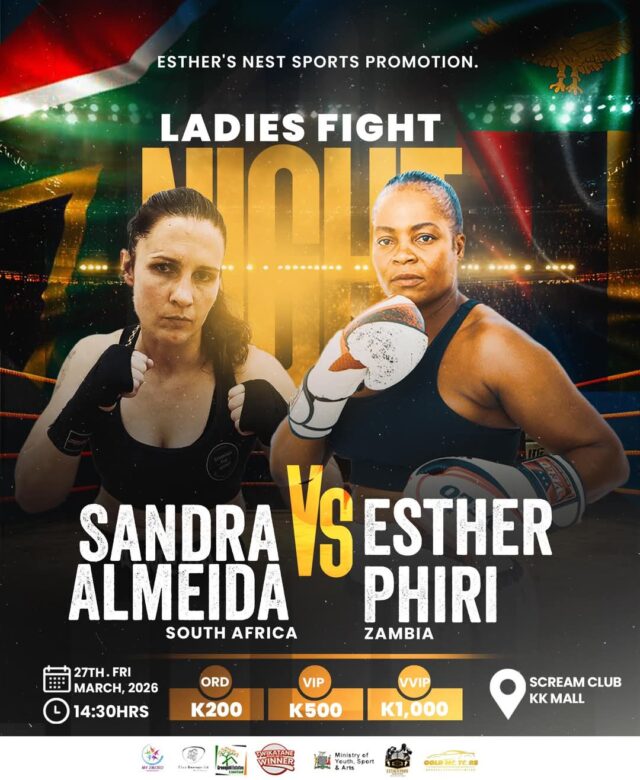
The exhibition rematch is officially confirmed for March 27, 2026, in Zambia, with contracts signed and preparations underway. While the bout is not for a title, the stakes are deeply personal—and historically significant.
“This is not nostalgia,” Almeida adds. “This is about accountability. You don’t walk away from a draw, claim robbery, and leave questions hanging for decades. You come back and prove it—or you get proven wrong.”
Now a registered South African boxing coach, Almeida has shifted much of her focus to developing women in boxing, creating pathways for young female fighters to gain exposure, discipline, and confidence through the sport. She is also passionate about using boxing as therapy for children on the autism spectrum, reinforcing boxing as a tool for empowerment rather than just competition.
The Zambia event will include young female boxers from South Africa and other countries, giving them a rare international platform to showcase their skills alongside two pioneers of women’s boxing.
“This fight is bigger than me and Esther,” Almeida says. “It’s about showing young girls that women belong in this sport, that their careers matter, and that their stories don’t get erased or dismissed.”
Still, Almeida is unapologetically clear about her personal goal.
“I’m going to beat Esther,” she states. “Not to humiliate her—but to close this chapter properly. Women’s boxing deserves honesty, not myths and excuses.”
As the countdown begins, the rematch promises not only fireworks in the ring, but a defining moment for women’s boxing in Africa—where legacy, truth, and the future collide.
Who will laugh last in this grudge match with all the trappings of an explosive and furious showdown?
▪️”The days of impunity in the selection of boxers for international events are over, we will be fair and transparent,” says NBF Vice-President Omonlei Imadu
January 13, 2026
Nigerian Boxing Federation (NBF) has announced plans to conduct an open trial for boxers ahead of the 2026 Commonwealth Games.
A statement from the federation’s Communications Department said the screening exercise will be open to pugilists across all weight categories, with the date and venue to be announced once arrangements are finalized.
NBF Vice President, Omonlei Imadu, assured stakeholders that the selection process would be transparent, credible and fair.
“The days of impunity in boxers’ selection for international events are over,” Imadu declared. “We have put machinery in place to ensure that every athlete gets equal opportunity to make the final shortlist.”
He noted that the current NBF board is committed to changing the narrative of boxing in Nigeria by upholding integrity and professionalism in athlete selection.
Imadu further urged boxers and their coaches to intensify preparations, stressing that only athletes with the right skills, mentality and readiness would be selected.
“Our aim is to pick boxers who can bring glory to the nation. Coaches must ensure their pugilists are in perfect shape ahead of the screening process,” he said.
The 23rd Commonwealth Games will take place in Glasgow, Scotland, from July 23 to August 2, 2026.
▪️The unbeaten South African top prospect meets Polish opponent in March
January 13, 2026
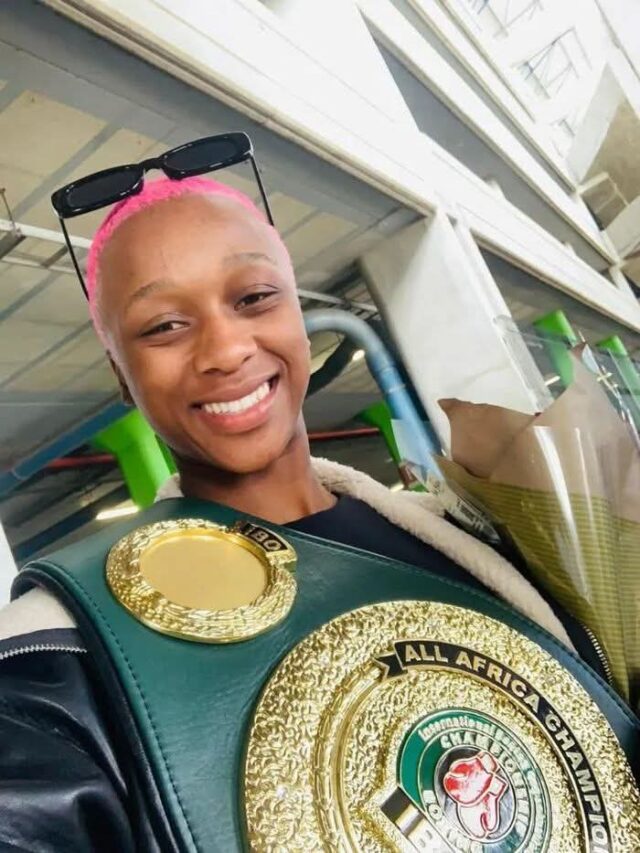
South Africa’s Simamkele Tutsheni (pictured), the IBO All Africa champion, skipped festive celebrations to prepare for her IBO WORLD TITLE challenge against unbeaten Laura Grzyb of Poland on March 28, 2025.
The Langa-based 24-year-old spent most of the holidays in the gym, sharpening for what is described as the biggest test of her professional career so far.
Tutsheni enters the bout with an 8-0 record, including three stoppages, while Grzyb brings an 11-0 ledger, also with three stoppages, setting up an unbeaten-vs-unbeaten clash. Her last fight, a win over Caleigh Swart for the IBO All Africa title, drew strong praise locally, and this March assignment will be her first outing under MATT LEISCHING’s ML BOXING stable after being named Prospect of the Year by the SOWETAN.
Govt appoints six-man Normalisation Committee led by a top magistrate Chrysostome Kana to oversee the elections
Cameroon’s ministry in charge of sports has appointed a six-man Normalisation Committee to bring back normalcy in the troubled national federation.
The committee is led by a top magistrate Chrysostome Kana who is deputised by University lecturer specialized in law Professor Odille Emmanuelle Mfegue.
A former Cameroon Boxing Federation Secretary-General Pierre Matongo and a PhD in Law of Sport Albert Ayomba are the two members of the Normalisation Committee.
Others are Patrice Marcel Djambou Tientcheu and a former Africa Boxing Confederation (AFBC) Ethics Committee chairman David Pina.
The Normalisation Committee was established in November 20, 2025, and the members were appointed in January 6, 2026.
Officially they will be in office for six months, and their main mission is to oversee a free and fair elections of the new executive committee.
With the appointment of NC members, the previous interim office led by Banga Pierre Edmond now ceases to exist. They have been in office since June, 2023 following the dissolution of President Bertrand Mendouga’s executive committee.
Interestingly Mendouga, who was kicked out of AFBC leadership by the board in 2023, is reportedly keen on fighting for the top federation position again.
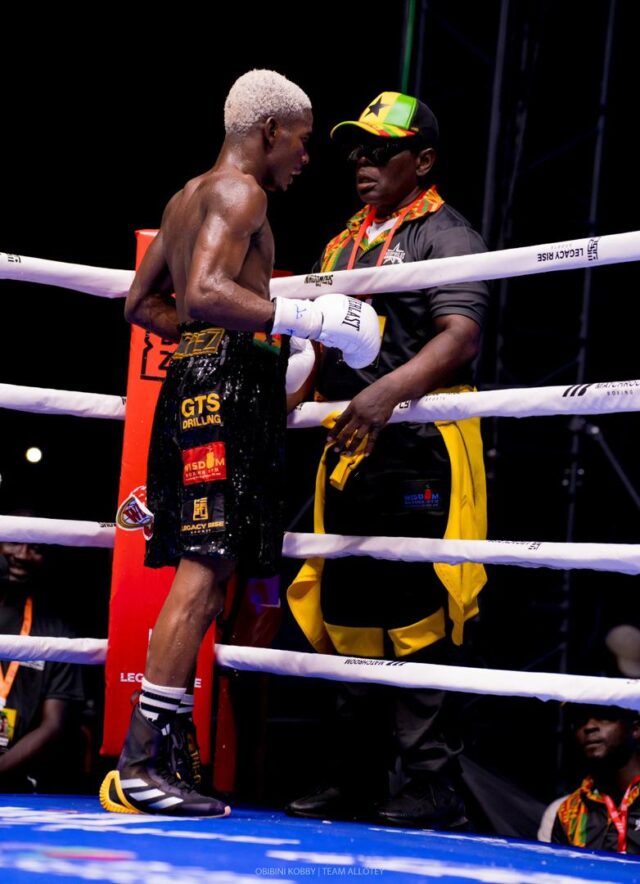
Theo "Lopez" Allotey listens attentively to coach Ofori Asare in between the rounds during his WBO Global super-flyweight title fight.
▪️“We strategised well to face Raquinel because we knew how difficult it is to fight a southpaw,” says coach Ofori Asare ▪️The 23-year-old Allotey is now a proud owner of four titles
Ghana’s newly-crowned WBO Global super-flyweight champion Theo “Lopez” Allotey has attributed his steady rise in boxing to coach Ofori Asare.
Allotey (13-0-0) put up a dominant show to outpoint Jayr Raquinel of Philippines and in the process became WBO Global super-flyweight champion at the University of Ghana Stadium in Legon on December 20, 2025.
“Asare is the one who made me win the fight, I owe my success in boxing to him,” Allotey told boxersworld.co.ke in an telephone interview.
“I will continue training hard with discipline and dedication until we get there.”
The WBO Global belt is now mine, so seems to be saying Theo Allotey
Commenting on his victory which gave him his fourth title, Allotey said they planned well for it with his coach Ofori Asare.
“I feel great and happy for having a good team by my side and through their support led by Asare I’m fulfilling my goals.
“Raquinel is a tough boxer I respect him, I won because of my skills and advice from my coach Asare, he caught me with some heavy punches in the 11th round ”
Asare, who has been coaching Allotey for 15 years now at his Wisdom Gym, is a proud man seeing Allotey rising higher.
“Theo keeps on improving and there’s no doubt he’s one of Africa’s best pro boxers and a future world champion,” said the highly respected Ghana’s national boxing team head coach.
“It was a hard fought bout, Theo’s skill level prevailed, we were aware it was going to be a big fight, he was ranked number 10 by Ring Magazine and number five by WBC.
“We planned thoroughly for it because we knew how difficult it is to face a southpaw opponent, that’s why Theo sparred with several southpaws with different styles to make sure we get it right. I’m proud of him, having been with him for 15 years he’s like my son now ”
Asare’s sentiments are echoed by Allotey.
“My coach has provided me with lots of skills fighting southpaws, you have to move to his right side,” says Allotey, a bronze medallist at the 2024 African Games in Accra where he lost in the semi-finals to the eventual champion Zambia’s World Championships bronze medallist Patrick Chinyemba who has defeated the Ghanaian boxer three times.
Allotey and his Filipino opponent Jayr Raquinel after the fight
In addition to the latest title – the fourth one – Allotey is also the national super flyweight champion, UBO Africa super-flyweight title holder and WBO Africa bantamweight champion.
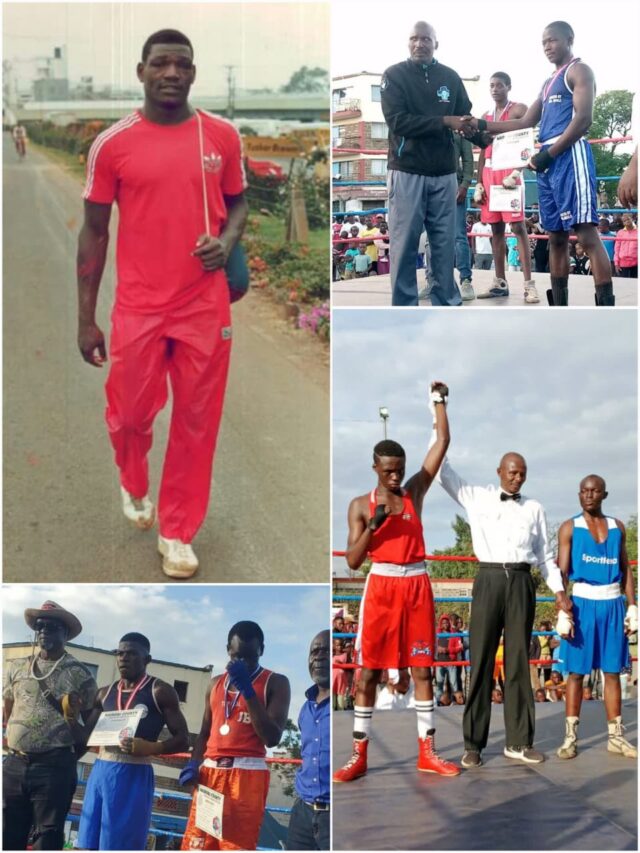
Harold "Schetza" Obunga (top left) strolling at Ruaraka's Camp David training camp and some of the youthful Nairobi boxers who took part in the Obunga Memorial Tournament on December 20, 2025, at Kaloleni open ground.
▪️ Boxer from various clubs among them Kibra Youth, Jericho and Mathare North converge at Kaloleni open air ground for the annual Obunga Memorial tournament
▪️ An attempt to sabotage the Obunga Memorial event by anti-BFK forces was nipped in the bud by a senior national federation official
▪️ A capsule summary on Obunga’s highlights during his heydays in the ring
▪️ We rewind to that tension-charged heavyweight battle between Obunga and David Anyim in the 1988 Olympic Games trials in “NaxVegas”. At stake was also the Kaloleni bragging rights heavyweight king
▪️The hotly contested trials were loaded with talent. Some of the big names in action included Maurice “Kawata”Maina, Steve “Dempsey” Mwema, John “Duran” Wanjau, David “DK” Kamau, Jericho-bred Robert “Aruba” Wangila, Chris “Bingwa” Sande, Mohamed “Body” Orungi, Mike “Spinks” Mutua, Martin “Nyoka” Ojuang, Silvanus Sullu Okello, Joseph “Nyundo” Alhasamba and James “Demosh” Omondi
22/12/2025
The final heavyweight bout was one of the key fights of the night during the 1988 Olympic boxing trials at Nakuru’s Madison Square Garden.
In the ring were two equally matched boxers from the famous Kaloleni Estate in Nairobi or Ololo if you like.
Harold “Schetza” Obunga was facing David “Santos” Anyim for a ticket to the Seoul Olympics.
Nakuru’s boxing-mad fans were eagerly waiting for this bout with the experts analysing the likely winner. I was there too. I hardly missed boxing contests at the Madison Square Garden to report for the KANU-owned newspaper Kenya Times which had selected me to cover the Seoul Olympics. I was supercharged for the trials compiling stats ahead of my Olympic Games debut.
The muscular Obunga was in top shape, so was Anyim. Who will blink first?
Madison Square Garden was packed. At the club’s pub, patrons clinked glasses, laughter filled the air with their faces illuminated by the frothy liquids of Ruaraka as they shouted from the usually elevated stools at the counter. The pub was doing roaring business.
For more details on the story visit boxersworld.co.ke, East Africa’s first ever boxing website
📸 Harold “Schetza” Obunga (top left) strolling at Ruaraka’s Camp David training camp and some of the youthful Nairobi boxers who took part in the Obunga Memorial Tournament on December 20, 2025, at Kaloleni open ground.
Theophilus Kpakpo Allotey added more gloss to his budding reputation with a flawless and dominant performance at the University of Ghana Stadium in Legon last Saturday night, after completely outclassing Asian champion Jayr Raquinel to become the new WBO Global super flyweight champion.
With the global spotlight firmly fixed on Ghana on a show presented by Legacy Rise Sports Promotions run by Sharaf Mahama, in collaboration with renowned British promoter Eddie Hearn’s Matchroom Boxing and broadcast live across the globe on the leading sports streaming platform, DAZN, and which also witnessed an electrifying entertainment from dancehall king Shatta Wale, Allotey seized the moment to further enhance his rapidly rising reputation that earned him the 2025 EMY Africa Sportsman of the Year award.
Fighting in front of President John Dramani Mahama, Sports Minister Kofi Iddie Adams and the legendary Azumah Nelson, Allotey reemphasised his world title credentials with a very patient yet deeply effective approach, breaking down the resolute defence of the Filipino round by round with well-timed jabs and body shots whilst staying far away from any danger.
In the end, all three judges, including one Filipino, were very emphatic with the verdict, 118-111, 119-109, 116-112 in favour of the 23-year-old Ghanaian who marches on in his avowed dream to become Ghana’s next world champion.
It was the 4th career title for young Allotey, a mere 17 months into his pro career, having previously become national and UBO Africa, as well as the WBO Africa bantamweight champion, on the back of which he is rated number 15 in the WBO world rankings.
In the chief support fight of the night, headlined by the all-British light heavyweight clash between Craig Richards and Dan Azeez, Jonathan “Worldwide” Tetteh also claimed a controversial victory over former national teammate Seth Gyimah, to clinch the WBA Africa light heavyweight championship after eight thrilling rounds at a packed-to-capacity University of Ghana Stadium.
Tetteh, also the reigning national light heavyweight champion, started on the front foot, landing some good shots in the opening two rounds as Gyimah, better known as Freezy Macbones, increasingly looked frustrated.
But the tide started tipping in Macbones’ favour after he engineered some good body shots in Round 3, which appeared to wobble the eccentric Tetteh.
The ferocious Macbones, however, continued to struggle to land clean shots as Tetteh continuously evaded his hefty-looking throws with his wonderful ducking skills, as the stadium kept buzzing, with fans on their toes with excitement for the eight rounds, as the momentum kept shifting from one end to the other.
The drama reached its peak in the eighth and final round after Tetteh was bundled to the canvas flat on his stomach, following a close exchange with Gyimah.
Referee Roger Barnor ruled that Macbones had bitten Tetteh and consequently deducted a point from the Ashanti-born fighter who came into the ring clad in royal regalia, celebrating his origins.
Later replays have, however, failed to showcase the “bite”, but it helped swing the verdict in favour of 25-year-old Tetteh, who annexed the national title in May after stopping the late Ernest ‘Bahubali’ Akushey in seven at the Bukom Boxing Arena. 77-75, 78-71, 77-75 read the verdict in favour of the still undefeated Tetteh, condemning Macbones, 36, to a first pro defeat.
In another electrifying and action-packed fight for the IBF Continental Africa featherweight championship, which saw both fighters floor their opponent, John Abaja Laryea claimed victory, courtesy of a Round 8 TKO victory after referee Nathaniel Obeng was forced to stop the contest at the end of the seventh.
Following advice from the ringside medic, Dr Eric Tetteh Ayertey, who suspected internal bleeding on Dorgbetor, in full compliance with strict medical and safety protocols established by the Ghana Boxing Interim Management Committee (GBIMC), the fight was stopped.
Laryea adds the IBF belt to his previous WBO Africa and national titles, while the previously unbeaten Dorgbetor suffers a second straight career loss following defeat in the WBC Grand Prix round of 16 in Saudi Arabia last June.
Meanwhile, national and UBO Africa welterweight champion Sampson Segbedzi came unstuck in a bid for the IBF International light middleweight title against Belgian-Guinean Ibrahima Diallo, who earned a resounding 98-91, 98-91, 98-91 verdict to hand the Ghanaian a first career defeat.
Army Officer Jerry Lartey consolidated his credentials with an immaculate display to see off British fighter Jesse Brandon, 78-74, 78-74, 77-75 to stay undefeated and raise high his first career title, the WBA International super lightweight strap.
Meanwhile, in the headline bout of the night, Craig Richards scored a brutal one-punch knockout of compatriot Dan Azeez in the 12th and final round of an otherwise close, highly competitive affair.
Richards consequently won the WBA International light heavyweight belt, bringing down the curtain on a splendid exhibition of impressive prize fighting in Accra.
Legacy Rise Sports Promotions delivered a world-class event again, following the success of their maiden global collaboration with Amir Khan Promotions back in June.
Rumours of Mahama Junior’s syndicate possibly staging the much-anticipated heavyweight blockbuster between Tyson Fury and Anthony Joshua next year have, no doubt, heightened.
Harold "Schetza" Obunga (top left) strolling at Ruaraka's Camp David training camp and some of the youthful Nairobi boxers who took part in the Obunga Memorial Tournament on December 20, 2025, at Kaloleni open ground.
▪️Boxer from various clubs among them Kibra Youth, Jericho and Mathare North converge at Kaloleni open air ground for the annual Obunga Memorial tournament
▪️An attempt to sabotage the Obunga Memorial event by anti-BFK forces was nipped in the bud by a senior national federation official
▪️A capsule summary on Obunga’s highlights during his heydays in the ring
▪️We rewind to that tension-charged heavyweight battle between Obunga and David Anyim in the 1988 Olympic Games trials in “NaxVegas”. At stake was also the Kaloleni bragging rights heavyweight king
▪️The hotly contested trials were loaded with talent. Some of the big names in action included Maurice “Kawata”Maina, Steve “Dempsey” Mwema, John “Duran” Wanjau, David “DK” Kamau, Jericho-bred Robert “Aruba” Wangila, Chris “Bingwa” Sande, Mohamed “Body” Orungi, Mike “Spinks” Mutua, Martin “Nyoka” Ojuang, Silvanus Sullu Okello, Joseph “Nyundo” Alhasamba and James “Demosh” Omondi
The final heavyweight bout was one of the key fights of the night during the 1988 Olympic boxing trials at Nakuru’s Madison Square Garden.
In the ring were two equally matched boxers from the famous Kaloleni Estate in Nairobi or Ololo if you like.
Harold “Schetza” Obunga was facing David “Santos” Anyim for a ticket to the Seoul Olympics.
Nakuru’s boxing-mad fans were eagerly waiting for this bout with the experts analysing the likely winner. I was there too. I hardly missed boxing contests at the Madison Square Garden to report for the KANU-owned newspaper Kenya Times which had selected me to cover the Seoul Olympics. I was supercharged for the trials compiling stats ahead of my Olympic Games debut.
The muscular Obunga was in top shape, so was Anyim. Who will blink first?
Madison Square Garden was packed. At the club’s pub, patrons clinked glasses, laughter filled the air with their faces illuminated by the frothy liquids of Ruaraka as they shouted from the usually elevated stools at the counter. The pub was doing roaring business.
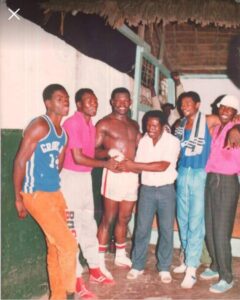
Obunga (third left) with Posta teammates
Japan-based Kenya’s legendary Philip Waruinge was also in the house. I did an interview with him, describing pro boxing as a dirty game. He lost his left eye during the 1976 inaugural WBC super-bantamweight title against Panama’s Rigoberto Riasco in Panama City. He told me between the rounds he felt an itchy substance on his left eye suspecting the corner of his opponent had smeared his gloves with some substance. He retired in round nine.
In the ring at Madison Square Garden, top Kenyan boxers furiously traded leather in the hotly-contested Olympics trials.
On his way to the finals, Obunga outpointed James “Demosh” Omondi in the semis and Anyim beat Francis Busienei of Rivatex to set up the final with rival Anyim. It was sweet revenge for Obunga. He had lost to Demosh in the 1986 Kecoso Games in Meru. Demosh, who had left KDF, was now representing Dallas’ Railways Starehe formed in 1969 by national team coach Charles Anjimbi.The trials were teeming with talent with each weight category having several quality boxers.
Chris “Teofilo” Sirengo, Charles “Ironman” Waithaka, Caleb Kuya, Alex “Osambla” Oduor, Mohamed “Body” and Mike “Spinks” Mutua were some of the big names who failed to make it to the finals. It was cut-throat competition.
Sirengo arrived in Nakuru breathing fire. He had caused a big upset the previous weekend by sensationally knocking out Posta’s strongman Chris Odera at super-heavyweight in a national league match. In NaxVegas, Sirengo met his match in unheralded KGGCU’s Joseph Nyahaya who stopped him in the second round round. His Olympic dream was shattered.
As we looked forward to the Obunga vs Anyim thriller, there was plenty of action in the preceding finals bouts. Among them dominant light-flyweight Maurice “Kawata” Maina had beaten Transcom’s Stanley Kinyanjui, flyweight Anthony Ikegu of AFABA outpointed MAB’s Muchiri Waititu, bantamweight Steve “Dempsey” Mwema defeated Breweries’ clubmate George Mwangi, fighting before his home fans John “Duran” Wanjau outclassed David “The Destroyer” Gakuha who the previous year had his cheek stung by a bee that was tucked in a toast of bread he was munching at Kasarani hostel ahead of KDF’s league match against KCC. Homeboy David “DK” Kamau was in devastating form, knocking out tough Prisons light-welterweight Titus Omondi in round three to the thunderous roar of fans. Welterweight Robert “Aruba” Wangila outpointed Ken “Bramble” Munika and Mohammed “Body” Orungi found it an uphill task to penetrate southpaw Chris “Bingwa” Sande’s watertight guard. Sande demolished Orungi to book his Seoul ticket.
Cheers, ululations and whistling greeted Obunga and Anyim as they headed to the ring.. The first round was balanced on a knife’s edge with Obunga connecting heavier shots. It therefore came as no surprise when his right punch exploded on Anyim’s jaw for a second round KO victory.
A delighted Obunga was mobbed by his excited Posta teammates. He had fufilled his dream of representing the national team in the Olympic Games though nothing was guaranteed by then.
In addition to booking a ticket to Korea’s capital city Seoul for the Olympic Games, Obunga had won the Kaloleni bragging rights battle.
Back in Ololo, the popular 1000 Street was abuzz with activity, the holy herb doing rounds among members. Towering Abich Mangwana, who was our pointman, led the chitchat on Obunga’s conquest.
The Amateur Boxing Association of Kenya later named a provisional team of 28 boxers for the Olympic Games with Obunga’s heavyweight berth having George “Foreman” Onyango on board. The tall GSU cop announced his arrival in 1986, a graduate of accomplished coach Eddie “Papa” Musi at Kariobangi Boxing Club nicknamed Bangladesh.
Onyango was not a favourite with the status quo at the time. He was among the 13 boxers dropped at Ruaraka’s “Camp David” training camp.
The coast was now clear for Obunga. His Olympic dream remained alive. He put issues beyond doubt in the regional Fescaaba tournament held for the second year running in Nairobi, winning his first ever gold medal for the country by beating Uganda’s Elphas Mubiru.
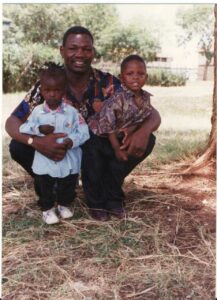
Obunga with his two sons Harold Jnr and Eugene William
The Ugandan boxer was timid from the bell, keeping his face low hardly throwing any punch as Obunga punched him at will. At one stage he spat out his gumshield looking at his corner as if signalling them to thrown in the towel. They finally did so when the towel came flying in the second round. Obunga had clinched the regional heavyweight title. With nine finalists, Kenya, the dominant regional powerhouse, won eight gold medals, one less than the nine gold Kenya reaped in the 1987 Fescaaba tournament.
Kenya retained the Fescaaba overall crown with 8-1-2 20pts, followed by Uganda 2-3-4 14 pts, Tanzania 1-3-4 10pts, Zambia 0-5-3 9pts and Malawi 1-0-3 5pts.
The other Kenyan gold medalists were light-flyweight Maurice Maina, bantamweight Steve Mwema, featherweight John Wanjau, light-welterweight David Kamau, welterweight Robert Wangila, light-heavyweight Joseph Akhasamba and super-heavyweight Chrispin Odera.
The aforementioned were all in Kenya’s team for the Seoul Olympics with Kenya stamping its authority by producing the first ever black African Olympic Games gold medallist in Robert Wangila. Others in the Seoul team were flyweight Anthony Ikegu, lightweight Patrick “Mont” Waweru and light-middleweight Mohamed Orungi who had lost to Chris Sande in the Nakuru trials but the ABA of Kenya showed faith in him, moving Sande up to middleweight. A wise decision in that Sande won a bronze medal.
Obunga accounted well for himself, stopping Tonga’s Tualau Fale in the first round and bowing out in the quarter-finals to Poland’s Andrzej Golota who settled for a bronze medal.
On our way back home from Seoul, the triumphant Kenya team had an overnight stop-over in Mumbai then known as Bombay. I was closely together with Obunga and Wangila, watching pro boxing tapes from his video he bought in Seoul. Almost every member of the Kenya team bought video player in Seoul at a throw-away price.
As we watched the pro boxing tapes, Wangila told us he had been approached by Top Rank senior official Muhamnad Akbar to turn pro but we keep the info to ourselves until he signed the contract.
The following morning after breakfast the three of us took a walk at the beach in Mumbai as some locals trailed us asking for “bakshish” meaning cash to help themselves.
“I didn’t know Indians are also beggars yet in Nairobi they behave like Gods,” wondered aloud Wangila.
We also encountered a drug dealer who wanted us carry his mandrax to Nairobi secure in the knowledge as sportsmen his “cargo” would be delivered safely. We told him bluntly NO! That’s not our cup of coffee look for your fellow drug dealers.
Obunga made his international debut in 1984 during a Scandinavian countries tour for boxers who had won the Kenya Open title in Kisumu. I covered the Kenya Open at Tom Mboya Memorial Hall with Obunga winning the heavyweight crown by stopping Thomas Okusi.
My first trip with Obunga out of the country was in 1986 when together with KBC’s renowned broadcaster, Daudi Kanja, we joined the Kenya team for a memorable trip by road to Jinja, Uganda, for the Fescaaba Championships marred by shameless biased officiating by the hosts who made sure they regained the regional overall title in any way possible. The tournament, held at the Kakindu Indoor Stadium, attracted Uganda, Kenya, Tanzania and Ethiopia with Uganda winning on 27pts followed by Kenya 23pts, Ethiopia 12pts and Tanzania 8pts.
Obunga lost in the semi-finals to Tanzania’s Caston Mlei but like other boxers received no medal. The organisers said the medals were still in the production stage in London. That’s now history.
In addition to Obunga, other Kenyan boxers in Jinja were light-flyweight Maurice Maina, flyweight Daniel Mwangi, bantamweight Sammy “Kigos” Mwangi, featherweight David Gakuha making his debut, lightweight Patrick “Mont” Waweru, light-welterweight David Kamau, welterweight Ken Munika, light-middleweight Chris Sande, middleweight Martin Ojuang, light-heavyweight Silvanus Okello and super-heavyweight Chrispin Odera.
The following year ahead of the African Games there was confusion on the suitable heavyweight to represent the national team “Hit Squad” in this major event Kenya hosted for the first time in Nairobi. Earlier, James Omondi was the favourite but his loss to Uganda’s Fred Kaddu in the Fescaaba finals in Nairobi knocked him out of the Kenya team. Omondi lost to George “Foreman” Onyango in the Fescaaba trials but the ABA dropped Onyango arguing his resistance in big international tournaments was not satisfactory.
Any hopes Onyango had of making it in Kenya’s team for the African Games in Nairobi were shattered when the ABA of Kenya picked Obunga in the heavyweight berth. Obunga found the going rough in his first fight going down to Algeria’s Dine Mohammed who stopped him in two minutes 35 seconds of the third round after the Kenyan held his own in the first and second rounds.
One of Kenya’s top former internationals, Kenneth “Valdez” Ochieng describes Obunga as a boxer loaded with stamina and appeared harmless outside the ring.
“Schetza was very polite boxer, showing no appetite for the game but when you spar with him is when you feel the full force of his punches, he had a nice left hook,” says Valdez while Foreman recalls losing twice to Obunga and defeating him once.
“He had heavy straight punches and occasional one-two punches, he was however slow and you could see his punches before he throws them,” says Foreman who at one time coached the national team during the reign of Boxing Association of Kenya (BAK) President John Kameta.
Obunga started boxing in 1983 on abandoning football. He was a soldier at KDF and quit in 1979 to join Posta.
After the Seoul Olympics, Obunga was less active in the ring and passed on in 1995 in a road accident.
His sister Josephine narrates how it all happened.
“They were going to Mombasa Port to collect a car with his friend and a mechanic. On reaching Makindu they got an accident by hitting a Canter from behind and my brother died on the spot. At that time he had left Kenya Posta and was working with Hyundai Motors in Sales and Marketing Department as a Sales and Marketing Manager.”
Harold “Schetza” Obunga was the second born to the late William Obunga and late Emma Obunga. He had five siblings, three brothers Zingy, Tony, Shaddie, and two sisters Josephine and Carol. He was married to Alice Koke and were blessed with two sons Harold Jnr and Eugene William. Obunga was a career soldier in the Kenya Army. He had risen to the rank of Captain when he left in 1979 to join Kenya Posts and Telecommunications.
His sister Josephine is married to the Assistant Secretary-General of the Nairobi County Boxing Association Ronnie Khainga who is the coordinator of the Harold Obunga Memorial Tournament.
“We had a very successful event on Saturday (December 20) at the usual venue in Kaloleni, and I thank all those who supported us,” the hard working Khainga told boxersworld.co.ke in an interview.
It’s understood there was an attempt to sabotage the Obunga Memorial by some anti-Boxing Federation of Kenya pessimists who reportedly paid some referees and judges.
A senior BFK official flexed his muscles, nipping the evil plan in the bud and read the Riot Act to the R&Js who coiled their tails in fear and toed the line to the amusement of the organisers.
Khainga said next year they will invite Kampala Combined to face their Nairobi counterparts in the Obunga Memorial Tournament.
▪️Who will laugh last between these two formidable Ghanaian pro boxers in this bragging rights duel?
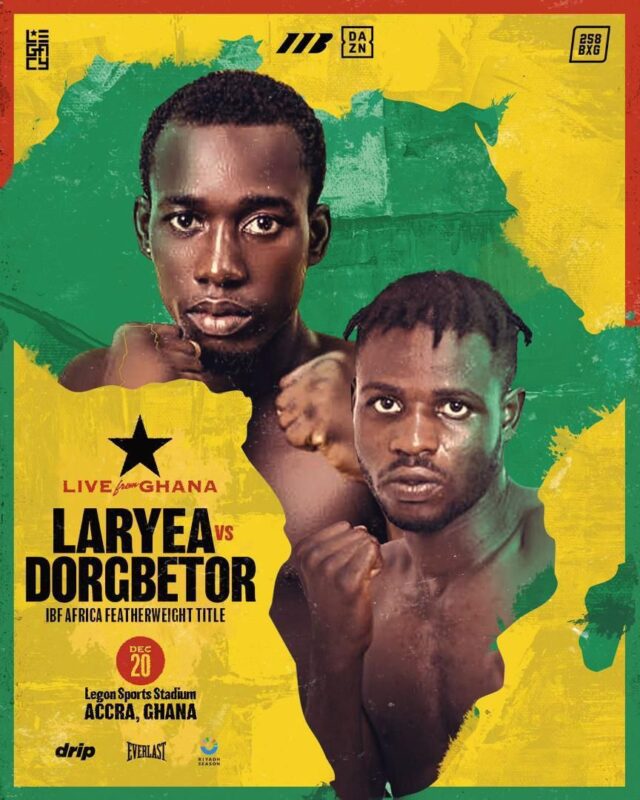
The highly anticipated showdown between John “Expensive Boxer” Laryea and Holy “Jaw Breaker” Dorgbetor takes place in Ghana today, December 20, 2025, at the University of Ghana Stadium.
It’s billed as a major featherweight clashfor Dorgbetor’s IBF Continental Africa title, featuring two top Ghanaian champions with international experience, organized by Legacy Rise Sports and Matchroom Boxing for major local bragging rights and legacy building.
Laryea (15-0-1) challenged Dorgbetor (14-1-1), the WBO & IBF Africa title holders respectively, in a fight that has all the trappings of a thriller..
Dorgbetor was interviewed by boxersworld.co.ke
Question: Dorgbetor, tell us the importance of the IBF Africa featherweight title in your pro career?
Answer: The IBF featherweight title is very important to me because it represents recognition at the international level. It’s a major sanctioning body, and holding an IBF title puts you on the global boxing map. I have held it before and I know what it did for me. For my career, it means progress, validation of my hard work, and a step closer to competing with the best featherweights in the world.
Q: Is the IBF Africa belt of importance to you or is it just for prestige?
A: It is definitely important to me. It’s not just about prestige. The IBF Africa belt represents dominance on the African continent and serves as a pathway towards bigger international opportunities. It’s a title that carries weight and respect, and winning it shows I’m ready for the next level.
Q: What value does this belt have in your career?
A: This belt adds value in many ways. It boosts my ranking, increases my visibility, and opens doors for bigger fights. The last time we checked, a win will take me to top 40s on boxrec. More importantly, it motivates me to keep improving because once you win a title, you have to prove you deserve it every time you step into the ring.
Q: What do you have to say about your opponent in terms of his technical ability?
A: My opponent is a good boxer with solid technical skills, otherwise he wouldn’t be here. I respect his abilities, but I don’t believe he is superior to me. He has not fought anyone as good as me yet. I trust my preparation, my experience, and my skill set. On fight night, it will come down to who executes better.
Q: Your game plan is of course your secret, but what are you predicting on the outcome of the fight?
A: I’m predicting a victory. I’ve prepared very well physically and mentally, and I believe my hand will be raised at the end of the fight. Whether it’s by decision or stoppage, I’m confident in my ability to win. This is the first time we are meeting in the ring. That makes the fight even more exciting, because we’re both coming in with something to prove. It’s one of the true 50/50 fights in Ghana, Africa, and the world.
Q:Tell us why you decided to fight as a professional?
A: I turned professional because boxing is my passion and my calling. I wanted to challenge myself at the highest level and build a career that allows me to represent my family, my country, and Africa with pride. Professional boxing gives me the platform to turn my talent into legacy.
Q: Who is the toughest opponent you have met so far?
A: Every tough fight teaches you something, but the toughest opponents I’ve faced are those with experience and strong mental toughness. My last two fights in the WBC were tough. Qamili gave me my first and my only loss. Those fights pushed me to grow, adapt, and become a better fighter overall.
Before turning professional, I built my foundation through discipline, hard training, and competitive amateur boxing. I learned the basics, gained experience in the ring, and developed my style. Those early years shaped me, prepared me mentally, and gave me the confidence to step into the professional ranks.